(Transcript from World News Australia Radio)
There has been mixed reaction to Australia's announced shift in voting at the United Nations on Middle East resolutions.
The federal government has announced that Australia will abstain from a vote on whether the Geneva conventions apply in the Palestinian Territories.
It also intends to abstain from a vote condemning the expansion of Jewish settlements in the Territories.
Kristina Kukolja has more in this report by Santilla Chingaipe.
News that makes sense
Your trusted source for staying up-to-date with the world around you. Get free daily news updates and analysis, straight to your inbox.
(Click on the audio tab above to hear the full report)
Under the previous Labor governments, Australia upheld both of the recurring resolutions on settlements, which are voted on every year in the United Nations General Assembly.
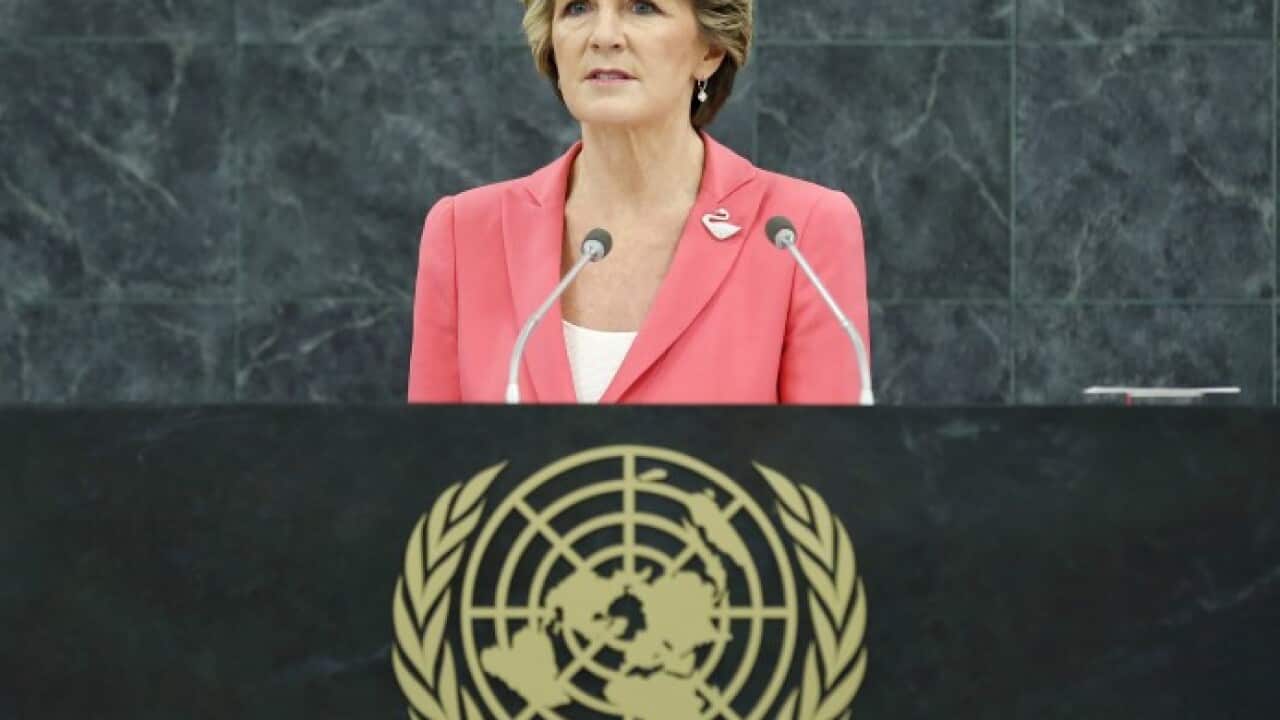
However, in a statement to SBS, a spokeswoman for Foreign Affairs Minister Julie Bishop has described the shift as reflecting the government's concern that Middle East resolutions should be "balanced".
The spokeswoman says the government considers each Middle East-related resolution on a case-by-case basis, and on its merits.
And she says the government will not support resolutions which it calls one-sided and pre-judging of the outcome of final status negotiations between the two sides.
Colin Rubenstein is the executive director of the the executive director of the Australia/Israel and Jewish Affairs Council.
Mr Rubenstein has welcomed the decision.
"Well I applaud the government's reversion back to the (former Prime Minister John) Howard and (former Foreign Minister Alexander) Downer approach on these resolutions which are essentially very one-sided, demanding things only from Israel, quite biased and actually factually and legally very challenged. So going from supporting such resolutions to abstaining, is a constructive step, especially if the main game is to encourage the current Israel-Palestinians talks towards a mututally accepted two-state outcome."
Izzat Abdulhadi is the head of the General Delegation of Palestine to Australia, which represents Palestinians in Australia.
Mr Abdulhadi has described the change in policy on this issue as deeply regrettable and a mistake.
He says there have been many political developments in the last six years on these matters and repeating the Howard-era stance will not be useful.
"One is the recognition of Palestine as a non-member observer state at the United Nations last year. This is an important political development and it should be taken into consideration. The second is the Australian public is really against the settlement activity in the Palestinian occupied territories and there are a lot of solidarity groups that are really working hard to influence the Australian policy to be more even-handed."
The issue of Israeli settlements is a controversial one.
Palestinians see the settlements as a major obstacle to resolving the decades-old conflict between the two sides.
About 500,000 Jews live in more than 100 settlements built since Israel's 1967 occupation of the West Bank and East Jerusalem.
The Palestinians want to establish their state in those areas, as well as in the Gaza Strip.
The International Court of Justice has deemed Israeli settlements in the West Bank and East Jerusalem illegal under international law, but Israel disputes this.
Australia is now one of *eight countries to abstain on the resolution relating to Israeli settlement in the Territories.
158 countries voted in favour of the resolution while the United States and five others have voted against it.
Colin Rubenstein from the Australia/Israel and Jewish Affairs Council says the debate around the legitimacy of settlements clouds the main issue.
"There's a view abroad that somehow settlements are expanding exponentially in a way that makes them an obstacle to achieving a Palestinian state. That's factually quite wrong. For well over ten years, the Israeli government that Prime Minister (Ariel) Sharon entered into with (US) President Bush, that there would be no territorial - that is geographic - expansion of the settlements and that indeed has been the case. There has indeed been growth within existing settlements."
Australia has also joined **four other countries in abstaining from voting on the resolution concerning the Geneva conventions.
Izzat Abdulhadi from the General Delegation of Palestine to Australia says that was a big mistake.
"Because this sends us a message that Australia believes that the West Bank is still disputed areas and not occupied territories and this is against international law and against the international human rights law and United Nations resolutions. I hope Australia will revisit their policy, revise this policy again to fit the realities on the ground and to become a partner in the global arena. Especially now they (Australia) are occupying a non-permanent seat in the Security Council which holds a lot of responsibilities and accountability."
Adjunct Professor Clive Williams is from the centre for Policing, Intelligence, and Counter Terrorism at Macquarie University.
Professor Williams says Australia may have been influenced by pressure from the US or Israel.
"I think that the bulk of nations internationally vote in favour of prevention of the settlement-building in particular in East Jerusalem, but now we're abstaining, so it makes it really easier for Israel to continue doing what it's doing (building settlements), which is of course in contravention of international agreements."
And Professor Williams warns that could lead to Australia becoming more vulnerable.
"I think it's a mistake because the perception among the Muslim part of the population in Australia will be that we are no longer operating a balanced policy in relation to Israelis and the Palestinians and I think the the implication of that in turn is that it increases the risk of a terrorist attack in Australia because realistically terrorist attacks are usually related to a government's foreign policies and I think that while there's a downturn or was going to be a downturn in the level of risk, because of our withdrawal from Afghanistan, I think that might now be offset by the perception that there is a bias towards Israel in our foreign policy."
Izzat Abdulhadi from the General Delegation of Palestine to Australia won't comment on Clive Williams' view about a potential attack.
But he agrees the Government's shift will be an issue amongst Muslim communities.
"So yes, this will be a source of worry and disappointment for all Muslims all over the world, including the one million Muslims here in Australia and, because of that, this Government should be careful. I don't know about this terrorist thing, whatever, it's not my job to comment on that, but I think it will have an impact on the feelings of the Muslim community here in Australia and all over the world."
However, Colin Rubenstein from the Australia/Israel and Jewish Affairs Council has dismissed Professor Williams' warning as irresponsible.
"There are indeed extremist elements, as ASIO keeps telling us. There are several dozen people in jail for having undertaken terrorist attempts in Australia, so we have that problem irrespective of Australia's voting record but the assumption is completely wrong. Australia is a well-respected party on all sides. After all we're abstaining on this resolution and we are overwhelmingly committed to a just and fair outcome, and a two-state outcome."
Foreign Minister Julie Bishop says Australia strongly supports a lasting two-state solution between Israel and the Palestinians.
Ms Bishop says Australia stands ready to assist in any way it can to support efforts to achieve lasting peace including supporting Palestinian development as an important contribution to the Middle East Peace Process.
She says Australian assistance to the Palestinian Territories in 2012-13 was more than 55 million dollars.
* 8 Abstentions = Australia, Cameroon, Honduras, Panama, Papua New Guinea, Solomon Islands, South Sudan, Vanuatu.
** 5 Abstentions = Australia, Cameroon, Papua New Guinea, South Sudan, Vanuatu.







