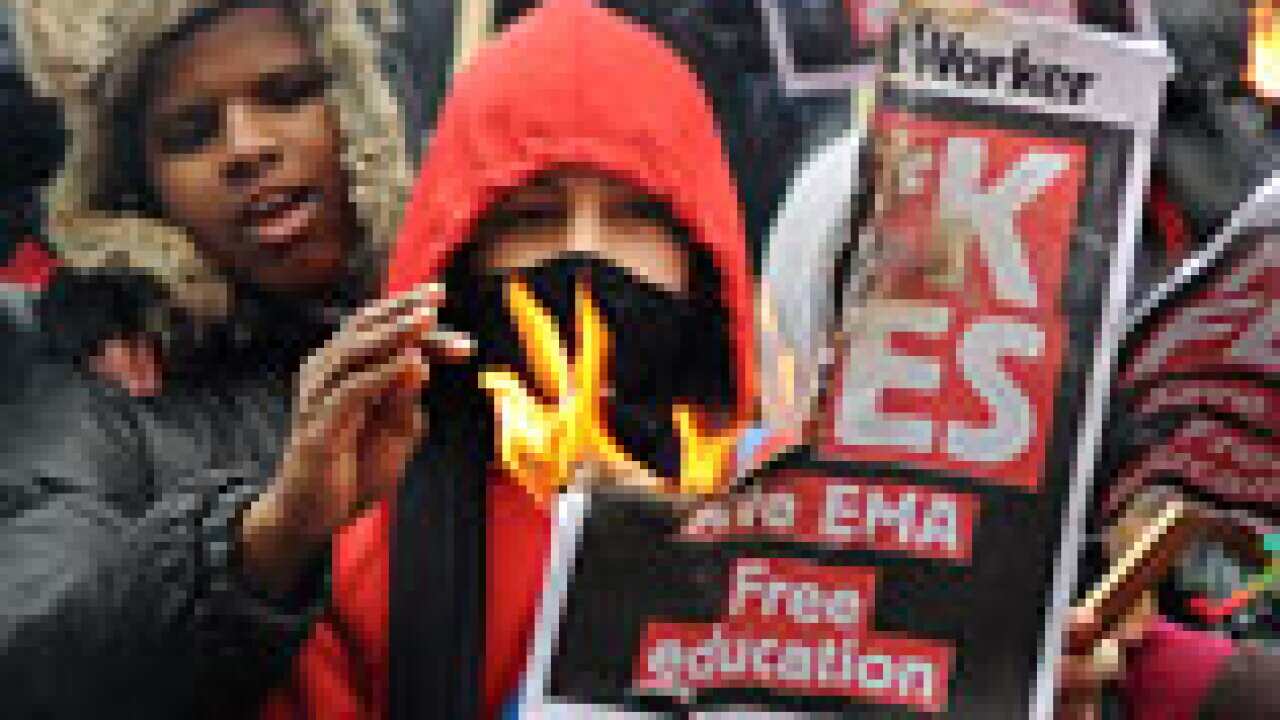
Masked rioters battled police outside parliament Thursday as Britain's coalition government survived its biggest test yet in a vote to hike university tuition fees.
Dozens of officers and demonstrators were wounded as a student protest in the heart of London turned violent following the government's narrow victory in a vote in parliament.
The government suffered its first resignations over policy and the plans to raise fees exposed the deep strains within the seven-month-old coalition.
News that makes sense
Your trusted source for staying up-to-date with the world around you. Get free daily news updates and analysis, straight to your inbox.
The government's majority was cut by three-quarters as lawmakers voted by 323 to 302 to raise the cap on annual tuition fees at English universities from 2012.
The basic level of fees will now climb to 6,000 pounds (9,460 dollars, 7,140 euros), with an upper limit of 9,000 pounds. The current cap is 3,290 pounds.
Demonstrator Anna Campbell, a 19-year-old studying French and Russian at Sheffield University, cried after hearing the result of the vote.
"I'm so angry, but this is not the end," she told AFP. "It's just the beginning, we are going to keep fighting."
Outside the Houses of Parliament hardcore activists rained missiles on police protecting the building and clashed with police at other points around Parliament Square, with several officers and demonstrators wounded.
Flares, sticks, metal fences, rocks, snooker balls and paint bombs were among the missiles hurled at police in a battle that lasted hours.
Hooded youths repeatedly attacked police lines, torched benches and a security guard box in the square, smashed the doors and windows of the Treasury, or finance ministry, and vandalised a statue of wartime prime minister Winston Churchill.
The iconic red telephone boxes outside parliament, used in countless tourist pictures, were wrecked.
Several protesters suffered head wounds, one being taken away on a makeshift stretcher.
Julyan Phillips, 23, a student at Goldsmiths College in London, had blood pouring from a cut on his head.
"The guys who were next to me were pushing a metal fence towards them but a policeman decided to lash out at me instead with a baton," he told AFP.
He said he was demonstrating because "education is a right, not a privilege".
At least 22 protesters and nine police officers were injured, while nine people were arrested.
Superintendent Julia Pendry of London's Metropolitan Police said it was "absolutely obvious" that people had come to the capital "with the intention of committing violent disorder" rather than peaceful protest.
Another spokesman said the police were being subjected to "extreme violence".
The proposal to raise fees has exposed deep tensions within the Liberal Democrats, putting the strain on their coalition with the larger Conservative Party which came to power following the general election in May.
As they try to rein in Britain's record deficit, the plans amount to a reversal of one of the Lib Dems' flagship election pledges.
Deputy Prime Minister Nick Clegg's party vowed to phase out tuition fees altogether if they won the election.
Of the 57 Liberal Democrat lawmakers, 28 voted with the government, while 21 voted against.
The coalition suffered its first resignations over policy when two Lib Dem parliamentary aides to ministers and one Conservative quit their posts in order to vote against the plans.
The Lib Dem U-turn has outraged students who voted for the centrist party and has sparked a series of demonstrations over the past month which have turned violent.
One protester, Andrea Baptiste, 18, from London, said Clegg was "a liar and a snake".
A defiant Clegg dismissed opponents of the plans as "dreamers" and insisted it was reasonable to make students pay more for their education at a time of deep cuts to public spending.
The rise in fees is also supported by the majority of universities. Graduates will begin to pay them once they earn more than 21,000 pounds per year.







