
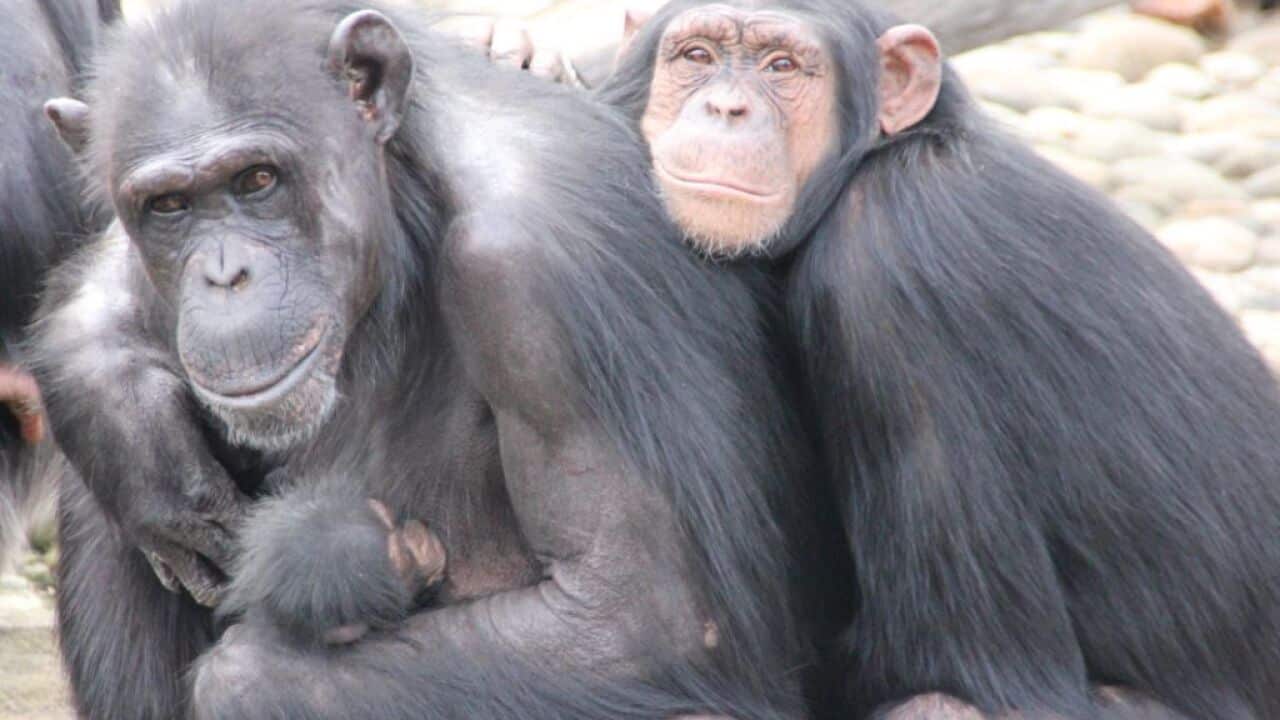
Comparing chimpanzees and humans without considering their upbringing is like comparing a child brought up in a loving family to one brought up in a Romanian orphanage, according to researchers studying primate behaviour.
Professor Kim Bard, from the University of Portsmouth's centre for comparative and evolutionary psychology and Dr David Leavens, of the University of Sussex, are calling for a fairer design for studies comparing humans and chimpanzees that takes their background into account.
They also say that some previous studies may need to be re-examined and could be flawed.
Prof Bard said: "Ignoring development is a real problem because primates and their social cognition develop as a result of their social and emotional experiences."
According to Prof Bard, studies that do not take rearing into account have three major flaws.
The first is mistaking group-specific differences as "species" differences, the second is a lack of consideration of development in non-human primates and the third is only using one human group, usually from rich families in developed countries, and treating them as representative of all humans, even though they are not.
"For human infants we have known for decades that engagement with social partners and objects are essential developmental precursors for joint attention, " Prof Bard said.
"For chimpanzees, we have known for decades that outcomes vary as a function of developmental experiences, but these developmental effects in apes have generally been ignored in theory building.
"We cannot base our scientific conclusions on flawed research designs, and argue that it would be difficult or cost more money to use a balanced research sample. That is simply not acceptable."
The researchers, whose report is published in the Annual Review of Anthropology, have proposed a new model for ensuring that developmental experiences are appropriately considered by taking into account a more diverse range of rearing environments.
Prof Bard added: "We really don't know very much about what chimpanzees are really capable of, since many of the recent studies have used institutionally-reared apes, who certainly are not the best representatives of the species."





