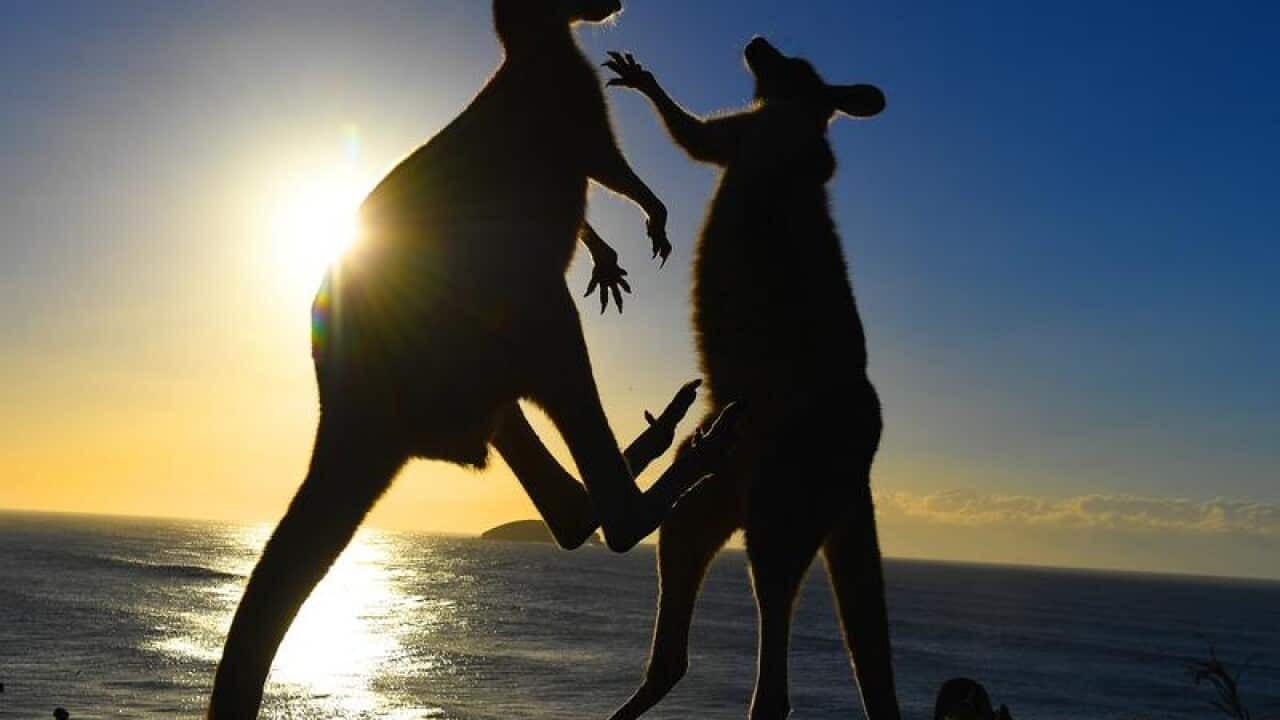
Scientists have been able to establish a timeline for the evolution of the modern kangaroo, showing that ancestors of today's kangaroos appeared in Australia at least 25 million years ago.
According to researchers from Flinders University, modern kangaroos rapidly evolved and diversified to develop their current features around 3 million years ago.
It was largely due to environmental change - the spread of grasslands across the continent - according to the study published on Friday in the journal Science.
The marsupials are Australia's national animal, with an estimated population of around 45 million, almost double that of the humans on the continent.
The scientists were able to establish the new timeline by analysing teeth, specifically their shape and wear, after studying about 1600 specimen of modern kangaroos and more than 100 from fossilised related ancestors.
News that makes sense
Your trusted source for staying up-to-date with the world around you. Get free daily news updates and analysis, straight to your inbox.
It helped them study the diet and the environment of the kangaroos.
The scientists established that the kangaroos transitioned from having short and stumpy teeth, which are good for eating vegetation out of trees and shrubs, to high-crown teeth that extend further into the gums to help graze on tough grass after the spread of grasslands.
Previously it was thought that they evolved gradually as aridity spread across the continent between 12 million and 5 million years ago.
Flinders University Professor Gavin Prideaux, one of the researchers of the study, said the findings help better understand how climate change has shaped the evolution of Australia's fauna.
"We are now exploring whether these evolutionary patterns hold up when we look at different parts of the skeleton, such as the feet, which might tell us about when and how hopping evolved," he said.







