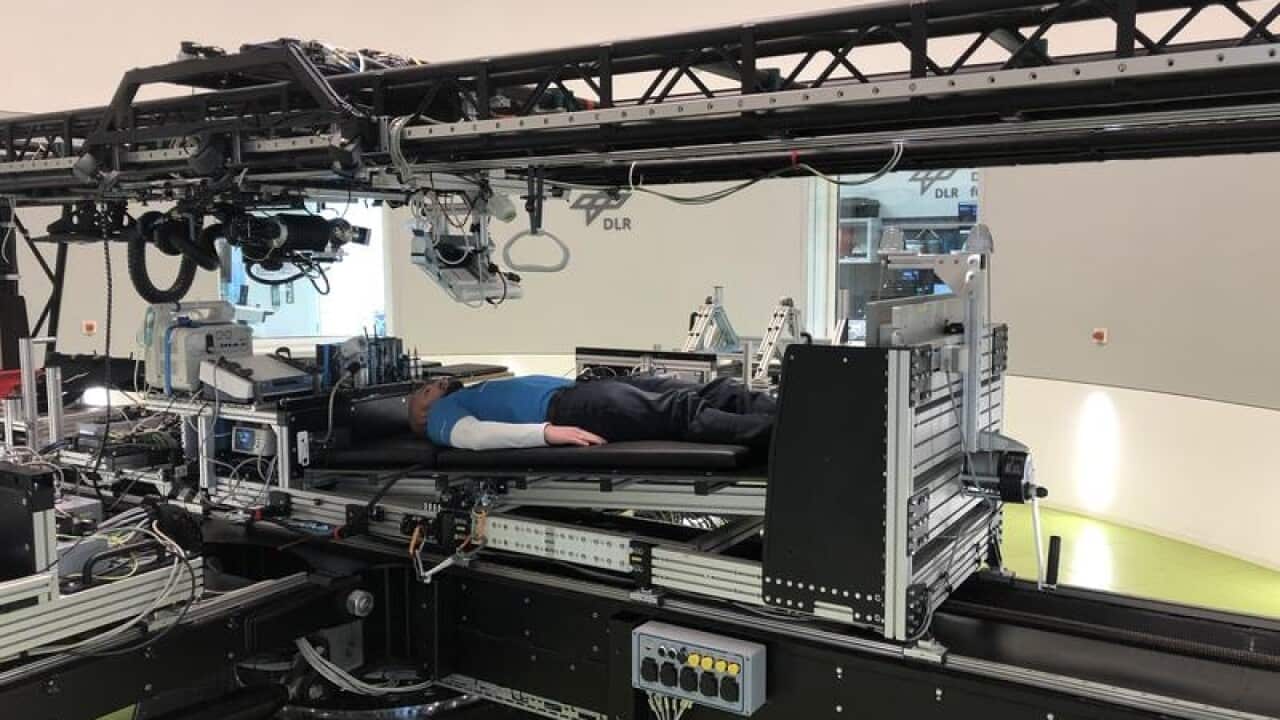
Patients could one day be spun around in machine which simulates the effects of gravity to prevent muscle wastage during long hospital stays.
A new study will explore what happens when volunteers, subjected to 60 days of bed rest, spend 30 minutes per day strapped to a human centrifuge.
The research will be carried out by two UK universities and could also help astronauts who are sent on long missions.
"Artificial gravity could help astronauts to maintain muscle mass in space and help back here on Earth too by preventing severe muscle degeneration in hospitalised patients.
"Currently astronauts have to exercise for up to 2.5 hours every day, take nutrient supplements, and keep high protein diets to maintain muscle mass while they are in space. Despite this, severe muscle deterioration still occurs," Professor Hans Degens, who is leading the work at Manchester Metropolitan University, said.
News that makes sense
Your trusted source for staying up-to-date with the world around you. Get free daily news updates and analysis, straight to your inbox.
"One day, astronauts might have a daily quick spin in a centrifuge on the ISS rather than spend hours on gym equipment in space.
"For hospital patients it could greatly improve their recovery during rehabilitation and after they leave."
A total of 12 healthy men and 12 healthy women are expected to take part in the research.
The volunteers will be subjected to 60 days of bed rest, mimicking the effects of microgravity space conditions.
Some of the group will spend 30 minutes every day lying flat in the human centrifuge as it spins.
Researchers will carry out a series of tests and examine muscle degeneration, as well as ways to prevent lower back pain.
The research is backed by the UK Space Agency and funding has been awarded to Northumbria University and Manchester Metropolitan University to carry out the project.
The first of two tests is already underway, with the second due to begin in September.







