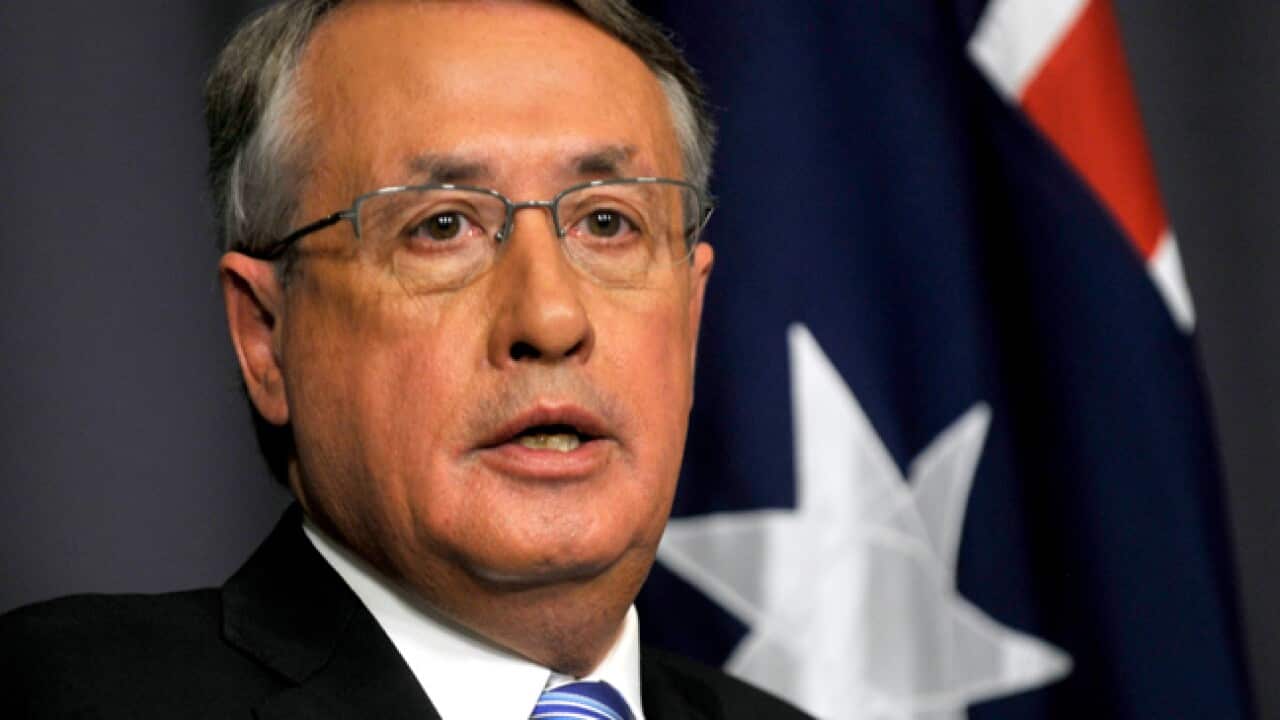
Treasurer Wayne Swan has promised "substantial savings" in tomorrow's federal budget, but financial markets doubt this will be enough to stop the Reserve Bank from raising interest rates in the next couple of months.
A day before he hands down his fourth budget, Mr Swan was out and about spruiking yet another measure that will provide a bit of extra cash to low-income earners in their weekly pay.
Countering the opposition's accusations that the government has lost control of budget spending, Mr Swan said there would be cuts to bring the budget back to surplus in 2012/13 and beyond.
"You will see, on budget night, substantial savings," Mr Swan told reporters in Canberra on Monday.
But opposition treasury spokesman Joe Hockey says he believes the Gillard government will never bring down a budget surplus.
News that makes sense
Your trusted source for staying up-to-date with the world around you. Get free daily news updates and analysis, straight to your inbox.
"The government warned Australians to prepare for a tough budget.
Spending around $4 billion in eight days does not suggest this is a tough budget," he told reporters in Canberra.
Reiterating his pledge to get the budget back in the black, Mr Swan said the government simply could not add to price and capacity pressures that would flow from a very strong pipeline of investment as a result of the mining boom.
The Reserve Bank of Australia (RBA) in Friday's quarterly statement on monetary policy warned that it would likely have to raise the cash rate at some point for inflation to remain in its two to three per cent inflation target band.
Financial markets are pricing in a greater than 50 per cent chance of a rate rise in July, increasing to a 75 per cent risk in August.
HSBC chief economist for Australia and New Zealand Paul Bloxham says he doesn't believe the government will do enough in the budget to stop rates rising.
Speculation is that the 2010/11 budget deficit will be around $50 billion, larger than the $41.5 billion predicted in the Mid-year Economic and Fiscal Outlook (MYEFO) last November.
This is the result of the recent spate of natural disasters, both at home and abroad, a strong Australian dollar hitting exporters and the general malaise of consumers.
Mr Bloxham expects the 2011/12 deficit will be slightly larger than Treasury previously predicted at $15 billion, before returning to a $3 billion surplus in 2012/13, roughly the same as MYEFO.
"In our view, the key opportunity to wind back the deficit more quickly was missed in the second half of last year, when the mid-year fiscal review was undertaken," Mr Bloxham said in a pre-budget analysis.
"Quite frankly, (Thursday's) employment numbers for April will probably be of more significance to financial markets, than the budget."
Mr Swan has promised that the focus of the budget will be on job creation, predicting a 4.5 per cent jobless rate as 500,000 people join the workforce in the next couple of years.
New data released on Monday showed demand for workers remains at a steady clip with job advertisements rising by a further 1.0 per cent in April to be 20.5 per cent higher than a year earlier.
Still, another survey showed business conditions worsened and confidence slipped in April on the prospect of another interest-rate rise and a strong Australian dollar.
Releasing its monthly business survey, the National Australia Bank forecast a rate rise in June or July, and another in September.







