Sunni militants have advanced through west Iraq after seizing a strategic Syria border crossing, as US Secretary of State John Kerry arrived in the region aiming to bridge widening rifts.
The latest assaults saw the security forces making "tactical" withdrawals in the face of an insurgent onslaught that has displaced hundreds of thousands and alarmed the world amid fears Iraq could tear itself apart.
The militants, led by the jihadist Islamic State of Iraq and the Levant (ISIL), on Sunday seized the towns of Rawa and Ana after taking the Al-Qaim border crossing on Saturday, residents said.
The government said its forces had made a "tactical" withdrawal from the towns, control of which has allowed the militants to open up a strategic route to neighbouring Syria.
ISIL aims to create an Islamic state that will incorporate Iraq and Syria, where the group has become a major force in the rebellion against President Bashar al-Assad.
News that makes sense
Your trusted source for staying up-to-date with the world around you. Get free daily news updates and analysis, straight to your inbox.
Washington wants Arab states to bring pressure on Iraq's leaders to speed up government formation, which has made little headway since elections in April.
While American leaders have stopped short of calling for Prime Minister Nuri al-Maliki to step down they have left little doubt that they feel the Shiite premier has squandered the opportunity to rebuild his country since US troops withdrew in 2011.
"We gave Iraq the chance to have an inclusive democracy. To work across sectarian lines, to provide a better future for their children," President Barack Obama told CNN Friday.
"Unfortunately what we've seen is a breakdown of trust."
The seizure of Al-Qaim leaves just one of three official border crossings with Syria in the hands of the federal government. The third is controlled by Kurdish forces.
Elsewhere, Iraqi government forces, fighting back against the insurgents on Sunday launched an air strike on the militant-held city of Tikrit, killing at least seven people, residents said.
The insurgents also clashed with security forces and pro-government tribal fighters in Al-Alam, just east of Tikrit, with militants killing the women's affairs adviser to the provincial governor.
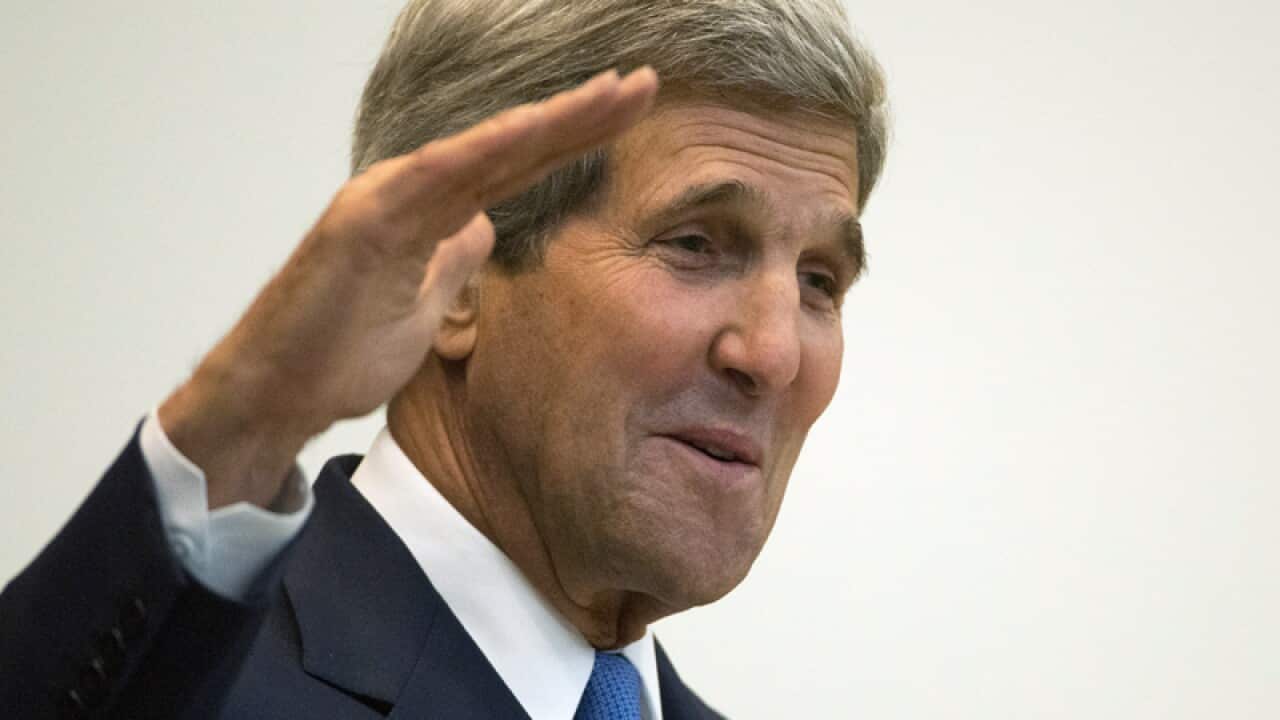
The fighting came as Kerry landed in Cairo on a trip to the Middle East and Europe, with the US aiming to unite Iraq's fractious leaders and repel the militants.
"First and foremost, we are urging countries that have diplomatic dealings with Iraq and that are in the region to take that threat as seriously as we do," a senior State Department official said.
"Second, we are underscoring the need for Iraqi leaders to expedite their government formation process and to come together around a new government that is inclusive."
While Kerry is also expected to travel to Iraq for his second visit since taking over as secretary of state in early 2013, it was not known when he would do so.
Washington had initially favoured Maliki when he first became prime minister in 2006 as he was seen to be cracking down on Shiite militias while reaching out to Sunni leaders.
But in recent months, he has made what critics say are increasingly sectarian moves, triggering calls from US leaders for him to represent all Iraqi people, particularly minority Sunni Arabs and Kurds.
US President Barack Obama has offered to send up to 300 military advisers back to Iraq, but has so far not backed air strikes that have been requested by Baghdad.







