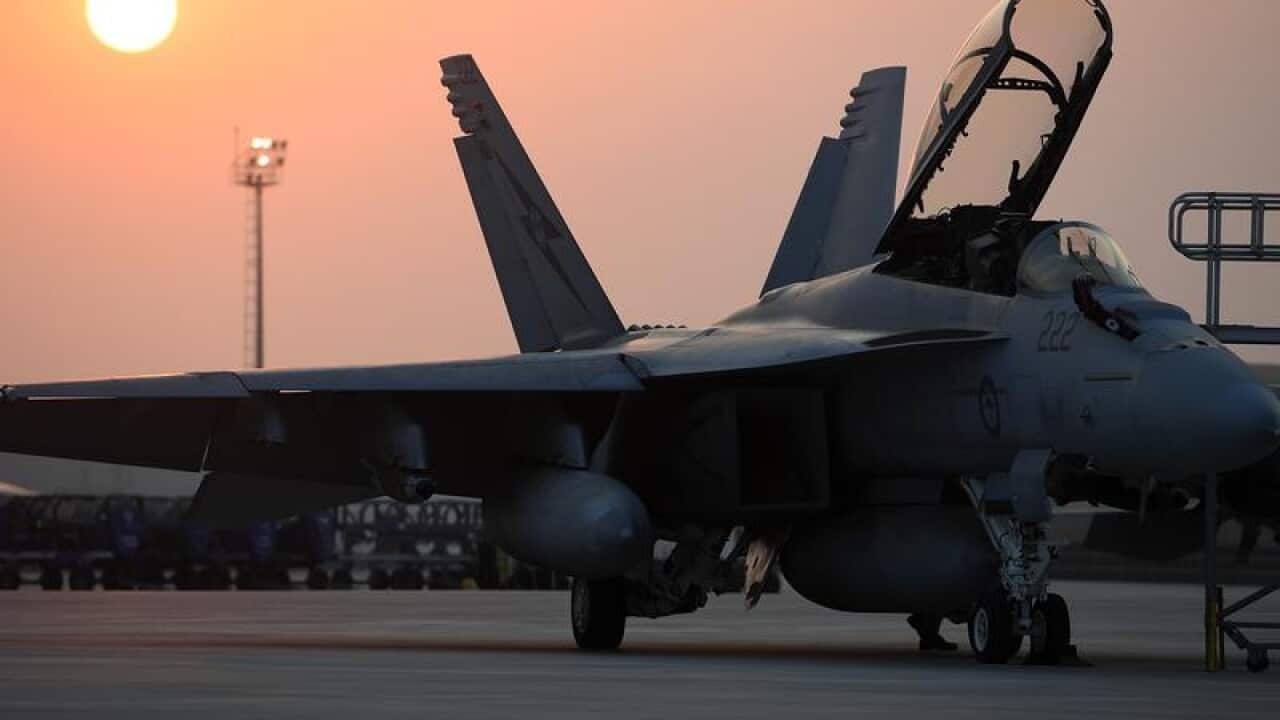
Australia's six Super Hornets are expected to return home as early as next week, after flying their last missions in the air strike operations against Islamic State in Iraq and Syria.
The Turnbull government announced the withdrawal late last year shortly after Iraq's prime minister declared victory over the militant group.
Belgium also brought home its six F-16 Falcon fighter jets late last year.
At its peak the so-called Islamic State caliphate controlled most of eastern Syria and about a third of Iraq's territory.
The Super Hornets call the RAAF Base Amberley in Queensland home.
News that makes sense
Your trusted source for staying up-to-date with the world around you. Get free daily news updates and analysis, straight to your inbox.
AAP understands the Hornets have flown their last missions and will return as early as next week.
As well as fighter pilots and weapons operators, also returning to Australia will be aircraft maintenance workers and armament technicians ("gunnies") who assemble the precision-guided bombs.
Air force personnel are likely to be relieved they won't have to endure another summer at Australia's main air operating base in the Middle East, where the temperature often reaches 50 degrees Celsius on the tarmac and 65 degrees on top of the aircraft.
The return doesn't mark the end of Australia's military commitment in the fight against IS.
The Wedgetail air battlespace management aircraft, on an operational pause, is expected to recommence sorties early this year.
Australia also has a KC-30 refueller tanker in operation which will continue to provide fuel in the air to the fighter jets from other countries in the US-led coalition.
Hundreds of Australian troops based out of Taji in Iraq will continue to train and mentor Iraqi soldiers, switching from combat training to ways to hold territory.
Australia's air contribution to the fight against IS has not been without controversies.
An Australian Super Hornet was responsible for an air strike in west Mosul in Iraq which may have killed a child in June.
In a separate incident in March, Australian military personnel had been involved in the target decision-making process of a botched air strike in which seven civilians were killed or injured, including a child.
The previous year, two Australian fighter jets dropped six bombs as a part of a bungled coalition air strike which hit Syrian government irregular forces rather than Islamic State.
* The Super Hornets have flown more than 21,400 flying hours, dropped more than 2400 precision-guided bombs on about 2750 sorties in the past three years.
* The air-to-air refueller tanker has flown 9400 hours on about 1200 sorties, and transferred about 42 million litres of fuel.
* The Wedgetail air battlespace management aircraft has clocked up more than 5000 flying hours and 400 sorties.







