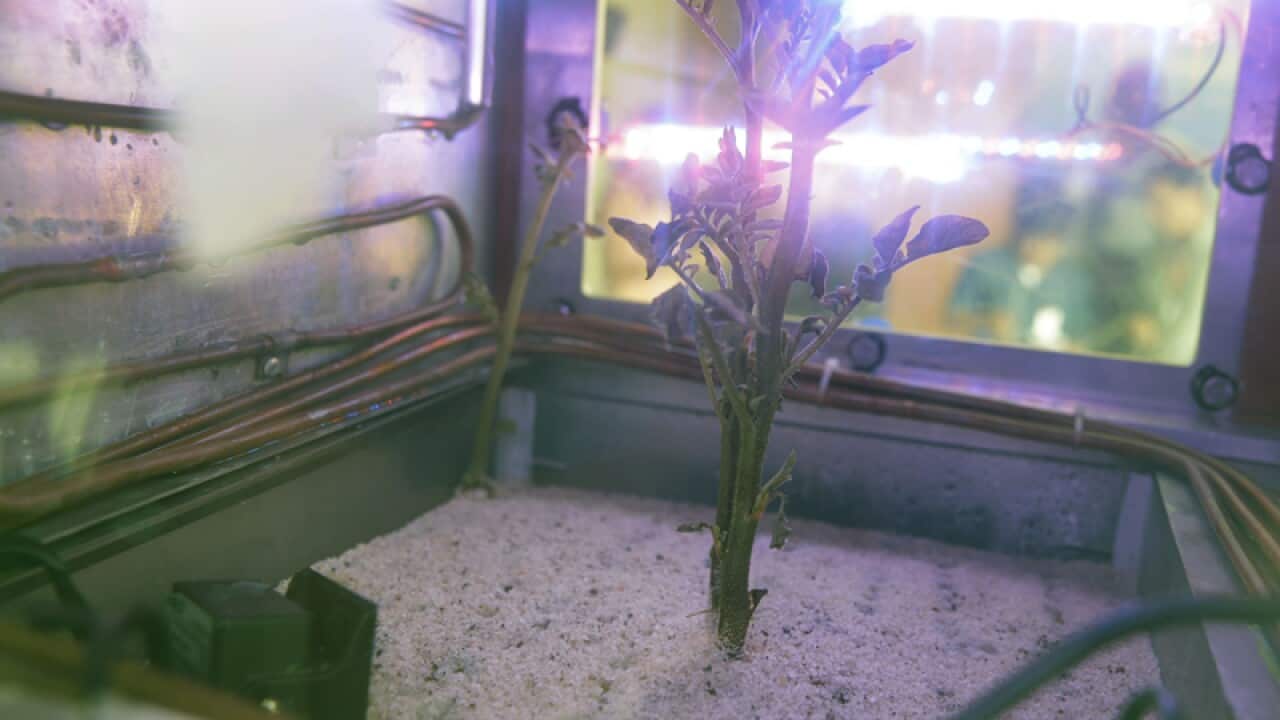
A simulator at a Peruvian lab that mimics the harsh conditions on Mars now contains a hint of life: a nascent potato plant.
After experimenting in the Andean nation's desert soil, scientists have successfully grown a potato in frigid, high carbon-dioxide surroundings.
Investigators at the International Potato Center in Lima believe the initial results are a promising indicator that potatoes might one day be harvested under conditions as hostile as those on Mars.
The findings could benefit not only future Mars exploration but also arid regions already feeling the impact of climate change.
"It's not only about bringing potatoes to Mars but also finding a potato that can resist non-cultivable areas on Earth," said Julio Valdivia, an astrobiologist with Peru's University of Engineering and Technology, who is working with NASA on the project.
News that makes sense
Your trusted source for staying up-to-date with the world around you. Get free daily news updates and analysis, straight to your inbox.
The experiment began in 2016, a year after the Hollywood film The Martian showed a stranded astronaut surviving by figuring out how to grow potatoes on the Red Planet.
Peruvian scientists built a simulator akin to a Mars-in-a-box: below-zero temperatures, high carbon monoxide concentrations, the air pressure found at 6000m and lights imitating the Martian day and night.
Peru was an apt place to experiment: the birthplace of the domesticated potato lies high in the Andes near Lake Titicaca, where the first were grown about 7000 years ago.
To find high-salinity soil similar to that found on Mars, researchers went to Pampas de la Joya, on the country's southern coast, whose parched terrain is somewhat comparable to the Red Planet's.
They transported 700kg of the soil to Lima, planted 65 varieties and waited.
In the end, just four sprouted from the soil.
In a second stage, scientists planted one of the most robust varieties in the even more extreme conditions of the simulator, with the soil - Mars has no organic soil - replaced by crushed rock and a nutrient solution.
The winning potato was a variety named "Unique".
"It's a 'super potato' that resists very high carbon dioxide conditions and temperatures that get to freezing," Valdivia said.
Ray Wheeler, the lead for advanced life support research activities at NASA's Kennedy Space Center, said plant survival in the open on Mars would be impossible given the planet's low-pressure, cold temperature and lack of oxygen.
However, showing plants could survive in a greenhouse-type environment with reduced pressure and high carbon-dioxide levels could potentially reduce operating costs.







