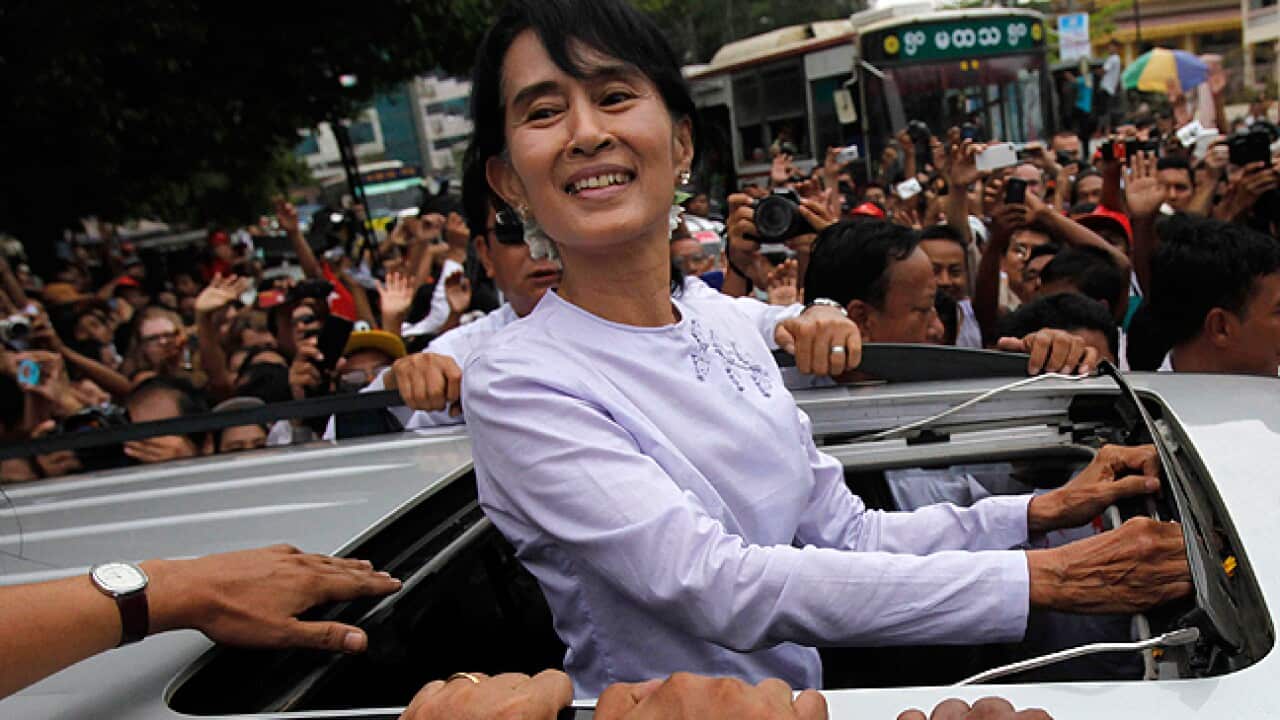
Pro-democracy leader Aung San Suu Kyi has hailed a "new era" for Burma and called for political unity after her party swept to victory in elections seen as a test of budding reforms.
The Nobel peace laureate won her first seat in parliament, state media confirmed, saying that her National League for Democracy (NLD) party secured 40 of the 44 seats it contested, according to partial official results.
The dramatic political changes spearheaded by the 66-year-old known fondly as "The Lady" were accompanied by the quasi-civilian government's most radical economic reform yet -- an overhaul of the country's complex currency regime.
News that makes sense
Your trusted source for staying up-to-date with the world around you. Get free daily news updates and analysis, straight to your inbox.
Supporters, some shedding tears of delight, celebrated into the night after the NLD declared that Suu Kyi -- who was locked up by the former junta for most of the past 22 years -- had secured a seat after Sunday's by-elections.
The veteran activist's election to political office marks the latest sweeping change in the country formerly known as Burma after decades of outright military rule ended last year.
"This is not so much our triumph as a triumph for people who have decided that they must be involved in the political process in this country," Suu Kyi said in a victory speech at her party headquarters in Yangon.
"We hope this will be the beginning of a new era."
Suu Kyi struck a conciliatory tone towards the other political parties as she prepares to take her place in a parliament that will remain dominated by the military and its political allies.
"We hope that all parties that took part in the elections will be in a position to cooperate with us in order to create a genuinely democratic atmosphere in our nation," she said.
The NLD said that its own tally showed it had taken at least 43 seats. In total, 45 seats were available.
The Myanmar government has surprised even its critics over the past year with a string of reforms such as releasing hundreds of political prisoners, but ethnic conflict and alleged rights abuses remain concerns for the West.
The European Union on Monday held out the prospect of further easing sanctions on Myanmar, while the White House voiced hope that Suu Kyi's election would lead to greater reform.
"We will continue to support the ongoing reforms in Myanmar and look forward to developing a new and cooperative relationship as these go forward," said EU foreign policy chief Catherine Ashton, who is expected to visit the country later this month.
French President Nicolas Sarkozy congratulated Suu Kyi on her victory. "I wish, in the name of the French people, to salute this victory for democracy in your country and your remarkable personal commitment," he said in a statement.
As a lawmaker and opposition leader in parliament, Suu Kyi will have an unprecedented voice in the legislative process, and her party is already looking ahead to the next general election, in 2015.
"Obviously they want to win the next election comprehensively and be able to set up a government in their own right," said Trevor Wilson, a Burma expert at the Australian National University.
Observers say the government that took power a year ago needs Suu Kyi in parliament to bolster the legitimacy of its political system and spur an easing of Western sanctions.
As part of moves to modernise an economy left in disarray by decades of military rule and encourage more foreign investment, Burma on Monday moved to revamp its dysfunctional exchange-rate system.
The central bank set a reference rate of 818 kyat to the dollar under its new managed floating exchange rate system, bringing the official rate roughly in line with its value on the black market, where it is widely traded.
Previously the official government rate -- which was widely ignored -- was pegged at around just six kyat to the dollar.
Unlike in the 2010 general elections, the government allowed foreign observers and journalists to witness Sunday's polls, which were to replace lawmakers who gave up their seats to join the government.
In the run-up to the vote, the NLD decried alleged intimidation of candidates and other irregularities, and the party also complained about some problems with ballot sheets on Sunday.
BURMA SAYS ELECTION SMOOTH AND ORDERLY: ASEAN CHIEF
Meanwhile, Burma's foreign minister told his counterparts from the Association of Southeast Asian Nations (ASEAN) Monday that his country's historic by-elections had gone "smoothly", diplomats said.
Burma's Wunna Maung Lwin said the vote "has gone rather smoothly, orderly and the participation has been very high," ASEAN chief Surin Pitsuwan said after a meeting of the 10-member block's foreign ministers in Phnom Penh.
The milestone polls on Sunday appeared to give opposition leader Aung San Suu Kyi -- whose landslide general election victory in 1990 was never recognised by the then-ruling junta -- her first seat in parliament.
Wunna Maung Lwin also told the assembled ministers that he hoped the elections would "contribute to a more effective integration of Myanmar into the global community," Surin said.
ASEAN observers were "very encouraged by the orderly manner of this important democratic exercise" in which Suu Kyi's National League for Democracy (NLD) claimed 43 of the 44 seats up for grabs, Surin added.
But asked whether ASEAN observers had reported that the polls were free and fair, Surin said: "We have to wait. They need to have some time to go through that. The (ASEAN) chair will have some statement."
Cambodia, which is hosting a two-day summit of ASEAN leaders this week, is the current ASEAN chair.
Indonesian Foreign Minister Marty Natalegawa welcomed the by-elections as "an opportunity for Myanmar to make the reform process even more irreversible".
Philippine Foreign Secretary Albert del Rosario told reporters the elections were a "vindication of the global community that believed that Myanmar could pursue this democratisation track effectively".
ASEAN comprises Brunei, Cambodia, Indonesia, Laos, Malaysia, Myanmar, the Philippines, Singapore, Thailand and Vietnam -- a grouping of nearly 600 million people of hugely disparate economic development and political systems.







