(Transcript from World News Radio)
Switzerland's decision to bring back quotas for immigration from European Union countries could see it have to re-negotiate all its agreements with the EU.
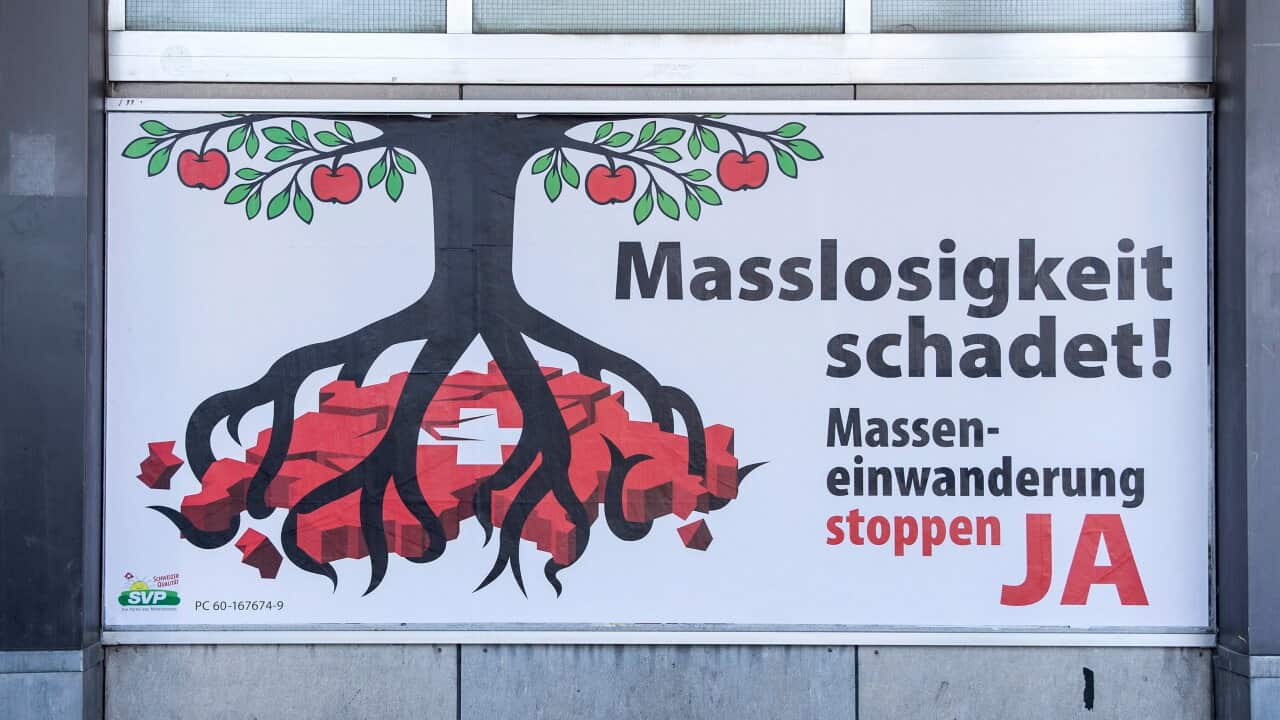
At a special referendum, just over 50 per cent of Swiss voters have backed the initiative of the Swiss People's Party.
While Switzerland is not a member of the European Union, it had forged a pact with Brussels in 2002 which had ensured the free movement of citizens.
The vote in favour of quotas now invalidates that agreement.
News that makes sense
Your trusted source for staying up-to-date with the world around you. Get free daily news updates and analysis, straight to your inbox.
Greg Dyett reports.
(Click on audio tab above to listen to this item)
It's a country that relies on foreign workers, it has a budget surplus and its unemployment rate is just 4 per cent.
Yet Switzerland has just decided to impose immigration quotas for EU citizens.
The government and business had argued against re-introducing quotas, an initiative of the Swiss People's Party which has an anti-immigration platform.
The party says the annual increase in Switzerland's population is not sustainable.
Last year, 80 thousand new immigrants arrived in Switzerland.
Swiss People's Party MP Ulrich Schuler told Al Jazeera the number of immigrants from the European Union is far higher than what was originally invisaged.
"When it was installed, this system, Swiss population was told that we will have an immigration of about 8000 people from the European Union into Switzerland. Now it is working since 2007 and we have 80,000 or 90,000, that means 10 times or 11 times more than predicted and that shows that it does not work how it should and now the people decided that we have to renegotiate the system with the European Union."
Rather than joining the EU, Switzerland negotiated a number of agreements such as a single market and the ability to move around Europe without the need for visas.
The President of the European Parliament, Martin Schulz says these bilateral agreements might have to be re-negotiated.
"The agreements between us and Switzerland and the free movement of EU citizens is guaranteed, if now in the follow up of this referendum, Switzerland has to modify laws and to limit free movement also of EU citizens then we have to react and to discuss and perhaps to renegotiate the agreement with Switzerland."
The vote could also have serious implications for Switzerland's economy because the European Union is its biggest trading partner.
Germany's Finance Minister Wolfgang Schaeuble says it's now up to the EU to better explain the benefits of the freedom of movement provisions.
"These moods and these fears exist and they have a little to do with the fact that in today's totally open (globalised world) it's convenient for populists to exploit the situation. That's why taking it seriously does not mean taking it into consideration. It means that we need to better explain that freedom of movement and openness is in everyone's interest. This has to happen and this also holds true for the European elections."
Roland Isler from the Swiss Club of Victoria believes the Swiss People's Party has successfully managed to stir up populist fears that are held all over Europe.
"The fears that people hold is very basic. They think that their jobs are in jeopardy and housing is a problem etc etc. It's cultural differences and so forth but these arguments really that exist in every country in Europe, not just in Switzerland."
More than a milion EU citizens are living in Switzerland but Ulrich Schuler from the Swiss People's Party says almost half of the EU immigrants are not in Switzerland to work.
"Between 40 and 50 per cent of the immigrants, they do not come to work, they are family followers or they are, they want to profit from our social system, a very high social system and that, I would say there is no country in Europe which can afford for a long a time such a development."
The Swiss Club of Victoria's Roland Isler says the Swiss government has three years to determine how the quotas will work and enshrine the provisions in some legislation.
"The immigration, it's not a one way freeway here, I mean it's also going both ways, there's a lot of opportunities for Swiss people to work in the EU and unfortunately we have now a situation that the country had to deal with and we still don't know what the impact really will be, it will only show in a couple of years maybe depending on how the EU reacts on that."