
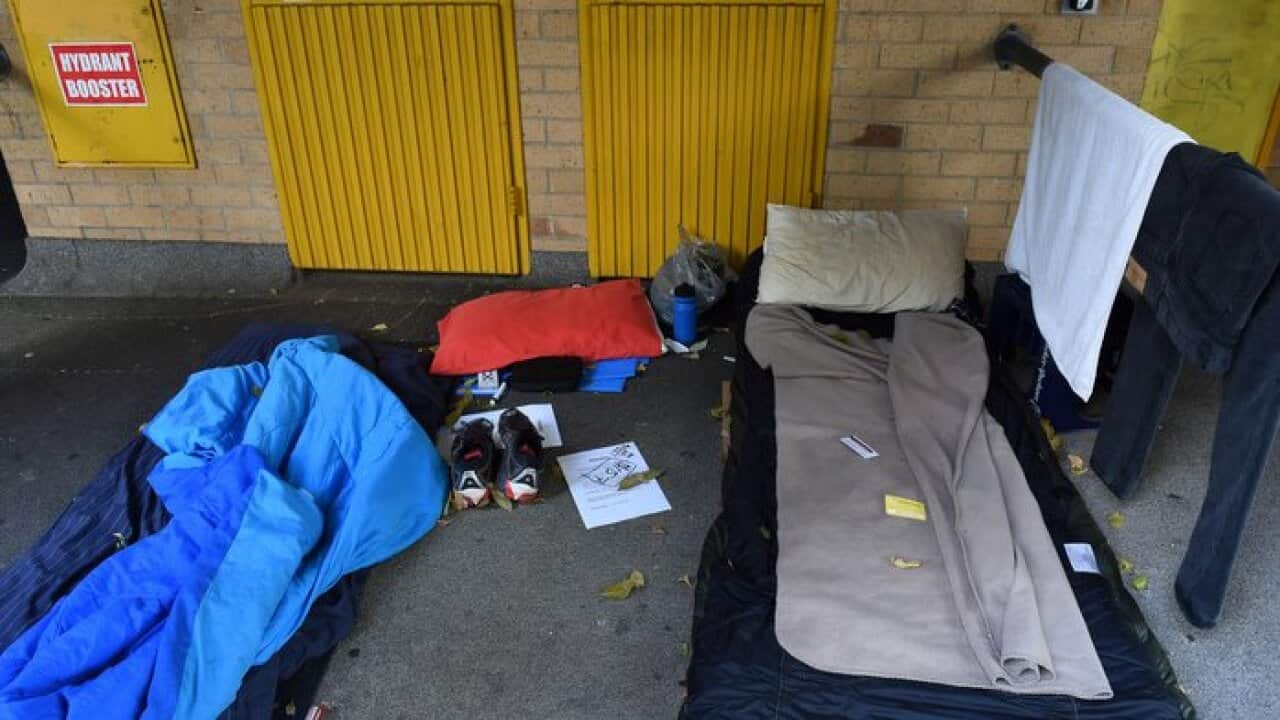
The extreme weather that ripped through NSW, leaving thousands without power and killing at least five people, have also made conditions worse for homeless people sleeping rough on the streets.
Mission Australia CEO Catherine Yeomans said the organisation’s MissionBeat drivers had worked through the night, picking up and dropping off people at an emergency shelter in Millers Point by Sydney Harbour.
"The storms in the last couple of days really do highlight the fact that people are not choosing to live on the streets," said Ms Yeomans.
"That tugs our heartstrings when we see it on a stormy night. But let’s just remind ourselves that 365 days a year 100,000 people across Australia are homeless."
Listen: Mission Australia CEO Catherine Yeomans on homelessness
According to Bureau of Statistics figures, the number of homeless people on any given night has risen from 90,000 in 2006, to well over 100,000 now. Of that number, around six per cent are sleeping on the streets.
A question that many would have asked themselves is whether or not giving money to people begging on the streets is actually helpful.
Ms Yeomans said the public needed to "follow their hearts" if someone approaches them for money, but to also be aware that it is only helping them in the short term.
"We can completely understand that sometimes we don’t know how to help. Do they give money to people they see on the street? What happens to all those blankets and jumpers that they donate?
"If you’re a little bit worried about donating to that person on the street – maybe you’re not quite sure about how that money might be used – you might want to buy some food instead or a cup of coffee," she said.
"Do something tangible for that person rather than just giving money perhaps."
Alternatively, Ms Yeomans said people could donate to a charity that works with homeless people.
A spokeswoman from The Big Issue told SBS buying a copy of the magazine was another way to directly support those doing it tough.
"Vendors are working for their living and we know from many years of supporting them, the benefits they receive by doing this, go well beyond the money they earn from each sale," she said.
"Benefits often come from being connected to a community and something positive, as opposed to begging, which in comparison can be a very lonely occupation."
NSW floods highlights plight of homeless people
Across social media platforms, many posted messages of support to highlight the plight of homeless people during the 'once in a generation' NSW storm.
The Salvation Army said there was a significant increase in the demand for emergency accommodation, as bus shelters, awnings and doorways were flooded with torrential rain.
"A lot of our community have bunkered down. Even sleeping in bus shelters doesn't help because the rain comes in sideways," The Salvation Army Streetlevel Mission Leader, Mitchell Evans, told Fairfax Media.
"City centres are pretty packed and full on. Last night many had nowhere to go," he said.
St Vincent's Health, a Catholic not-for-profit health and aged-care organisation in the city, said via Twitter that 365 homeless have been enduring the super storm comprising 100 kilometre-strong gusts and rain that have been pummeling in all directions from Illawarra to the Hunter region in the state of New South Wales.
The City of Sydney tweeted on Wednesday that Hyde Park, home to some of the city’s homeless, was closed, and covers such as bus stops are insufficient protection this week.
Housing shortage
Ms Yeomans said it’s important to consider the causes of homelessness.
"We all know what it feels like to be hungry. We all know what it feels like to be cold. So if we’re giving some immediate support for somebody, that’s going to make a difference right there and then.
"But the broader issue is that we have to ask ourselves is: what are some of the issues that are causing that person and people like them to be homeless in the first place?"
Mental illness and substance abuse are often factors that contribute to homelessness. Family breakdown, job losses and other financial difficulties can also lead to someone losing their home, Ms Yeomans said.
The lack of affordable housing is another reason why many end up on the streets.
"It’s a sad fact that there’s simply not enough housing at the moment. We need to increase the supply of social and affordable housing so we can move people from crisis accommodation into long-term housing. And that’s the best way to solve homelessness for the longer term."
In March, the federal government announced it will use an extra $230 million in homelessness funding to encourage the states to better target people who most need help.
Social Services Minister Scott Morrison said the extra two years of funding will give the Commonwealth time to work with the states and territories to review where the responsibility for homeless services lies.
“If we can intervene early, we can actually stop people from falling into homelessness,” said Ms Yeoman. ”But to do that we’ve got to support people when they need it most.”





