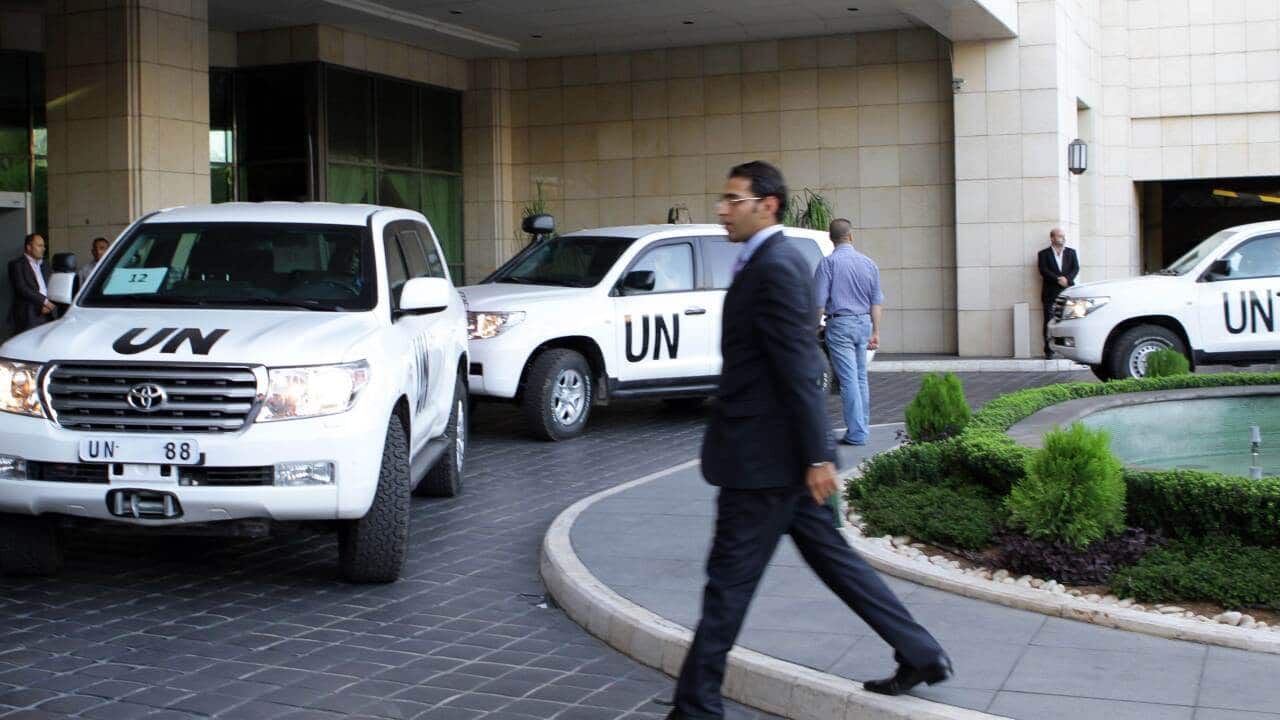
International disarmament experts have begun to catalogue Syria's arsenal of chemical weapons under a deal that will see the arms turned over for destruction by mid 2014.
The move comes as the United Nations Security Council puts renewed pressure on the Syrian government to ensure humanitarian aid can reach civilians.
(Click on audio tab above to hear full item).
The 19 member team from the Hague-based Organisation for the Prohibition of Chemical Weapons arrived in Damascus earlier this week to begin its task of cataloguing Syria's weapons stock.
Syria's arsenal is believed to include more than 1000 tonnes of sarin, mustard gas and other banned chemicals.
News that makes sense
Your trusted source for staying up-to-date with the world around you. Get free daily news updates and analysis, straight to your inbox.
The visit comes after the UN Security Council agreed on a statement calling on the Syrian government to allow aid agencies unimpeded access to civilians caught up in the 30 month conflict.
The statement, drawn up by Australia and Luxembourg is not legally binding.
But it urges all parties to the conflict to take all appropriate steps to facilitate the efforts of aid workers in Syria.
The UN's Humanitarian Coordinator Valerie Amos believes the resolution will help address a growing humanitarian crisis which has left two million people displaced.
"In the region, we should see greater and more united support to those communities and governments hosting refugees and to the refugees themselves. We hope all member states take note of this clear commitment and give even more generously. A steady stream of funding will mean the humanitarian community can scale up and continue to provide the help that people so urgently need."
The UN estimates more than 100 thousand people have lost their lives since the conflict began in 2011.
The UN High Commissioner for Refugees says 17 nations, including the US, France and Australia have agreed to accept a combined total of 10,000 of the estimated two million refugees.
Britain's Ambassador to the UN, Mark Lyall, says the number of refugees is expected to reach three million by the end of the year.
"Every 15 seconds, a new refugee is created. One in five schools has been damaged and put out of action. And this suffering has been exacerbated by obstacles that have been put in the way of humanitarian agencies, both of the UN and of other non governmental organisations."
Syria's Ambassador to the UN, Bashar Ja'afari, says the Syrian government will do all it can to help the flow of aid.
"My government has been and still is committed to the implementation of the plan of response for the full humanitarian needs of my country. We have signed with Mrs Amos, a fifth plan of response and we are deeply and fully committed to respecting and observing the provisions of this plan of response for the humanitarian needs in Syria."
Dr Roger Shanahan from the Lowy Institute for International Policy has conducted extensive research on the crisis in Syria.
He believes chemical weapons inspectors may struggle to get a clear picture of the weapons stockpile because they may not get full access.
Dr Shanahan says the passing of the non-binding resolution on humanitarian aid is a positive step forward.
However he says getting the full support of the Syrian opposition forces to deliver aid could be highly problematic.
"There is no unified Syrian opposition. So you're talking to a number of splinter groups and as we've seen recently, the infighting between the armed elements is increasing, the external political opposition doesn't wield control over all or it could be argued that much of the armed opposition. So an agreement would be essential, but again the practicalities of how do you implement an agreement signed by the opposition when not everybody accedes to the authority of the political opposition is a very difficult question."







