Western nations on the UN Security Council proposed a resolution demanding sanctions against Syria over the worsening conflict, as Syria's ambassador to Iraq Nawaf Fares defected from the regime.
The draft resolution lays the ground for a new Security Council battle over Syria in coming days after Russia proposed its own text with no threat of measures against President Bashar al-Assad.
The Security Council will have to pass a new resolution on the conflict state by July 20 when the mandate of the UN Supervision Mission in Syria (UNSMIS) ends.
News that makes sense
Your trusted source for staying up-to-date with the world around you. Get free daily news updates and analysis, straight to your inbox.
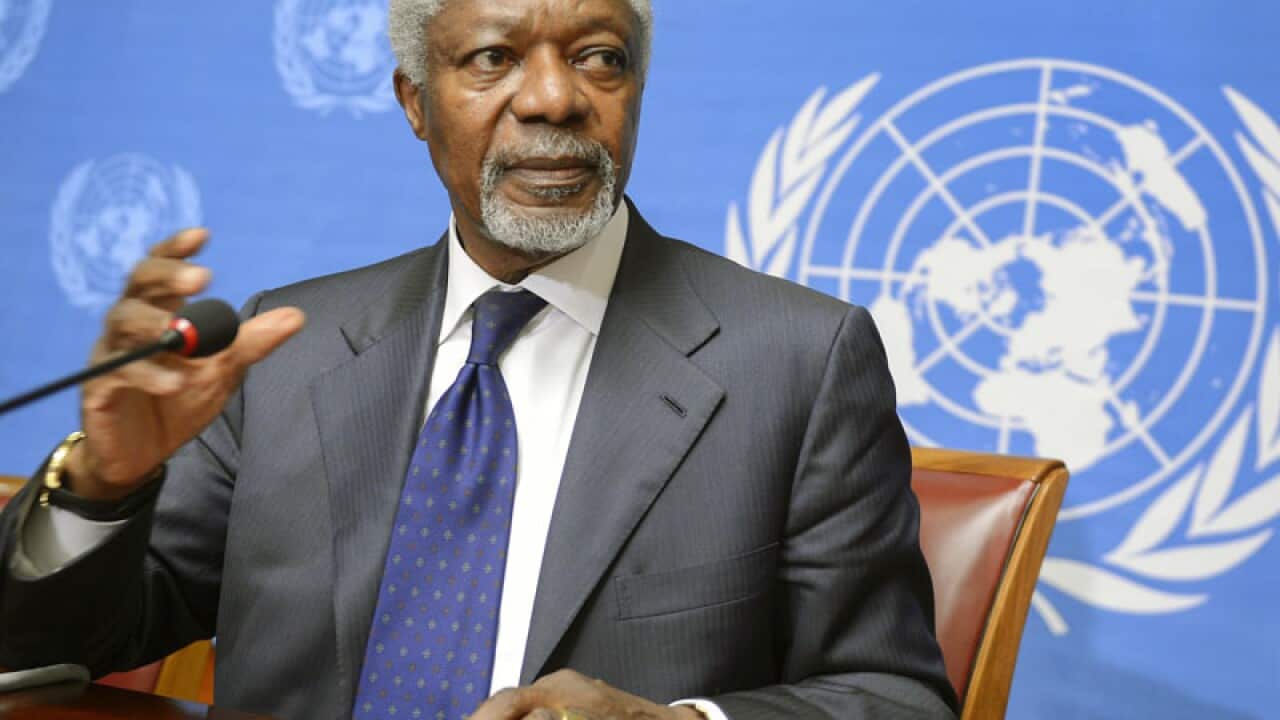
The sanctions will be demanded after UN-Arab League envoy Kofi Annan called for "clear consequences" if Assad and the Syrian opposition fail to carry out his peace plan, Britain's UN ambassador Mark Lyall Grant told reporters after a briefing by Annan.
Annan "called for the Security Council members to put aside their national interests and to put joint and sustained pressure on both parties with clear consequences for non-compliance," Lyall Grant added.
The proposal by Britain, France, the United States and Germany would make implementation of Annan's six-point peace plan and a political transition plan agreed by the international powers in Geneva on June 30 mandatory under Chapter VII of the UN charter, the British envoy said.
Annan agreed the peace plan -- which includes the withdrawal of heavy weapons and the first move toward political talks -- with Assad, but none of it has been carried out.
The resolution would include "a clear threat of sanctions if the regime fails in its first step of stopping the use of heavy weapons within a fixed timeline," Lyall Grant said.
Western nations will give only "a few days, or a very short time" for Assad's government to act to end violence, said France's UN envoy Gerard Araud.
"We can't wait weeks and months," he added. "Every week hundreds of Syrians are dying, so the council has to act."
Russia on Tuesday circulated a resolution which rolls over the UNSMIS mandate for three months, but makes no threat of concrete measures.
Russia opposes the use of Chapter VII in the Syria cases, said its deputy UN ambassador, Igor Pankin. But he did not state that Russia would veto any western resolution, insisting that negotiations had not even started over the rival texts.
Western nations have already rejected the Russian resolution.
"The Russian draft resolution is insufficient in that it does not give Mr Annan the means to act -- it does not act under Chapter VII and does not announce sanctions," said the French envoy.
AMBASSADOR DEFECTS
The Syrian ambassador to Iraq Nawaf Fares defected from the regime of embattled President Bashar al-Assad, an Arab diplomat in Baghdad told AFP Wednesday.
"He submitted a letter to the Iraqi MFA (Ministry of Foreign Affairs)," the diplomat said, speaking on condition of anonymity because of the sensitivity of the issue.
"They (Iraqi officials) will have a meeting tomorrow (Thursday). They are going to discuss sending him to another country."
The United States said it could not confirm Fares's defection, but White House spokesman Jay Carney told reporters: "There have been a number of high-level defections in recent days and weeks, and they are simply the tip of the iceberg."
"There have been many, many defections within the military leadership, within the government, and I think that is an indication of the fact that support for Assad is crumbling, internationally and internally. And that's a welcome development."
If confirmed, it would mark one of the highest-level defections from the Syrian regime since the uprising began in the country in March 2011, and comes barely a week after a top general defected.
General Munaf Tlass is thus far the most influential military officer to have abandoned the Assad regime.
An officer in the elite Republican Guard charged with protecting the regime, he is the son of former defense minister Mustafa Tlass, a close friend of Assad's late father and predecessor, Hafez.







