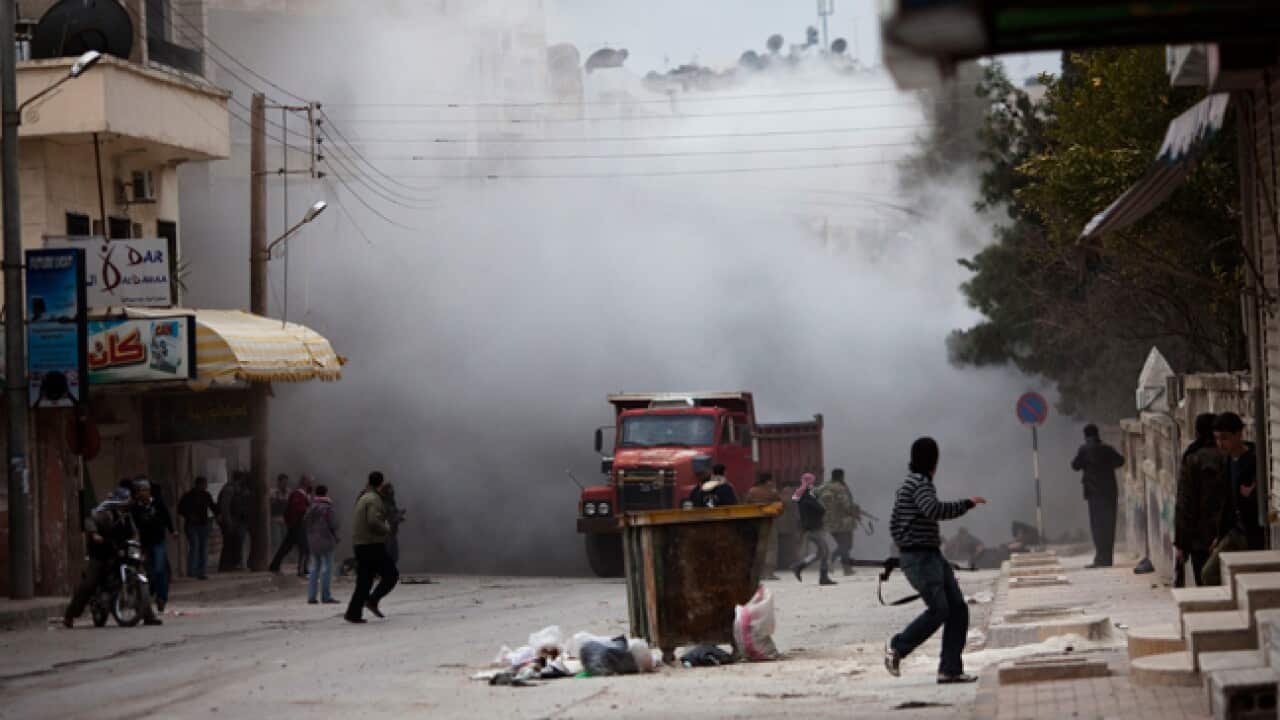
Fierce clashes between rebel troops and Syrian forces rocked a Damascus district bristling with security facilities on Monday, activists said, even as the capital was reeling from deadly weekend bombings.
The fighting, the heaviest in Damascus since a revolt against President Bashar al-Assad's regime erupted a year ago, comes as a mission sent by UN-Arab League special envoy Kofi Annan was headed to Syria for talks on a monitoring operation to end the bloodshed.
Rami Abdel Rahman, head of the Syrian Observatory for Human Rights, said at least 18 security troops were wounded in the fighting that broke out before dawn in the upscale and heavily guarded Mazzeh neighbourhood of Damascus.
News that makes sense
Your trusted source for staying up-to-date with the world around you. Get free daily news updates and analysis, straight to your inbox.
"The clashes were the strongest and the closest to security installations in the capital since the outbreak of the revolt a year ago," Abdel Rahman told AFP.
He said that by 4:00 am (0200 GMT) the fighting had ebbed.
Mourtada Rasheed, an activist in Damascus, said blasts and heavy shooting could be heard in Mazzeh as well as two other districts, Qaboon and Arbeen.
"We woke up at 3:00 am (0100 GMT) to the sound of heavy machinegun fire and rocket propelled grenades (RPG)," said one resident of Qaboon who did not wish to be identified.
"The fighting lasted about 10 minutes, then eased before starting again," he said.
A resident of Mazzeh said locals were terrified by the sound of gunfire.
"We were very scared but now the roads are clear and stores are open for business," she told AFP.
Rasheed said the fighting was the result of a hit-and-run operation launched in Mazzeh by the rebel Free Syrian Army to ease pressure on other regions targeted by regime forces.
"The rebels move in civilian clothes and work with army soldiers who wish to defect and who help them organise operations," he said.
Monday's clashes came after twin car bombs ripped through two neighbourhoods of Damascus on Saturday killing 27 people according to the Syrian interior ministry.
Another car bomb exploded on Sunday in a residential neighbourhood of Aleppo, Syria's second city and commercial hub, killing two people.
Syrian President Bashar al-Assad enjoys a strong support base in Damascus and Aleppo, both of which had so far been largely spared the unrest shaking the country since the revolt against the regime began last March.
More than 9,100 people have been killed in the fierce government crackdown to crush the uprising, according to the Britain-based Observatory.
The regime has consistently blamed the unrest on foreign-backed "armed terrorist gangs" and has pressed its crackdown despite a chorus of international condemnation.
On the diplomatic front, former UN chief Annan, who met Assad in Damascus earlier this month, has ordered a team of experts to Syria to discuss a possible ceasefire and an international monitoring mission, his spokesman said.
His team would head to Damascus from New York and Geneva on Monday.
On the ground, technical experts from the UN and Organisation of Islamic Cooperation were on Monday working in Syria to assess the humanitarian impact of the regime's deadly crackdown on the protests.
"The joint OIC-UN mission entered Syria on Friday to carry out an evaluation of humanitarian aid," on a mission led by the Syrian government, OIC assistant secretary general Atta al-Mannan Bakhit told AFP.
The mission, with three OIC experts in the team, would cover 15 cities, he added. It would submit a report to the Saudi-based Islamic grouping and the United Nations on the humanitarian needs of the Syrian population.
UN humanitarian chief Valerie Amos, who held talks in Damascus earlier this month, has said the experts would join the assessment mission to Daraa, Homs, Hama, Tartus, Latakia, Aleppo, Deir Ezzor and rural zones around Damascus.
In parallel with the mission, Jakob Kellenberger, president of the International Committee of the Red Cross, flew to Moscow for talks Monday with Russian Foreign Minister Sergei Lavrov on the "extremely difficult" humanitarian situation in Syria's protest centres.
"A daily ceasefire of at least two hours is imperative to allow the evacuation of the wounded," he said ahead of the mission to Moscow, an ally of Damascus which is seen as having some influence on Syria's leadership.







