(Transcript from World News Radio)
Some of the world's most precious artefacts and monuments are at risk in an area of Syria widely considered the cradle of civilisation.
Islamic State extremists have seized almost full control of the ancient town of Palmyra after Syrian government defence lines there collapsed.
News that makes sense
Your trusted source for staying up-to-date with the world around you. Get free daily news updates and analysis, straight to your inbox.
Activists say it remains unclear how close to the famed archaeological site the extremists have advanced, but Syrian state TV says pro-government forces have withdrawn from the city.
Darren Mara reports.
An amateur photographer captures gunfire and smoke - purportedly rising over Palmyra in central Syria.
The reported fall of the town to the self-proclaimed Islamic State is a stunning defeat for President Bashar al-Assad's forces.
Speaking to the BBC, a local who's identified himself as Omar Hanza says he witnessed the takeover of Palmyra by IS fighters days after their assault began.
(translated) "The regime has lost control of the main hospital in the west of the city. Islamic state has taken over the hospital and large parts of the West. IS also took over the north of Palmyra completely. The clashes are at the heaviest between I-S and the regime. You can't see any civilians on the streets. But many of the civilians don't have shelter, so they use schools as shelters."
Palmyra is potentially an enormous loss to the Syrian government, not only because of the cultural significance of the ruins on its outskirts.
It also sits on the main route between IS's stronghold in the country's northeast and the capital, Damascus.
The city is home to around 100,000 people and is surrounded by gas field and includes Syria's infamous Tadmor prison, a military airport and a weapons depot.
This Syrian government soldier describes the IS assault on Palmyra and the threat to the region.
"The IS militants have tanks, mortars, missiles, and heavy machine guns. Their weapons are advanced. They launched the attack from many directions, with each group consisting of a dozen to some 30 people. They attacked our soldiers at the outposts, and some residents. They bombed these places and made them their posts. They even used civilians as shields. Now they are hiding in Palmyra and nearby areas."
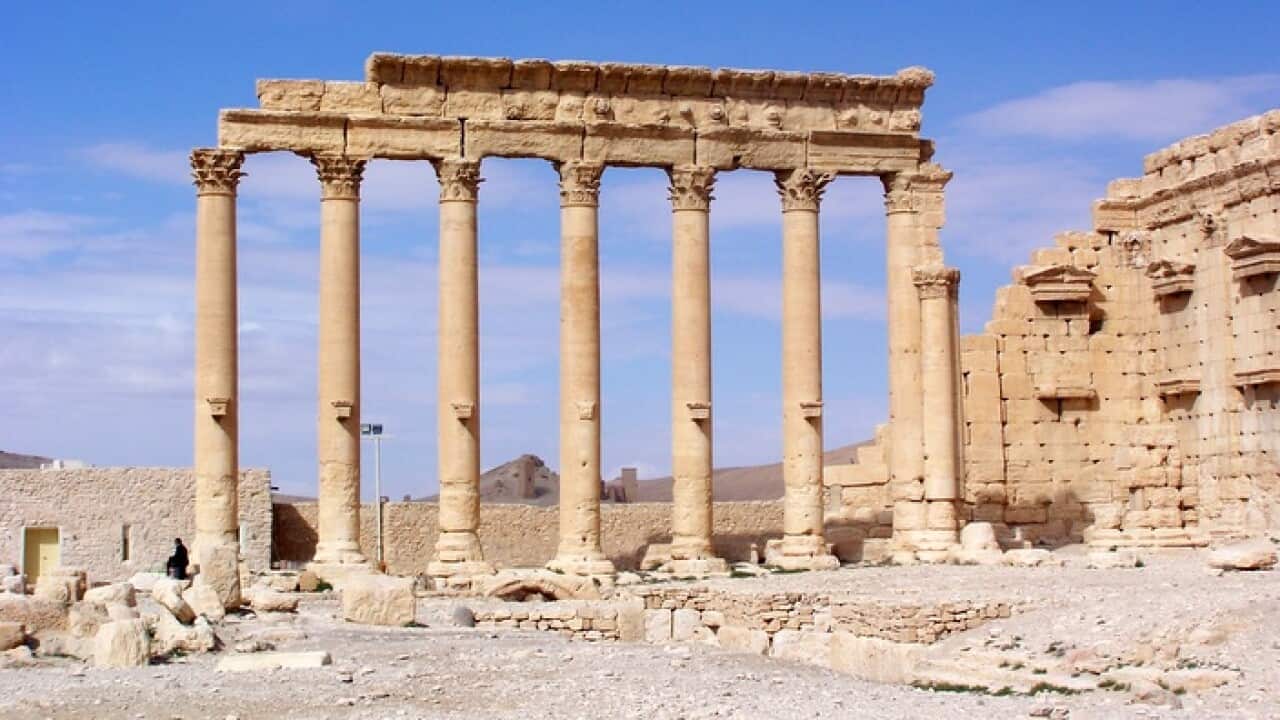
Palmyra is home to a UNESCO World Heritage site and there are fears the militants would destroy the ancient ruins if they took control of them.
Settlement in the lands around Palmyra goes back to the Neolithic period.
The city is mentioned in the Hebrew Bible and was eventually incorporated into the Roman Empire, before passing to almost all empires to have operated in the region over the last 2,000 years.
Ancient Palmyrene art, monuments, temples, cemeteries and statues are among Syria's - and the world's - most treasured artefacts.
Syrian Interior Minister Mohamad Al-Shaar says hundreds of statues were moved from Palmyra to pre-empt the IS takeover.
(translated) "We will make all possible efforts to maintain this large stock (of antiquities) and we will give this the greatest importance because, as we said, this is the inheritance for the nation and for humanity."
The ruins at Palmyra had already been placed on the UNESCO World Heritage 'in danger' list in 2013.
Dr Steven Bourke is an archaeology researcher at the University of Sydney who's led multiple ongoing excavations at historic sites in the Middle East.
He says the new risk to one of the ancient world's most culturally significant sites cannot be understated.
"Well, it's catastrophic, it's our history, it's the history of all humankind that's at risk here. It's the history of the peoples of the Middle East, it's the history of the Arab peoples, it would be the pre-history of the state that's trying to form itself in that area, it's to understand where people came from, how they developed into who they were, what are the major key advances, when did they occur and how we got to be who we are. So, Palmyra has material bearing on all of those questions."







