

(Transcript from SBS World News Radio)
The pro-democracy protests in Hong Kong are drawing close attention around the world, but nowhere is that attention more intent than in Taiwan.
Taiwan is a self-governing democracy.
But China's ruling Communist Party has long wanted to bring the island back under its control -- under the same "one country, two systems" arrangement in place in Hong Kong.
Taiwan has run its own affairs since the 1940s, and Taiwanese who like it that way say the protests highlight the dangers of closer relations with the government in Beijing.
News that makes sense
Your trusted source for staying up-to-date with the world around you. Get free daily news updates and analysis, straight to your inbox.
Greg Dyett reports.
(Click on the audio tab above to hear the full report)
Just a day before tens of thousands of protesters started their action in Hong Kong, China's President Xi Jinping suggested Taiwan should join his country.
China specialist Thomas Bartlett, at Stanford University in the United States, says the Taiwanese leadership was quick to reject the idea.
"The real significance of this is not only for Hong Kong, but for Taiwan, and the same slogan was put out toward Taiwan, so-called 'one country, two systems,' and now we're seeing in Hong Kong the drama that's working itself out. And I thought it was very interesting that the president of Taiwan, just within the last day or two, made a very clear and explicit statement that this would not be acceptable for Taiwan."
Professor Jocelyn Chey was Australia's consul general in Hong Kong from 1992 to 1995.
She says the government in Beijing wants its "one country, two systems" model to work especially because of its intentions towards Taiwan.
"It is Beijing's hope and, in fact, intention that, ultimately, there will be a reunification with Taiwan. And they want to apply the same formula of one country, two systems to that, to the relations with Taiwan. So, if they can get it to work in the case of Hong Kong, then they have more hope of getting Taiwan people to accept it. If it's shown this time to be unworkable, then it's certainly going to make things much more difficult in their negotiations with Taiwan."
Thomas Bartlett, from Stanford, says there is a wide range of opinion in Taiwan right now about reunification.
That includes, he says, many who are undecided.
"Some people are, more or less, eager for what they call reunification -- that is, for Taiwan to be brought under control of mainland China. Other people don't want that, at all. And then there are people who aren't quite sure, maybe just want to put off a decision until another time. So I think there are a variety of responses, and it's going to be an interesting process to see how those responses are expressed as the Hong Kong drama works out."
Dr Mark Harrison, from the University of Tasmania, says what is happening on the streets of Hong Kong mirrors similar protests by student demonstrators in Taiwan.
Those demonstrators have galvanised in recent years.
Known as the Sunflower Movement, they occupied a chamber of Taiwan's parliament in March and April to protest against a trade deal with mainland China.
"A lot of what the protesters in Hong Kong are doing is actually learning from the Sunflower Movement and some of the movements that came before that. An era of student activism in Taiwan really kicked off in 2008 and then intensified in 2012, and then, in many ways, it culminated in the Sunflower Movement. But the Taiwanese student activists developed a whole array of protest practices, using social media and direct action and branding and all kinds of things, a really, really powerful set of practices, for their politics. And I think we're seeing that in the Hong Kong protest, as well. So that's part of the dialogue."
Protesters from Hong Kong joined the occupation in Taiwan's capital Taipei, and now Tawainese students are voicing support for the Hong Kong protesters.
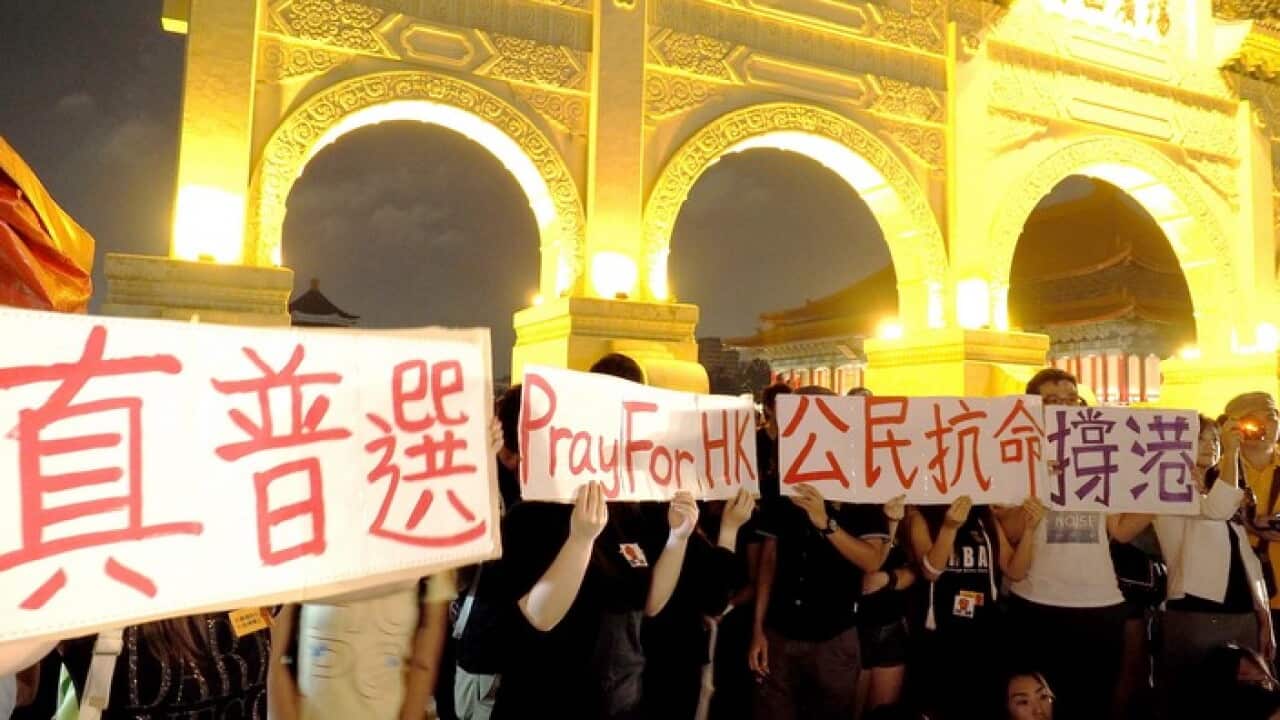
Around two thousand people gathered in Taiwan's Liberty Square to show their support for the protesters in Hong Kong.
Taiwanese students like 19 year old Liu Po Chun say they are keen to show solidarity.
(Translated)"When I saw people from Hong Kong in Taiwan who are so sad but they can't go back to Hong Kong to give their support to them -- the protesters -- I thought we should give them some support and strength. They are in a foreign country. So we are here to let them know they're not alone and that the Taiwanese are with them."
And Mark Harrison, from the University of Tasmania, says all that serves to undermine those in Taiwan who want closer ties with mainland China.
"I think what the protests in Hong Kong do, though, is they undermine the other side of politics, the side of politics in Taiwan that's encouraging closer and closer links to China and makes very reassuring statements about the implications of those links. But the situation in Hong Kong really undermines their argument that China is a benign power, as far as Taiwan is concerned. So it gives the pro-independence, or the green side, of politics in Taiwan a lot of ammunition."