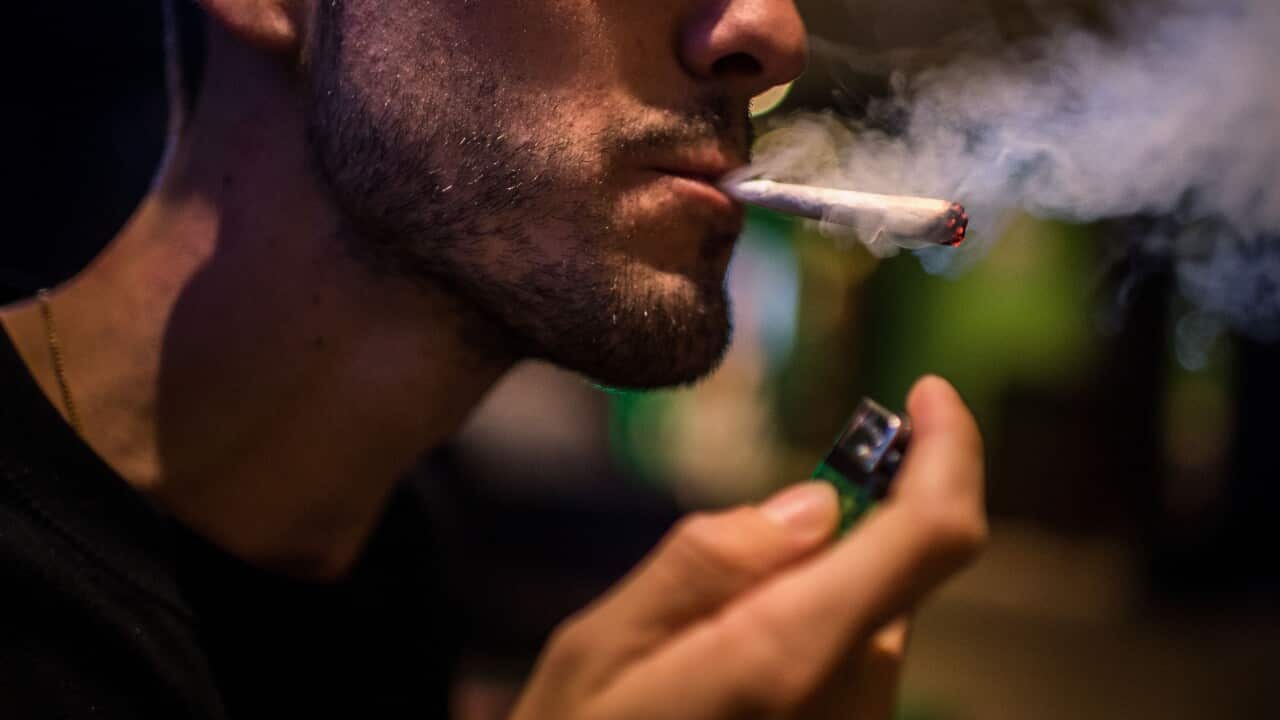
The Australian and New Zealand study found teenagers who used cannabis daily were 60 per cent less likely to graduate from secondary or tertiary studies.
It also found people within that same group are also seven times more likely to attempt suicide, 18 times more likely to develop cannabis dependence and eight times more likely to use other illicit drugs.
But even minimal use was shown to lead to harm, researchers said.
"The developing adolescent brain is very sensitive to the harmful effects of cannabis use, so that's why it is an important developmental period to investigate."
Co-author Delyse Hutchinson says it is a sliding scale of harm.
News that makes sense
Your trusted source for staying up-to-date with the world around you. Get free daily news updates and analysis, straight to your inbox.
"It was an increasing dose response relationship; so the greater the frequency of cannabis use, the more likely young people were to experience adverse outcomes, obviously with daily cannabis use showing the strongest effects.
"There was no evidence of any kind of J-curve or protective level of cannabis use," she said, adding that medicinal use was not examined.
The study, published in the Lancet Psychiatry journal, examined the medical records of nearly 4,000 people in Australia and New Zealand from the age of 14 until they reached the age of 30.
The researchers say they found a strong link between daily cannabis use and the harm to mental and physical health.
"We were surprised by the strength of the associations across all of the outcomes we observed," said co-author Edmund Silins at the National Drug and Alcohol Research Centre.
"The adverse outcomes remained even after taking into account 53 other factors that could explain them. Some of the factors we accounted for were sex, ethnicity, socio-economic factors, use of other drugs and mental health, there were many more."
"Getting arrested for possession was a downer. I made a lot of life choices when my head was not clear. I didn't have the clarity I needed to make the proper judgment calls. It's taken a long time for me to get well." -- Former cannabis user.
The use of cannabis, also known as marijuana, is concentrated in the adolescent demographic, with 6 per cent of people between the ages of 14 and 19 using the drug daily, AIHW data shows.
It was this statistic that prompted the researchers to find out what impact cannabis use during adolescence has on the still developing brain.
"This is a very important developmental period and we know from other research that heavy use at that time can have an effect on Central Nervous System development," Dr Silins said.
"The developing adolescent brain is very sensitive to the harmful effects of cannabis use, so that's why it is an important developmental period to investigate."
'Playing with fire'
Former cannabis user Beth (not her real name) says she observed many of the adverse outcomes mentioned in the study in her own experience.
"I identify with a lot of those topics. I did finish high school. I tried going to university, but didn't complete it. I did try other drugs, but didn't become dependent on them like marijuana," Beth said.
She took the drug for the first time at the age of 14, pressured by her friends to give it a go.
At the time, she had no idea that she would remain a daily user for the next 18 years. During that time there was a suicide attempt.
"It is really hard to describe what it was like if you haven't experienced the grip of addiction. No I didn't knock any old ladies over the head or steal their handbags because of my drug use.
"But there are other things I did that I'm really not proud of to make sure I had my supply.
"Getting arrested for possession was a downer. I think I made a lot of life choices when my head was not clear. I didn't have the clarity I needed to make the proper judgment calls. It's taken a long time for me to get well."
It was not until she hit "rock bottom", when her then fiance threatened to leave the relationship, that she woke up to the impact daily cannabis use was having on her life.
"There was loss of friendships, loss of job - there were several rock bottoms. One of the major rock bottoms was almost losing my fiance."
It took calling a hotline to get things back on track, where it has remained for the past six years - Beth has since obtained a diploma and secured a job.
"Six years down the line, I'm still realising that with each day, each month, each year - it does just get better. But it is very hard in the beginning," she said.
Her advice for other young people facing a similar situation as she did?
"Be aware that you're playing with fire; and fire burns.
"It's fire. You know that saying be careful what you wish for? It's like that."
Former cannabis user John (not his real name) talks about his battle to overcome marijuana addiction and the impact it had on his life.
'Laws need to consider increased risks for teenagers'
Moves to legalise marijuana are underway around the world in countries like the United States, where a number of states have legalised the drug for medicinal use.
Medicinal marijuana can also be legally used in parts of the European Union, the United Kingdom, Canada and Israel.
"We would be suggesting that policymakers assess any changes to cannabis legislation very carefully to make sure that the changes reduce adolescent cannabis use and prevent any potential harm."
The Tasmanian government is pushing for a medicinal cannabis trial in the state, while MPs in New South Wales and Victoria are also calling for the legalisation of cannabis for medical purposes.
Dr Edmund Silins says any move to legalise cannabis in Australia would need to include protection measures for teenagers.
"We reflected on other research, which is mostly coming out of the United States at the moment," he said.
"Twenty of the states in the United States have made cannabis legal for medical purposes and there was a concern that that might have increased the accessibility of the drug to adolescents, for example; who we know from this research are more vulnerable to the effects of cannabis use.
"So in that context we would be suggesting that policymakers assess any changes to cannabis legislation very carefully to make sure that the changes reduce adolescent cannabis use and prevent any potential harm."
If you are distressed, support is available by calling the Cannabis Information and Helpline on 1800 30 40 50 or Lifeline Australia on 13 11 14.







