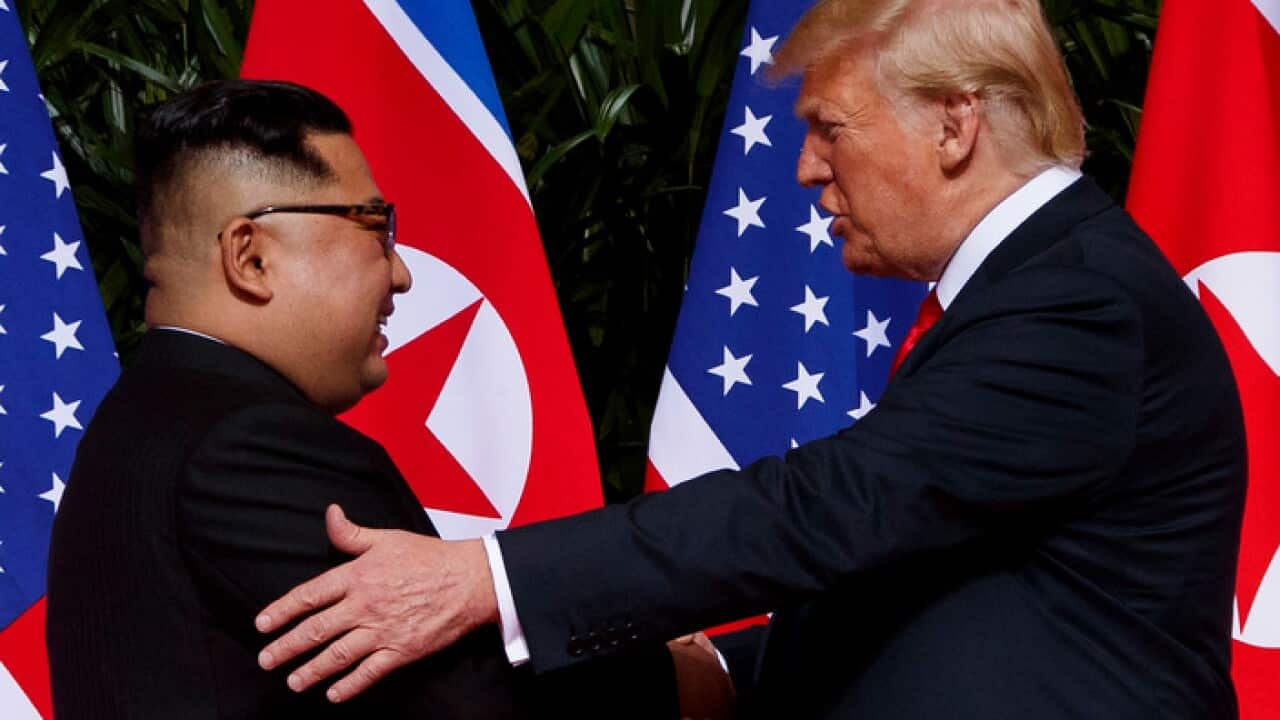
After flying back to Washington last week, giddy with success, the US leader tweeted "There is no longer a Nuclear Threat from North Korea" -- a bold claim with Kim's arsenal still in place.
But senior US officials admit there is much work to be done as negotiators thrash out the details of what they hope will be Pyongyang "complete, verifiable and irreversible" disarmament.
Many observers were disappointed that the short statement of intent signed by the two leaders was not more clear on the definition of denuclearization, fearing Kim plans to keep his hard-won deterrent.
News that makes sense
Your trusted source for staying up-to-date with the world around you. Get free daily news updates and analysis, straight to your inbox.
Secretary of State Mike Pompeo angrily insists that the term "complete" in the document "encompasses" the concept that the denuclearization will be "verifiable and irreversible."
Trump has gone further, claiming on June 12 that the process will start very quickly, then on June 21 confusing the issue: "It will be a total denuclearization, which is already taking place."
Pompeo has been only marginally more cautious.
On June 13, he said "We believe that Kim Jong Un understands the urgency ... that we must do this quickly" and added that he hopes for "major disarmament" with two-and-a-half years.
So far, however, this confidence rests solely on trust in the assurances that Kim gave Trump at the summit, and his reported promise to China to "implement the summit's consensus step by step."
When Pompeo said of Kim's pledge, "I was there when he said it. He made a personal commitment. He has his reputation on the line," Thomas Wright, a senior fellow at Brookings, was scathing.
"This is one of the most naive statements ever made by an American diplomat," Wright wrote on Twitter. "I hope he is trying to mislead us because it would be truly frightening if he believed it."
Abraham Denmark of the Wilson Center warned a congressional hearing: "Considering North Korea's repeated history of violating past agreements, there is little reason to trust them this time."
And, despite his professed faith in Kim's word, Pompeo knows he has work to do to establish a roadmap towards concrete steps and that he will have to speak to Kim again, probably in Pyongyang.
Highlighting this apparent gap between Trump's rhetoric and facts on the ground, the administration Friday cited the "unusual and extraordinary threat" from North Korea's nuclear arsenal to extend decade-old sanctions on Kim's regime in a statement to Congress.
War games
"There's a lot of work between here and there. My team is already doing it. I'll likely travel back before too terribly long," Pompeo said on Monday, without setting a travel date.
Pompeo's spokeswoman Heather Nauert has said she will not provide details of the negotiations, warning reporters the process "can be difficult when we're distracted by all of the questions going on."
But she denied that the talks were at a dead halt, even if the detailed negotiations have yet to begin.
"We have been in communication with the Government of North Korea," she said on Thursday.
"Secretary Pompeo will be meeting with them and talking with them at the earliest possible date to try to implement the outcomes of the US-DPRK summit."
While Pompeo pushes on with follow up talks, Trump appears happy to celebrate the summit as a success, as if the joint statement itself marked a beginning to the end of Kim's nuclear program.
He claims he has already received "good news" and on Thursday declared that the North has "already blown up one of their big test sites. In fact, it was actually four of their big test sites."
But the North Korean test site at Punggye-ri was demolished in late May, weeks before the summit, and there does not appear to have been any disarmament activity since then despite Trump's boast.
Defense Secretary Jim Mattis, who has been ordered by Trump to unilaterally halt "provocative" US war games in South Korea, was cautious when asked whether the North had indeed begun to disarm.







