

Thailand's army chief has imposed martial law after months of deadly anti-government protests caused political paralysis, but insists the intervention does not amount to a military coup.
Troops fanned out after martial law was declared in a dawn broadcast on Tuesday, as General Prayut Chan-O-Cha exploited century-old legislation that confers far-reaching powers on the military to act in an emergency.
But he left the caretaker civilian government in office and invited the country's warring political factions to sit down for talks, as the United States, Japan and Southeast Asian neighbours urged Thailand to stay on a democratic track and resolve its differences peacefully.
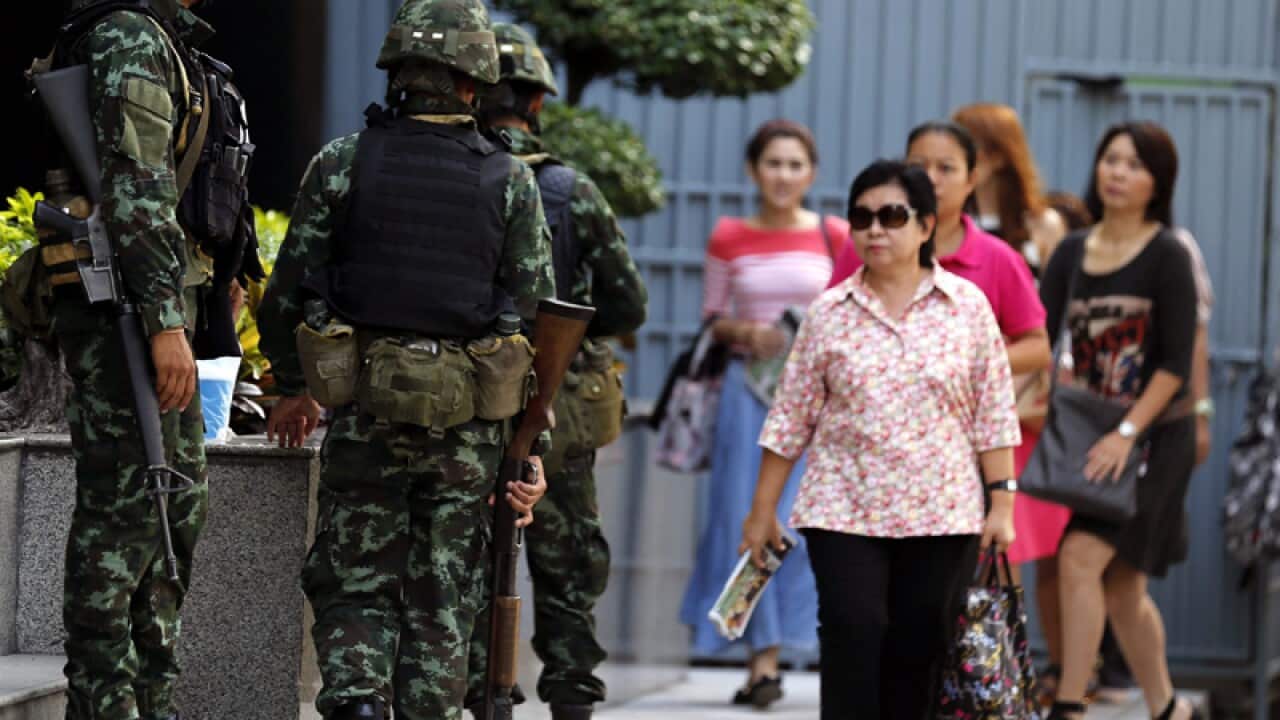
Soldiers and military vehicles were seen in the heart of the capital's retail and hotel district. Troops were also positioned at TV stations where broadcasts were suspended under sweeping censorship orders, although regular Thais appeared largely unfazed.
The dismissal of prime minister Yingluck Shinawatra earlier this month in a controversial court ruling has stoked tensions in the kingdom, which has endured years of political turmoil.
News that makes sense
Your trusted source for staying up-to-date with the world around you. Get free daily news updates and analysis, straight to your inbox.
"Red Shirt" supporters of Yingluck and her brother Thaksin Shinawatra, who was deposed as premier in a 2006 coup, have warned of the threat of civil war if power is handed to an unelected leader, as the opposition demands.
Thaksin, who lives abroad to avoid a jail term for corruption, said on Twitter that the imposition of martial law was "expected" but must not "destroy" democracy.
The backdrop is a nearly decade-long struggle pitting a royalist establishment - backed by parts of the military, judiciary and Bangkok-based elite - against Thaksin's billionaire family, which has traditionally enjoyed strong support among poor and rural voters in the north.
New York-based Human Rights Watch branded the imposition of martial law a "de facto coup", voicing alarm at the impact on freedom of expression.
But the government officially remained in office, and General Prayut presented himself as a mediator.
"We are in the process of inviting both sides to talk but at the minute the situation is still not normal... that's why I have had to invoke martial law," he told reporters.
"The military will not tolerate any more loss of lives."
Prime Minister Niwattumrong Boonsongpaisan, who replaced Yingluck, urged the army to act within the "constitution", urging the generals to "follow a peaceful path".
Martial law allows the army to ban public gatherings, restrict people's movements, conduct searches, impose curfews and detain suspects for up to seven days.
The US, a key ally of Thailand, said martial law must be "temporary" and urged all parties "to respect democratic principles".
Japan, whose companies have some of the biggest foreign investment in Thailand, also expressed "grave concerns" at the unfolding crisis.
The imposition of martial law comes after nearly seven months of protests that have left 28 people dead and hundreds wounded.
"This is not a coup," the early morning broadcast said. "The public do not need to panic but can still live their lives as normal."
But concerns a military takeover was under way were fuelled by the troop presence and the censorship of media in the interests of "national security".
"I think what we are looking at is a prelude to a coup. That is for sure. It is all part of a plot to create a situation of ungovernability to legitimise this move by the army," said Pavin Chachavalpongpun from the Centre for Southeast Asian Studies at Japan's Kyoto University.