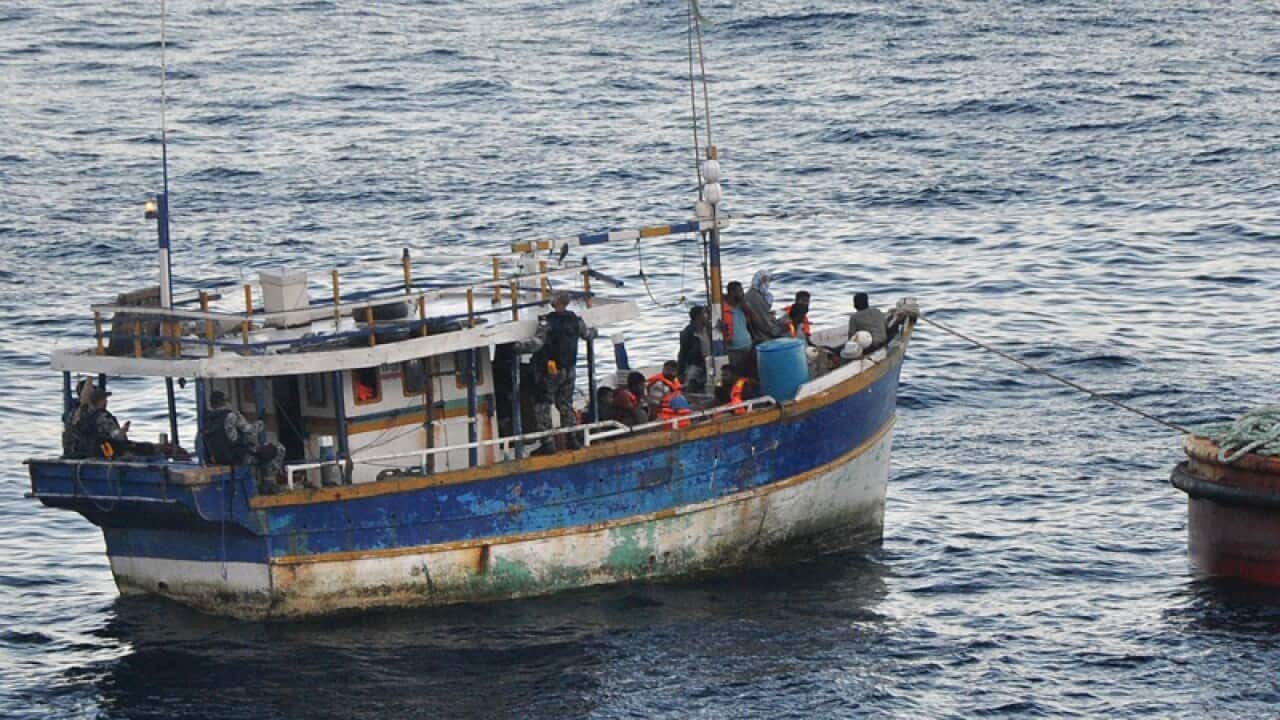
The public debate on asylum seekers has been focusing on boat arrivals, but government figures show that the large majority of asylum applicants arrive by plane.
The information is contained in a Federal Parliament background note on boat arrivals.
"The majority of onshore asylum seekers actually arrive in Australia by air with a valid visa and then apply for onshore protection through Australia's humanitarian program at some stage after their arrival," the note, authored by Jane Phillips said -- referring to figures issued by the Department of Immigration.
RELATED: Dept. Immigration - Monthly Detention Snapshot, May 2009
Most of these applicants receive a bridging visa upon lodging a protection visa application.
News that makes sense
Your trusted source for staying up-to-date with the world around you. Get free daily news updates and analysis, straight to your inbox.
In most cases, the bridging visa allows the applicant to remain lawfully in the community until the protection visa application is finalised.
Boat people 'usually genuine refugees'
Ms Phillips says those who arrive by boat, in any country, are more likely to be accepted as genuine refugees than those who fly.
Of the boat arrivals, past figures showed between 70 and 97 per cent were later found to be genuine refugees.
The majority arriving by plane were not found to be refugees, the report said.
Most people in detention visa over-stayers
Detention is mandated for all unlawful non-citizens in Australia.
Over much of the past two decades people in immigration detention have predominantly been visa over-stayers, unauthorised air arrivals, and those whose visa has been cancelled, rather than those who have arrived unauthorised by boat, the paper said.
Australia's refugee resettlement program
The UNHCR's '2009 Global Trends' report published in September 2010 says Australia is performing creditably in refugee resettlement, with 11,080 refugees resettled from other nations in 2008-2009, making up 9.9 per cent of the global total of 112,442.
The United States alone received 71 per cent of all refugees resettled in 2009 (79,937).
But only 0.5 per cent of the 1.18 million new global asylum applications were lodged in Australia in 2009, the UN report adds.
This means Australia is ranked 47th in the world as a refugee host country, granting visas to 22,548 refugees between 2005 and 2009 (0.2 per cent of the global total).
Australian asylum seekers system
So, how does Australia process its asylum seekers claims?
Australia takes in refugees through its Refugee and Humanitarian Program.
The program consists of the Onshore Protection and Offshore Resettlement programs.
Onshore protection
The Onshore Protection program is for people who are already in Australia -- lawfully or unlawfully-- and who have made an application for refugee status.
If found to be owed protection, these applicants will be granted a permanent protection visa, provided they meet health and character requirements.
Where an application by a person in Australia is refused, that person can seek a merit review of that decision from an independent tribunal - either the Refugee Review Tribunal or the Administrative Appeals Tribunal, depending on the basis for refusal.
Offshore resettlement
But the majority of refugees in Australia have been and are resettled from other countries through Australia's offshore humanitarian resettlement program.
The offshore resettlement program is divided in two categories.
Refugee: for people who are subject to persecution in their home country, who are typically outside their home country, and are in need of resettlement. These applicants are usually identified and referred by the UNHCR to Australia for resettlement.
Special Humanitarian Program (SHP) for people outside their home country who are subject to substantial discrimination amounting to gross violation of human rights in their home country.
An Australian citizen, permanent resident or eligible New Zealand citizen, or an organisation that is based in Australia, must support applications for entry under the SHP.
Most visas granted under offshore program
In 2008–09 a total of 13,507 visas were granted, of which 11,010 visas were granted under the offshore component and 2497 visas were granted under the onshore component.
In May 2008 the Government announced an increase in the Humanitarian Program to 13,750 places for 2009–10.
The Refugee category for 2009-2010 was set at 6000 places and the remaining 7750 places were made available under the SHP category and for onshore protection needs.
In 2008-2009, most offshore visas were given to asylum seekers from Iraq (2874), Burma (2412), Afghanistan (847), Sudan (631), Bhutan (616), Ethiopia (478), Congo DRC (463), Somalia (456), Liberia (387), Sierra Leone (363).
Detention Centres
There are different categories of detention centres in Australia.
Immigration Detention Centres (IDCs) mainly accommodate over-stayers, people in breach of their visa conditions, or people refused entry at Australia's international airports.
Offshore facilities cater for unauthorised boat arrivals. These are Villawood IDC, Maribyrnong IDC, Perth IDC and Christmas Island IDC.
Curtin is classified as an Immigration Reception and Processing Centre (IRPs) and is primarily used for unauthorised boat arrivals.
Curtin was re-opened in June by the Rudd Government, and is being used to house Afghan and Sri Lankan people who have had their refugee applications suspended.
Due to the increased number of asylum seekers arriving by boat in 2010, and to reduce the overcrowding at the Christmas Island IDC, last June the Rudd Government relocated around 90 asylum seekers to a disused mining camp in Leonora in Western Australia.
In October last year, Prime Minister Julia Gillard announced that changes would be made to Australia's mandatory detention policy, and that more children and families would be moved out of immigration detention centres into community-based accommodation, such as centres run by churches and charities.
In addition to these changes, the federal government announced that they would open two new detention centres – one in Northam, 80 kilometres north-east of Perth, and another at Inverbrackie, 37 kilometres north of Adelaide.







