
By Michelle Smith, Deakin University

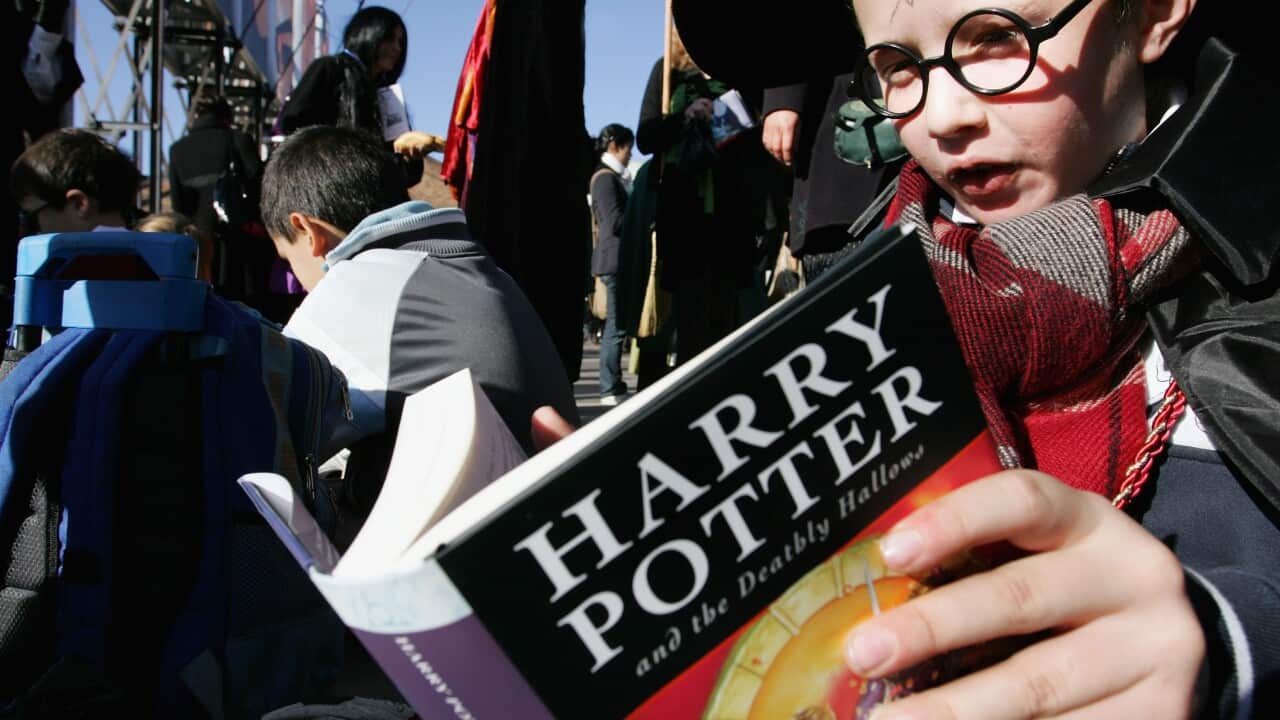
The invisible diversity of Harry Potter Joya Wu/Flickr
Who owns a story? When an author writes a book, are the words on the page the definitive version of the plot and characters? Does what the author have to say outside the world of the book have the power to add to the meaning of the book itself?
In response to a question from a Jewish fan, J.K. Rowling recently explained on Twitter that the Harry Potter series includes a Jewish wizard, Anthony Goldstein.
Goldstein’s name is recorded in an early notebook in which Rowling listed the original forty students whom she imagined attending Hogwarts School of Witchcraft and Wizardry. Within the series, however, he only appears as a minor character in the fifth and sixth novels.
Within the same Twitter question-and-answer session, Rowling also “revealed” that the school was similarly diverse in its inclusion of gay and lesbian students. She shared an image created by a Canadian LGBTQ organisation that reads, “If Harry Potter taught us anything, it’s that no one should live in a closet.”

Youth Project poster shared by J.K. Rowling on Twitter
Both Jewish and LGBTQ news sites have reported these brief comments by Rowling in positive terms. The Harry Potter series, which totals some 4,000 pages in US editions, did not give millions of readers any clear sense that Hogwarts was home to Jewish or gay and lesbian students. However, Rowling’s declarations on Twitter are not only newsworthy, but a cause for pride.
Similar feelings of celebration were evident when Rowling announced in 2007 that she had “always thought of [beloved headmaster Albus] Dumbledore as gay”. Likewise, very few people had gathered from the books themselves that Dumbledore was homosexual. Although subsequently his penchant for “plum velvet” and high-heeled boots were interpreted as clues to his sexual orientation.
With both of these announcements, some fans have also questioned whether these extra-textual announcements carry any weight. If it was not possible for readers to detect that a character was gay or Jewish then how could they possibly be considered as positive signs of increasing representation and inclusion of minority groups in popular culture?
Admittedly, there is an argument that attempts to depict a character as being of a particular race, sexuality or religion could appear tokenistic. Should Rowling, for example, have made more of Anthony Goldstein’s Jewish identity by mentioning his observance of Hanukkah, or need for kosher meals at banquets in the Hogwart’s Great Hall?
Nevertheless, depicting a character like Dumbledore as having fallen in love with a man as a matter of course could have done much to present gay and lesbian relationships as unremarkable. In an imagined world in which the supernatural is possible and the limitations of reality are few – something for which the books have been criticised by religious extremists – it speaks volumes that a gay relationship cannot be represented to the degree where it is discernable.

The Harry Potter series has had worldwide influence Hung Chieh Tsai/Flickr
To figure out to what degree Rowling’s comments should influence our interpretation of the highest-selling book series in history, we can turn to a standard idea within literary criticism.
In his 1967 essay “The Death of the Author”, French literary critic and theorist Roland Barthes challenged the traditional practice of analysing literature by focusing on the motivations and biography of a work’s author. Barthes argues that looking to the author for a text’s explanation not only limits it to a single meaning, but also denies the influence of other texts (intertextuality) and the responses of the reader in producing meaning.
Indeed, Barthes famously suggests that individual readers produce their own, different interpretations of the same texts, dismantling the idea of the author as the creator of a text’s definitive meaning. As Barthes describes the process of removing the author as the explanation of a text, “the birth of the reader must be at the cost of the death of the Author”.
Barthes and Michel Foucault, among others, contributed to changes in the study of literature under the umbrella of the poststructuralist movement. Scholars abandoned the search for a work’s “true meaning” – as imparted by the author – to marshalling a variety of critical approaches relating to gender, sexuality, and class, for example, to expose the shifting meanings of a given text.
When we study literature today, we are not interested in answering what we think an author truly “meant”, but what readers understand it to mean. We examine the words within a book, their interaction with other stories in all kinds of media, and their reflection of and influence upon the world in which they have been written.
If we approach Rowling’s Twitter comments armed with Barthes, we can say that what she “always thought” of a particular character, or whether she always imagined gay and lesbian students at Hogwarts are irrelevant to how we interpret the Harry Potter series.
Though the final Potter book was published in 2007, Rowling seems eager to retain an influence on how we understand her books by revealing ostensibly new information about her characters. Whether these character points were announced to readers via Twitter or alluded to within the Potter books, however, the meanings that we as a diverse international community of readers wish to take from them trump Rowling’s intentions as an author.

Michelle Smith does not work for, consult to, own shares in or receive funding from any company or organisation that would benefit from this article, and has no relevant affiliations.





