
When and where does the Tour de France begin?
The 101st Tour de France began on July 5th in Leeds in northern England.
It's not the first time the Grand Depart has taken place on foreign soil (the other frontrunner to host this year's start had been Barcelona).
This year, riders will cover 3,664 kilometres cycling through parts of the UK, Belgium, France and Spain.
The course is split up into 21 stages and riders will get two rest days during the race.
The stages are a mix of flat, hill and difficult mountain routes with one stage made up of individual time-trials.
Accordingly riders target different stages - flat suit the sprinters (green jersey) , steeper sections favour the climbers (polka dot jersey) while the overall winner of the race needs to be strong across all aspects (yellow jersey)
How do the teams work?
There are 22 teams made up of nine riders each.
Each team has a leader and the remaining riders are known as domestiques, which literally means 'servant' in French.
These riders are responsible for shielding the leader from attacks.
They also bring food and water from team cars and sometimes even sacrifice their bicycle in the case of a mechanical emergency.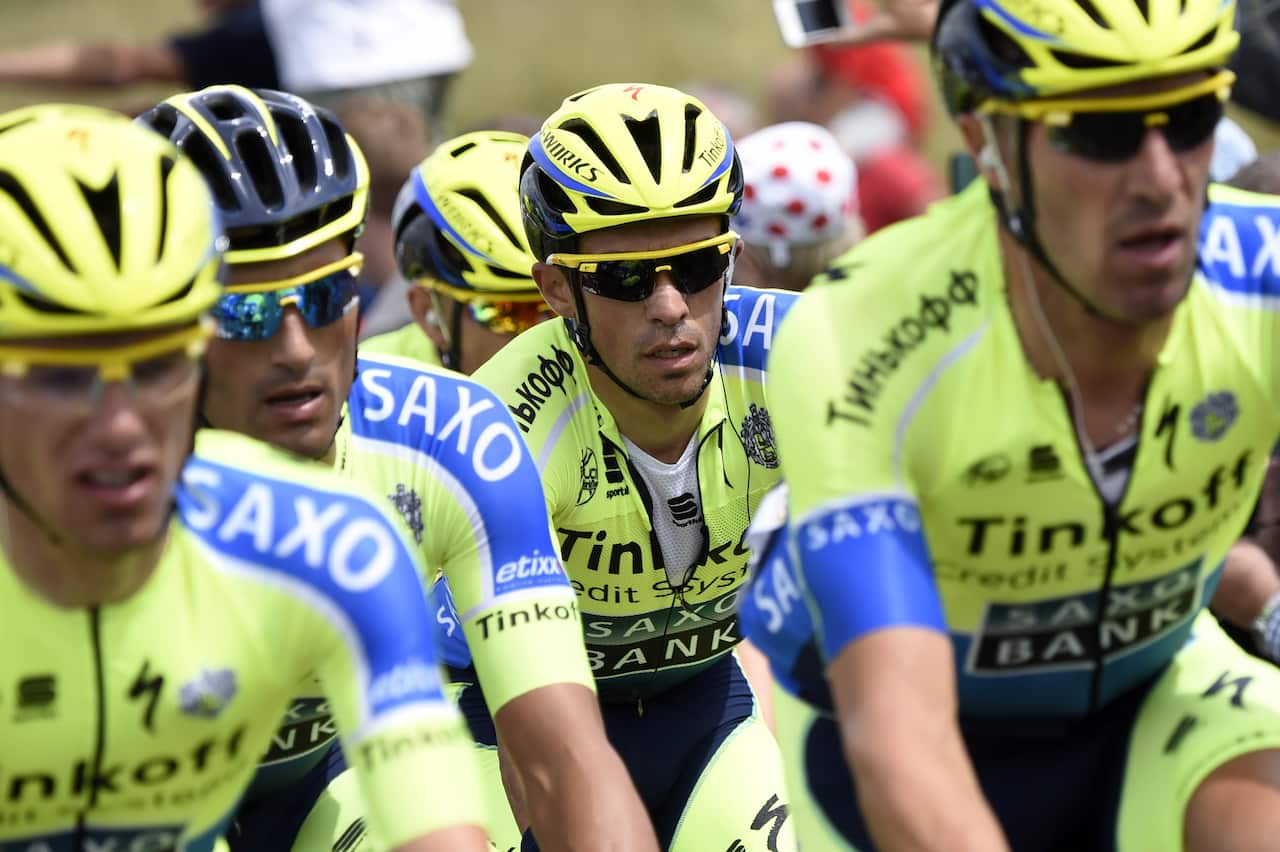
Spain's Alberto Contador (C) rides in the pack with his teammates of Russia's Tinkoff-Saxo cycling team during the 201 km second stage of the 101th edition of the Tour de France cycling race (AAP)
What do the different coloured jerseys mean?
The yellow jersey or maillot jaune is awarded to the person with the lowest combined overall time across the stages. It's the most prestigious of the jerseys.
The yellow jersey contenders don't have to win every stage. As long as the riders ahead of them are behind in the overall standings, they just have to concentrate on beating the other yellow jersey contenders. This category is best known as the "general classification"
The fastest sprinter is awarded the green jersey. Points are given to the first cyclists across the finish in each stage and in some stages, intermediate sprints.
The polka dot jersey is given to the best mountain climber. Points are awarded to riders who get to specific peaks first.
The white jersey is awarded to the best young rider under the age of 26.
Cofidis Procycling team rider Cyril Lemoine of France celebrates on the podium wearing the best climber's polka-dot jersey following the 3rd stage of the 101st edition of the Tour de France 2014 (AAP)
Who are the favourites to win?
British cyclist Chris Froome took home the yellow jersey last year, and is the favourite to do it again in 2014.
One of Froome's biggest threats is Spaniard Alberto Contador, who won the 2007 and 2009 Tour de France races.
Italian Vincenzo Nibali, nicknamed the Shark, is another favourite to win. He won the 2013 Giro d'Italia.
The overall winner recieves more than $650,000 AUD in prize money, while the winners of each stage recieve around $32,000.
There is also a substantial cheque for winners of the green, polka dot and white jerseys. That amount is about $30,000.
This prize money is often distributed amongst the teams - it is a combined effort after all.
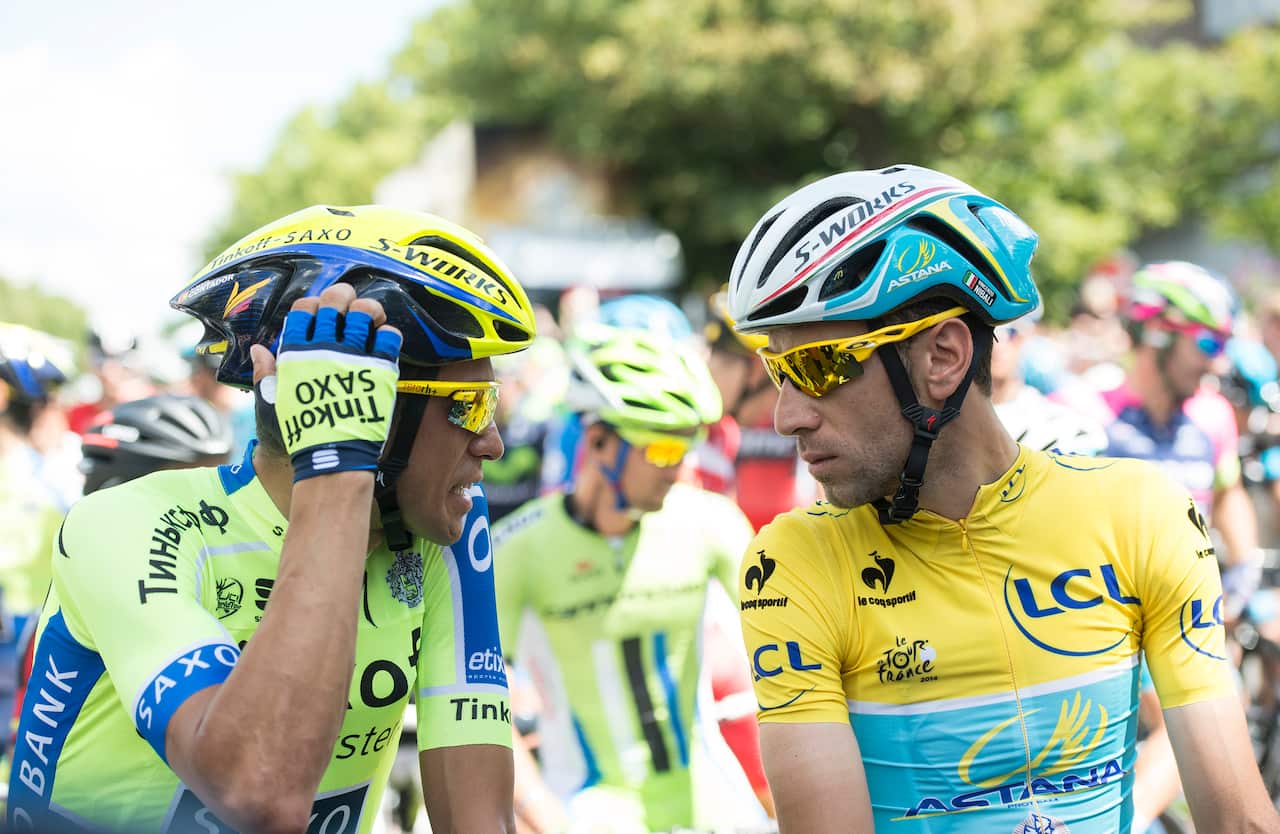
Vincenzo Nibali, Astana Pro Team, Alberto Contador, Tinkoff-Saxo, during stage three of the Tour de France. (AAP)
How can I read the score?
The winner of the yellow jersey isn't decided on points but time. The rider with the lowest time is winning the race.
Riders chasing the leader will be chasing a time gap.
How will the Aussies fare?
Unfortunately Australia's first, and to this date only, Tour de France Champion Cadel Evans is not racing. He is focussing on the Spanish Grand Tour.
And Australia's hopes were dealt another blow on race eve with the last minute withdrawal of Michael Matthews.
The Orica GreenEdge rider crashed in a ride before the Tour and was unable to make the start line.
In another cruel twist of fate, Australia's national champion Simon Gerrans was involved in a nasty tangle during stage one.
The Australian-licensed team Orica GreenEdge will be hard pressed to match last year's historic feat of capturing the yellow jersey for the opening stages of the TDF 2013.
There are many other riders who will fly the Australian flag. Chief among them is Tasmania's Richie Porte.
The Team Sky rider is a key member of defending champion Chris Froome's tilt at back-to-back wins. There is also Michael Rogers, he is playing a similar role for Tour contender Alberto Contador.
Australian Richie Porte with Team Sky teammate Chris Froome (AAP)
One of the shrewdest operators in the peloton (the field), Rogers, is also capable of winning stages on the alpine passes.
Mark Renshaw is probably another name to watch. He has long been a "lead out man" for the sprinters in his teams. An early injury to his team's speedster Mark Cavendish could see Renshaw wrestle for his own glory.
What's attacking mean and when do riders decide to do it?
The team who has the rider in yellow is ultimately responsible for controlling the tempo of the race.
Often in a stage there will be a small group of riders who make a breakaway from the main field.
If they are no threat to the overall lead, the yellow jersey wearer will let them go.
These riders will ultimately not be able to steal the overall honours but they could win a stage and get valuable publicity for their team.
Should a rider with a chance of wresting the yellow jersey from the grip of the current holder make an attack, or attempt to get in a breakaway, the team who holds the maillot jaunne will attempt to neutralise that move by ensuring the yellow jersey wearer is chased back into the front group. The race is hugely strategic in this way and riders themselves will often be racing under team instruction. So snap decisions (when to chase, when to let a rider go) will be made by a team director - who sits in a team car following the race and has radio communication with his team.
Chris Froome (L) of Team Sky leads the race as he attacks on the final climb and claims the points at the top of the Cote de Jenkins Road during stage two (Getty)
An unwritten rule of the race also outlines when not to attack.
If the man wearing the yellow jersey or a challenger for the leader's jersey has a mechanical issue it is considered poor form to launch an attack at that time.
How do the riders go to the bathroom?
When you are watching shots of beautiful scenery or ancient monuments it could be because the riders are taking a comfort stop.
Some stages can be more that six hours long - inevitably nature will call.
How can I watch?
This part is probably the easiest. SBS is the official broadcaster of the Tour de France in Australia.
All the stages will be shown live on SBS ONE or streamed live online. You can find the full broadcast schedule here.
The Cycling Central website is the hub of SBS's Tour de France coverage. Here you can find highlights, race reports, reactions, news and blogs from the Tour.
To stay across all the latest information, both on and off the course, you can follow Cycling Central on Facebook or Twitter or you can download the Tour Tracker app on your mobile or tablet device.
Share


