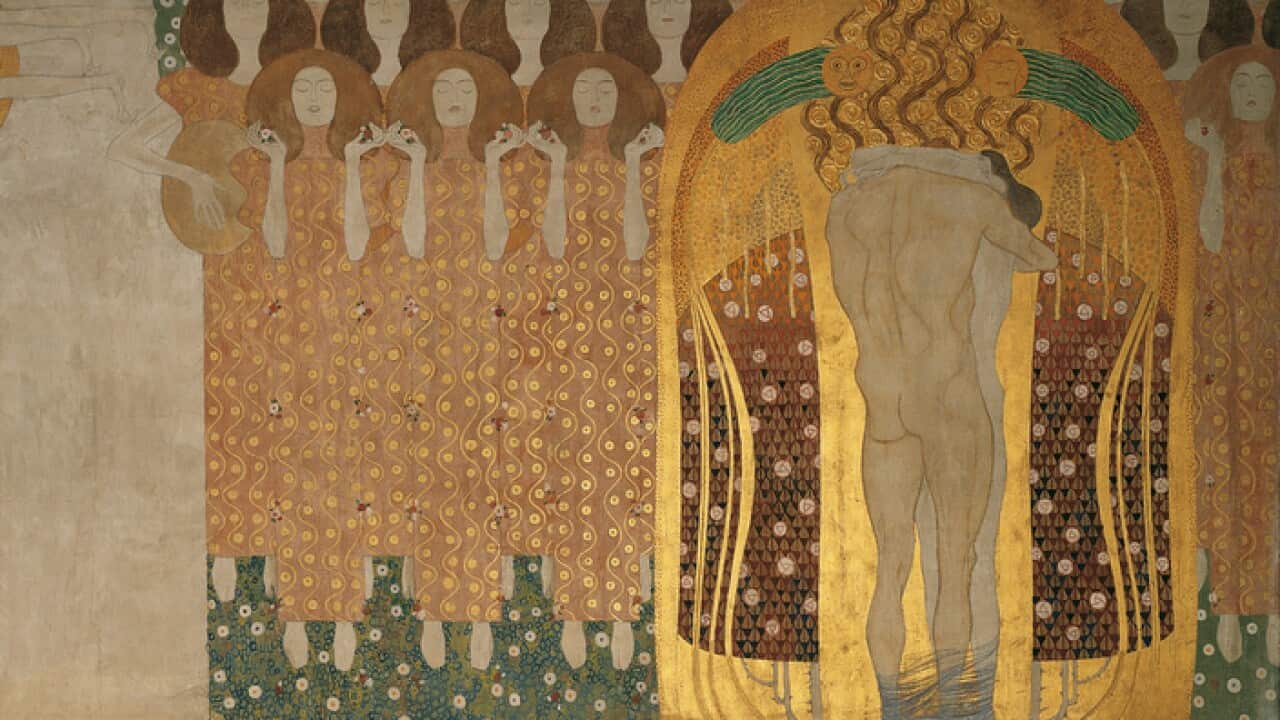
In 1902, Gustav Klimt painted the Beethoven Frieze onto the walls of Vienna's Secession building.
It was an artwork inspired by a work of art, which, in turn, was a tribute to the works of another artist Ludwig Van Beethoven.
The painting is one of the city's most visited and probably most valuable.
Now, its future ownership and location are uncertain.
Erich Lederer was a Jewish art collector who fled to Switzerland to escape the Holocaust.
News that makes sense
Your trusted source for staying up-to-date with the world around you. Get free daily news updates and analysis, straight to your inbox.
The Nazis confiscated his possessions, including the Beethoven Frieze.
After the Second World War, Austria returned the painting but imposed an export ban.
Eventually, Mr Lederer sold it to the Austrian state, but his heirs argue he sold under duress and below market price.
Restitution board chairman Clemens Jabloner gave this reason for the decision.
He is referring to events in 1972 when Austria purchased the painting from Erich Lederer.
"Because the federal chancellor declared that there are two possibilities, to give the export license or to keep the work of art for Austria, to buy the picture from Lederer. But he didn't use the export ban as a tool for forcing Lederer to sell it."
But one of Europe's most respected art historians and an expert on art looted in the Holocaust, Sophie Lilly, disagrees with the decision and the panel's justification.
"That's ridiculous, because, of course, Erich Lederer applied for an export license in 1967, and it was the decision then on the level of both the monuments office and also the ministry that he should not be given an immediate answer, that he should be referred to a very lengthy process. They were basically buying time."
Klimt prices have rocketed into territory once occupied only by the artists Picasso and Cézanne.
At an auction in 2006, his portrait of Adele Bloch-Bauer sold for $78-million.
One art expert says the Beethoven Frieze would be worth at least 200 million.
But it is the painting, not its monetary value, that keeps tourists and art enthusiasts crowding into the Secession building, where the Frieze occupies three walls of a room.
It is difficult to imagine this building, or Vienna, without it.
Yet, for Sylvie Liska, president of the Friends of Secession -- as Gustav Klimt once was -- it is important to face one fact.
That is, although Austria returned the painting to Erich Lederer after the war, the export ban meant he could never take possession.
"The restitution was a fake restitution, because, I mean, obviously, all the Jews were forced to leave the country. They were not really invited back, to come back and settle in Austria. They didn't get, automatically, their citizenship restituted. But their possessions were national heritage. So, I mean, this is ironic."
Lawyers for the descendants of Erich Lederer also say the decision is wrong.
One wants to take the case to the European Court for Human Rights in Strasbourg or a court in the United States.
Some sections of the frieze reframe Beethoven's 9th Symphony -- floating female figures symbolise the yearning for happiness and peace.
But in the case of Klimt's most monumental work, legal peace remains out of reach.