This audio is voiced by AI and may occasionally mispronounce words.
Share your feedback and help us improve this feature. Read more about how we use AI at SBS here.
It's a stifling hot day in Indonesia’s Central Kalimantan province, as researcher Abdul Aziz and I wade through thick jungle in Sebangau National Park — home to the largest remaining orangutan population in the world.
We've been walking for about half an hour, climbing over fallen tree trunks, when Aziz suddenly stops and points to the canopy above us.
"There's an old nest, maybe less than half a month old," he says.
"You can tell because the structure is still good."
I ask whether that means we're getting close.
News that makes sense
Your trusted source for staying up-to-date with the world around you. Get free daily news updates and analysis, straight to your inbox.
"Yes, when we see old nests, that usually indicates the orangutans are crossing around here."
We have come to visit Camp LAHG, a research station set inside the national park, jointly run by the Borneo Nature Foundation and the University of Palangka Raya.
This is where Aziz and his team spend long, hot days — armed with binoculars, walkie-talkies and knee-high gumboots — wading through dense forest to monitor the critically endangered Bornean Orangutan.
Joining us on our patrol is the camp's coordinator Arif Rahman. He says orangutan sightings are rare, but when they find one, they can spend hours observing it.
"When we find the orangutans, there are many interesting behaviours we can explore," Rahman says.
"For example, what kind of foods are they consuming? That helps us work out what specific food sources we need to conserve for them."
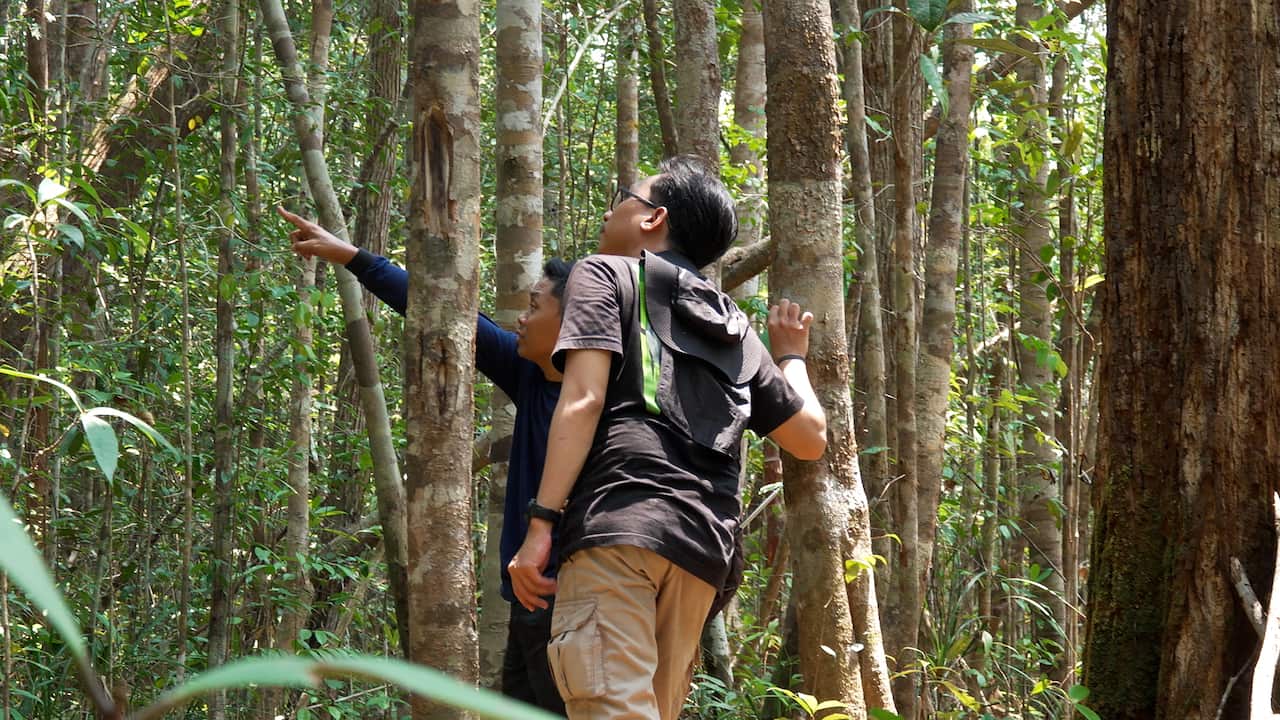
It is a serene setting to carry out their conservation work, but their task is far from a walk in the park. Even during the height of the dry season, one wrong step can land them knee-deep in swampy peatland.
But it's all worth it, the team says, as they work to keep the last of Indonesia's great apes alive.
A species under constant threat
Aziz has been stationed at Camp LAHG for more than a decade, where he says the team has developed deep knowledge of the jungle. Some of the researchers have spent so much time with the orangutans that they now know many of them by name.
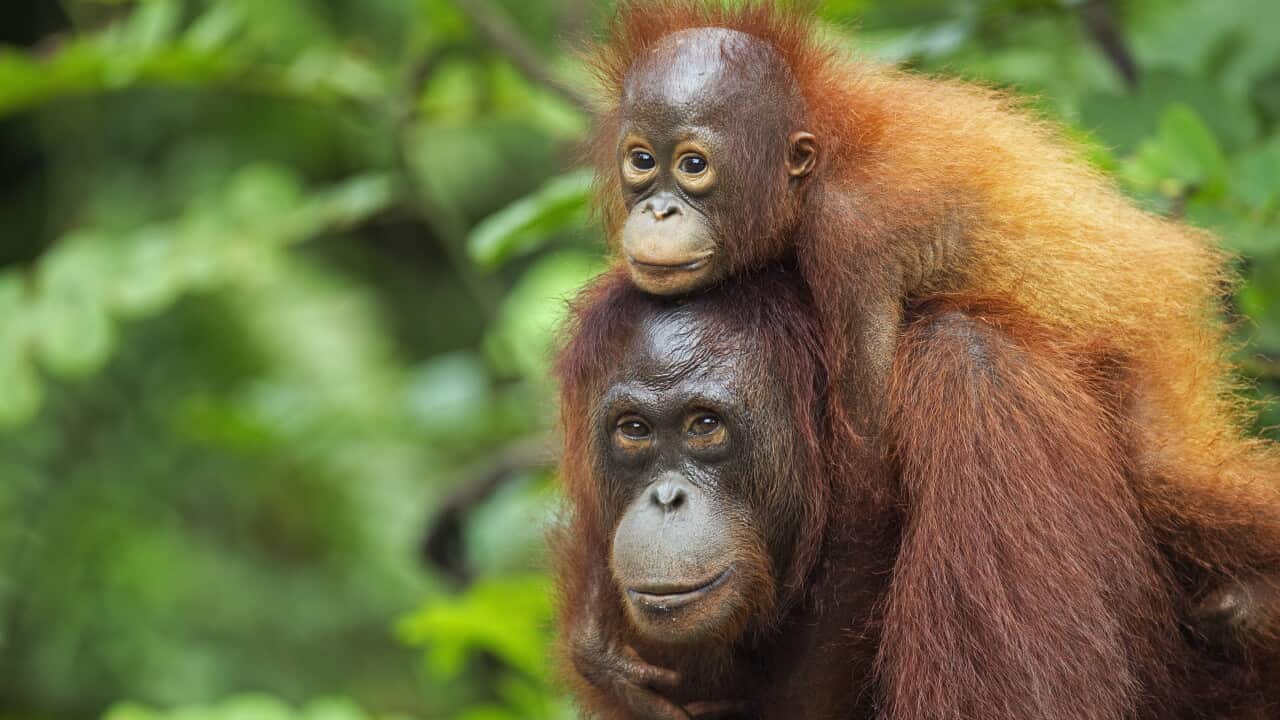
"For example, we have the 'G Family', where all of the orangutans' names start with 'G'," Aziz says.
"There's Gracia; she's the mother. Georgia is the first daughter, and the second daughter is Gretel."

It speaks to the unique connection the team has forged with the Bornean Orangutan, one of the world's three distinct orangutan species, and the only one found on the island of Borneo.
The other two — the Sumatran and Tapanuli — are native to neighbouring Sumatra.
They are closely related, but the Bornean Orangutan has developed unique features over time: they are stockier than other species, with darker, shorter hair and a broader face. There are behavioural differences too. In Borneo, the great apes have been spotted walking along the forest floor, a behaviour scientists once considered extremely rare. In Sumatra, where predators including the Sumatran Tiger and Sunda Clouded Leopard present an additional threat on the ground, orangutans are more likely to remain in the trees.
The northern part of Borneo is jointly governed by Malaysia and Brunei, while Indonesia controls the remaining 73 per cent of its southern and central territories (where Camp LAHG is). Rainforests across Borneo have been progressively decimated since the 1950s, with about half of its original forest cover lost to large-scale agriculture, mining and logging operations over the decades.
Its orangutan population has similarly plummeted to roughly half over the same period. Most estimates suggest between 50,000 and 100,000 of the great apes now remain.
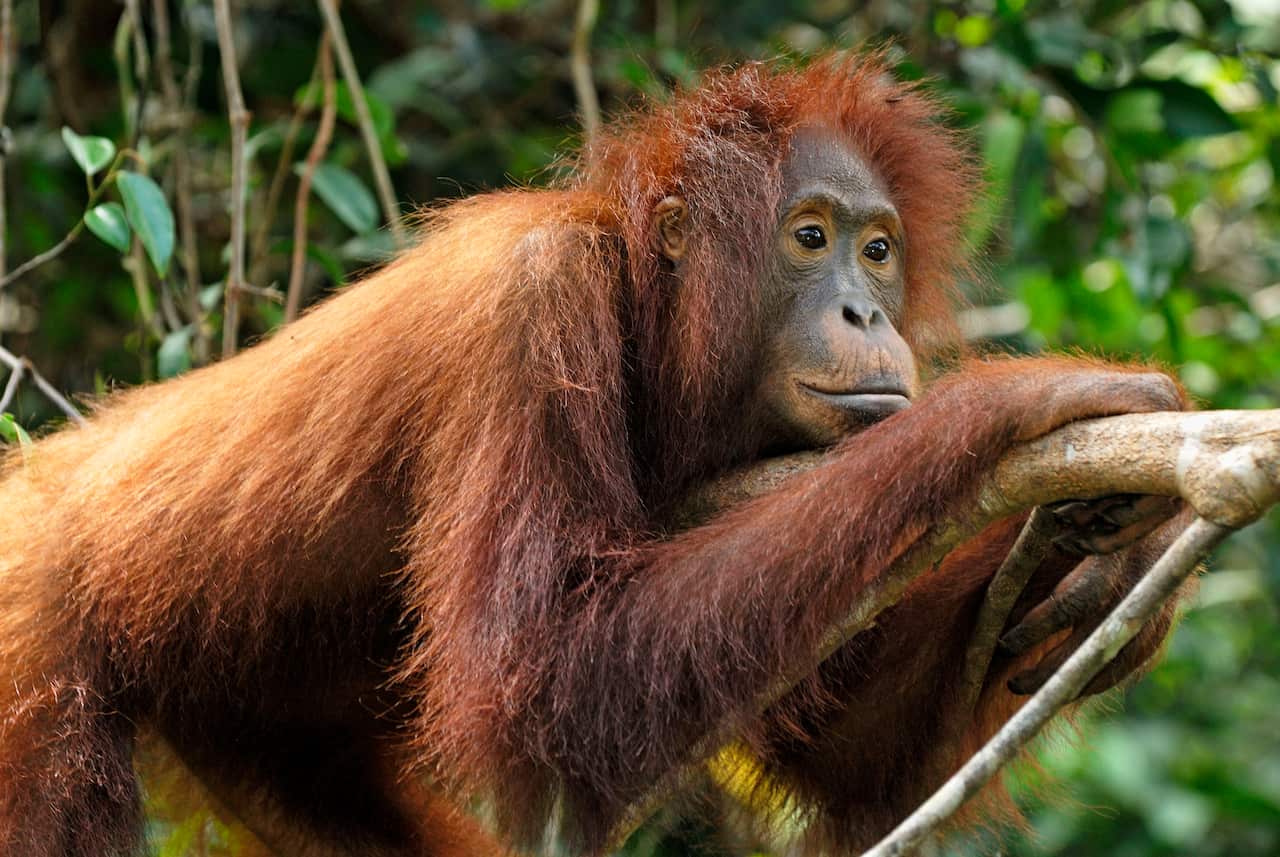
As numbers have dwindled, conservation work led by organisations such as Camp LAHG has become increasingly vital to species recovery. Females only give birth every seven to 10 years, making natural population recovery almost impossible.
Aziz explains the confluence of threats they are facing.
"There have been cases where we've seen the orangutans walking on public roads, or entering people's gardens, because the forest is gone," he says.
The forest has turned into palm oil plantations, coal mines, or logging sites.
"Almost half of the forest in the G Family's home range is gone, so they get pushed into the home range of other orangutans, and then they have to compete with each other for food."
With wildfires now ravaging Indonesian Borneo, the threats are quickly stacking up.
Fires threaten habitats
This year, Indonesia has been experiencing some of one of its worst wildfires on record, fuelled by the ongoing severe El Niño weather event.
The blazes have already burned through some 895,000 hectares of the country, according to monitoring group Nusantara Atlas, with some of the worst fires burning around Kalimantan — the name Indonesia gives to its share of Borneo.
Over the past month, at least 15 orangutans have been rescued from burning forests around the island.
Conservationists say the risks are threefold: more orangutans could be killed; more of their habitat destroyed; and the health of remaining forests endangered.
"When there are big fires, the forest delays its productivity," Borneo Nature Foundation CEO Anton Nurcahyo says.
"It's not just about the number of trees becoming less, but the standing trees will also delay their fruiting for several years, so there will be a gap of years without good biomass for the orangutans," he says.
In human context, it's maybe a famine.
During our visit to Camp LAHG, smoke from nearby wildfires hangs thick in the air.
In a laboratory surrounded by towering trees, a team of scientists works to understand how that haze is impacting the great apes' health.
It is one of the less glamorous parts of the job, explains scientist Mila Power.
"We do this by going out and collecting faecal samples from the orangutans and then analysing them in our lab here," she says.
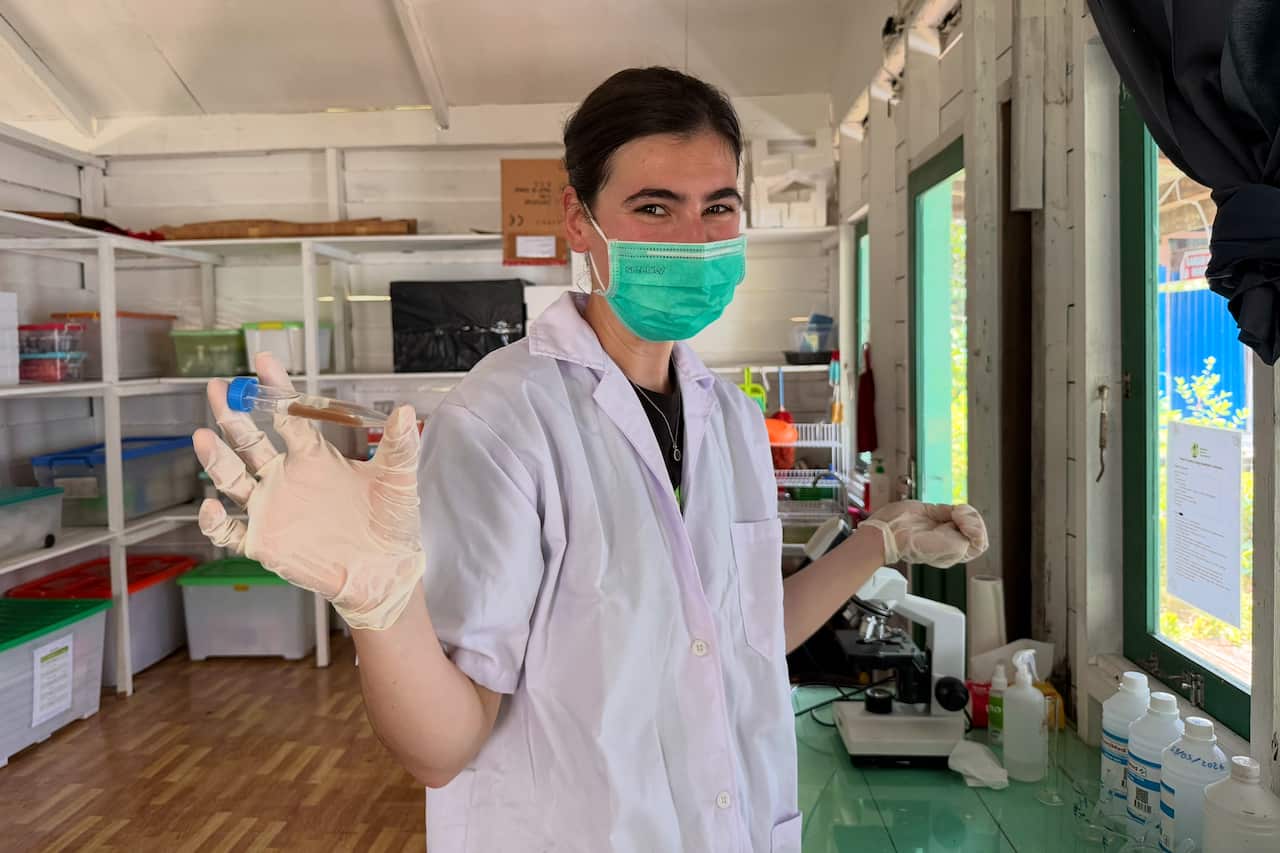
It's earned her the nickname 'Peneliti Tahi' — Indonesian for 'shit researcher'.
"I analyse the parasite composition of the orangutans at Sebangau. We use this almost as a proxy for overall health.
"For example, we've got a lot of smoke at the moment from wildfires; we're expecting that will have a negative impact on orangutan immune system function and, in turn, we're going to see higher levels of parasites as a result."
Environmental monitoring group Geopix reported earlier this month that the fires had already impacted around 60 per cent of the island's total orangutan habitat; although the Indonesian Ministry of Environment and Forestry has since said that figure needs to be verified.
'Healthy forest, healthy people'
On the neighbouring island of Sumatra, the consequences of extreme forest loss are a canary in the coalmine for Borneo's conservationists.
In the island's south, home to the Tapanuli Orangutan, nearly all of the species' historical habitat has already been destroyed by logging and land-clearing.
Today, only around 700 to 800 individuals remain; of the world’s seven great apes, they are by far the closest to extinction.
Borneo’s orangutan population is relatively healthy by comparison; but if more forest is lost, more orangutans will be, too.
At the same time, Nucahyo says the threats facing the island's orangutans carry broader consequences.
"We believe that everything is connected. It’s not all about orangutans; a good forest means other biodiversity is in a good condition too," he says.
"And for people in Central Kalimantan, and maybe people all over Borneo, if you ask them what their occupation is, many of them will say they fish. A good forest is where fish will breed, fish that support the livelihood of our people.
So for us, the orangutans are connected to the people. Healthy forest, healthy people, healthy orangutans.
For the latest from SBS News, download our app and subscribe to our newsletter.







