(Transcript from SBS World News Radio)
The world's longest running international digital arts festival has just been held in the Austrian city of Linz.
The Ars Electronica Festival, as it is known, awards prizes for innovation in electronic arts, media and culture.
And this year, it has been asking the question, "What does it take to change?"
Kerry Skyring reports.
(Click on the audio tab above to hear the full report)
In a multi-storey glass building beside the Danube River, artists, curators and journalists get an introduction to Ars Electronica.
First held in 1979, around the dawn of the digital age, this is a festival which looks to the future.
And its record is not bad.
Pixar and Wikileaks were prize winners here before they became world sensations.
Ars Electronica artistic director Gerfried Stocker says, when the festival began, the heavy-industry city of Linz was heavily polluted -- and in decline.
"Linz had a need for change, because the steel industry was no longer supportive for the wealth and income of people, so the city had to look for the future."
Novmicho Tosa sits in a Japanese tearoom.
He pulls some wires, and a figure he calls Mr Knocky plays Japanese percussion music.
Welcome to Device Art.
Back in 1979, the term was yet to be coined.
This year, Ars Electronica invited artists from Japan, the United States and Europe to exhibit and demonstrate.
The one analog piece of Device Art here is a bicycle with an old-fashioned screen carousel rotating above the handlebars.
The creator is Hong Kong-based artist and film maker Scott Hessels.
"Device Art is definitely a rebellion of form, taking everyday objects and inverting them to tell you something different. So the machine is the message here. If you look through this entire exhibition, there's no political statements, there's no angry cultural diatribes being spoken. It's humorous machines, as if the machines are our pets to present a larger message."
Scott Hessels' Bicycle Luminaire reminds us of the path of cinema - from pre-celluloid to digital.
Gerfried Stocker says it is a comfortable fit with the festival's theme, what it takes to change.
"They want to change the way how things are done, they want to change the world, they want to make the world a better place. And so we bring them all together, expose them here to the audience. It will be a super-inspiring dialogue -- among them, but also with the audience -- and I think this is where we really will get some answers to this question of what it takes to change."
Ars Electronica says the content of Device Art is the device itself, that form, appearance and function are inseparable.
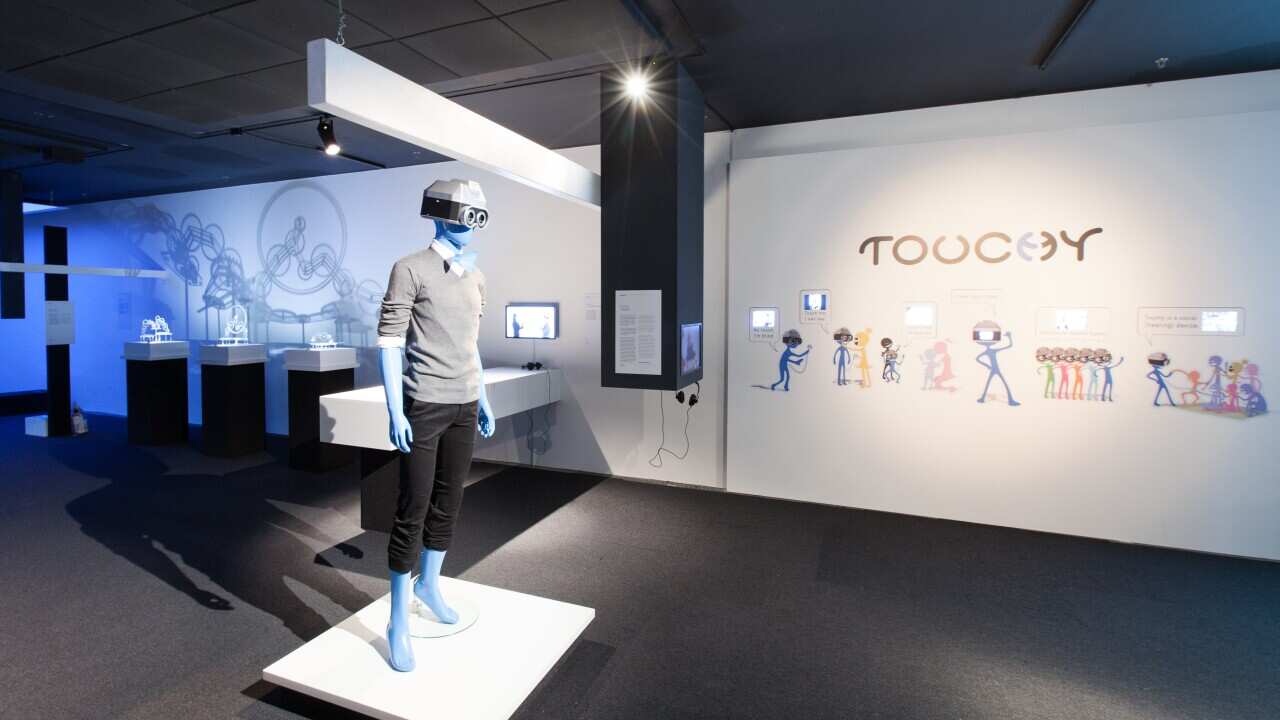
Eric Sui is from Hong Kong, and he is wearing what looks like an early version of a virtual reality headset.
"Hello, my name is Touchy. I am a human camera. When there's nobody touching me, I cannot see anything. So, now -- click -- I am blind, but you can hear a sort of shutter sound ... (Sound of lens shutter ...) so, whooo, whooo, this is when people (are) touching me, my shutters open. Then I can see."
Other device art objects here include a computer that does street begging.
It has actually proven more successful than a human beggar.
It is another example of Device Art reminding us of how easily we empathise with devices ahead of people.
Device Art is not confined to art spaces.
Some devices, like Mr Knocky, who plays percussion without electronics, are sold commercially.
So, will Touchy, the human camera -- a star at Ars Electronica -- one day be worn by many more than just its creator?
"Of course, eventually, I want to open the possibility to basically let other people buy it, maybe sell it on the market, something like that. But I mean, whenever I'm on vacation, I let other people wear it. If you're interested, you can try it later ... " (Trying it:) "Okay, so if we all hold hands, what happens?" (Touchy:) "Now I touched you, it will work. So look into my eyes. My eyes are the lens. Okay. Looking into my eyes? Okay. Smile for me, alright? Three, two, one ... Yeah. (laughter fades out ...)
Share


