
in brief
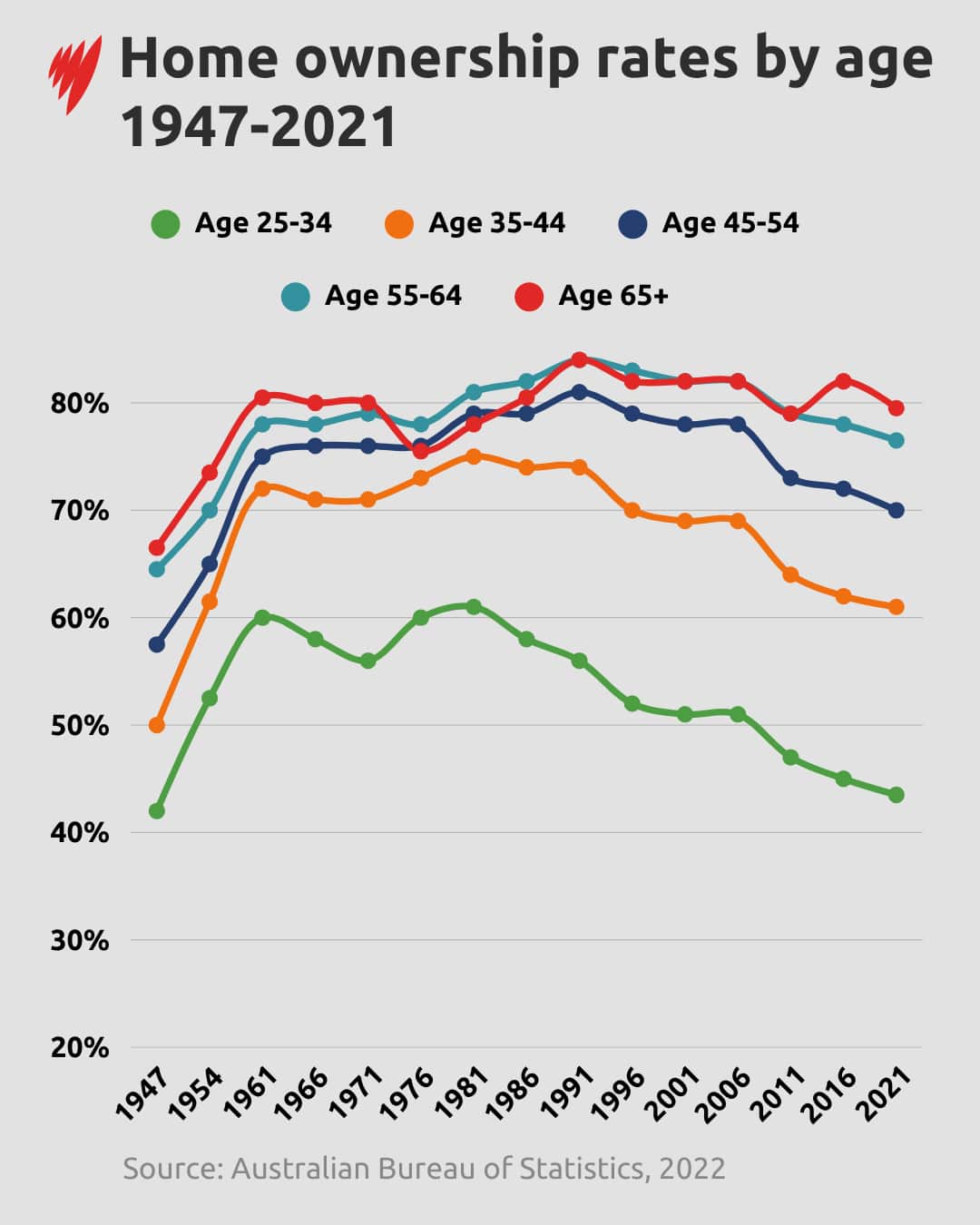
- Fewer than 40 per cent of 25-34-year-olds were listed as homeowners in the 2021 Census, and has reached 1940s levels.
- Anglicare Australia would like to see policy settings shift to support younger Australians aspiring to home ownership.
The number of younger Australians who own their own homes has stagnated, sitting at around the same levels recorded during World War Two, as the cost of living and rents rise.
Fewer than 40 per cent of 25 to 34-year-olds were listed as homeowners in the 2021 Census, and that rate is expected to have fallen since, according to analysis from social welfare charity Anglicare Australia.
This is equivalent to the homeownership rate recorded in the 1940s, before the post-war boom took hold as multiple policies prioritised construction and housing for veterans.
At the same time, home prices and rents have risen, putting pressure on younger Australians to save for a mortgage while living away from home.
A recent report from property data company Cotality has shown that rents in some parts of Australia have soared by 80 per cent over the last five years, since COVID-era rent freezes were lifted.
News that makes sense
Your trusted source for staying up-to-date with the world around you. Get free daily news updates and analysis, straight to your inbox.
Anglicare Australia said that support lines for younger people are dominated by stress over housing security and related bills.
"It's almost impossible to have a call from a younger person who doesn’t mention the stress of rents or bills," Anglicare Australia executive director Kasy Chambers told SBS News.
"They are studying, working and contributing. But they are earning less than the generations before them, being locked out of housing, and struggling to build the security that past generations took for granted."
Home ownership has steadily declined across age groups since the 1970s, but younger Australians have felt the sharpest declines, according to the Australian Bureau of Statistics.
Angela Jackson, an economist at the Productivity Commission, the Australian government's independent economic advisory body, said home ownership is particularly hard for lower socioeconomic groups.
"It is a lot more expensive relative to people's incomes to get into the housing market than it was for Gen Z's parents or grandparents," she told SBS News.
"Which does raise alarm bells about broader equity."
Housing in the 1940s
Home ownership rates have declined generation on generation in Australia, off the back of the housing boom in the post-war era.
Liz Allen, a demographer and social researcher from ANU, described 1940s Australians as going through "tough times".
"There were issues with inequalities, especially around education, geographic and income and wealth inequality," she said.
"I think it would be fair to say that the inequalities faced in that period and the global shocks during that period surpassed those that we're experiencing now."
Home ownership across all ages was lower than it is today, with younger people aged 25-34 the least likely to own property.
Allen said that the years after World War Two saw the "rhetoric of a fair go", where government made a non-partisan effort to "rebuild Australia".
It was a time of rapid residential construction and increases in home ownership.
"There were policies on multiple fronts to get people to Australia, to get people in Australia in work, in paid work, and to get people established in life with good wellbeing, access to education, homes, and so on," she said.
"But now we've lost our way."
Allen said that decades of governments have shifted towards short-term policy wins, and "kicked the can" of long-term housing "down the road".
"We're no longer in that mentality of building, but maintaining," she said.
"And that undermines the very notion that we are a growing population, that we have new forms of inequalities emerging, and policy has not kept with societal and economic change."
Less secure work
For many Australians, a home and the equity it generates over time will be their largest source of wealth and a source of security for children who may subsequently inherit it.
But for younger generations who take longer to save and pay off a home, the economic benefits can be diminished.
Jackson explained that the nature of work also makes it harder for Gen Zs to earn like their parents and grandparents.
"Work is more casual and can be more gig work, or less secure, which can make entering into mortgages and those long-term financial arrangements more difficult," she said.
"And then incomes themselves have changed over time. For lower entry-level jobs compared to more experienced jobs, the relative wage is also lower."
Rentals out of reach
Anglicare Australia would like to see policy settings shift to support younger Australians aspiring to home ownership.
"The government has taken an important step by reforming property tax breaks that have favoured accumulated wealth over work. Now we need to build on that progress," Chambers said.
"One of the clearest places to start is Youth Allowance.
"We have a social security system that literally says a young person needs less money to live on simply because of their age. Our findings show they can’t afford rent on Youth Allowance anywhere in the country."
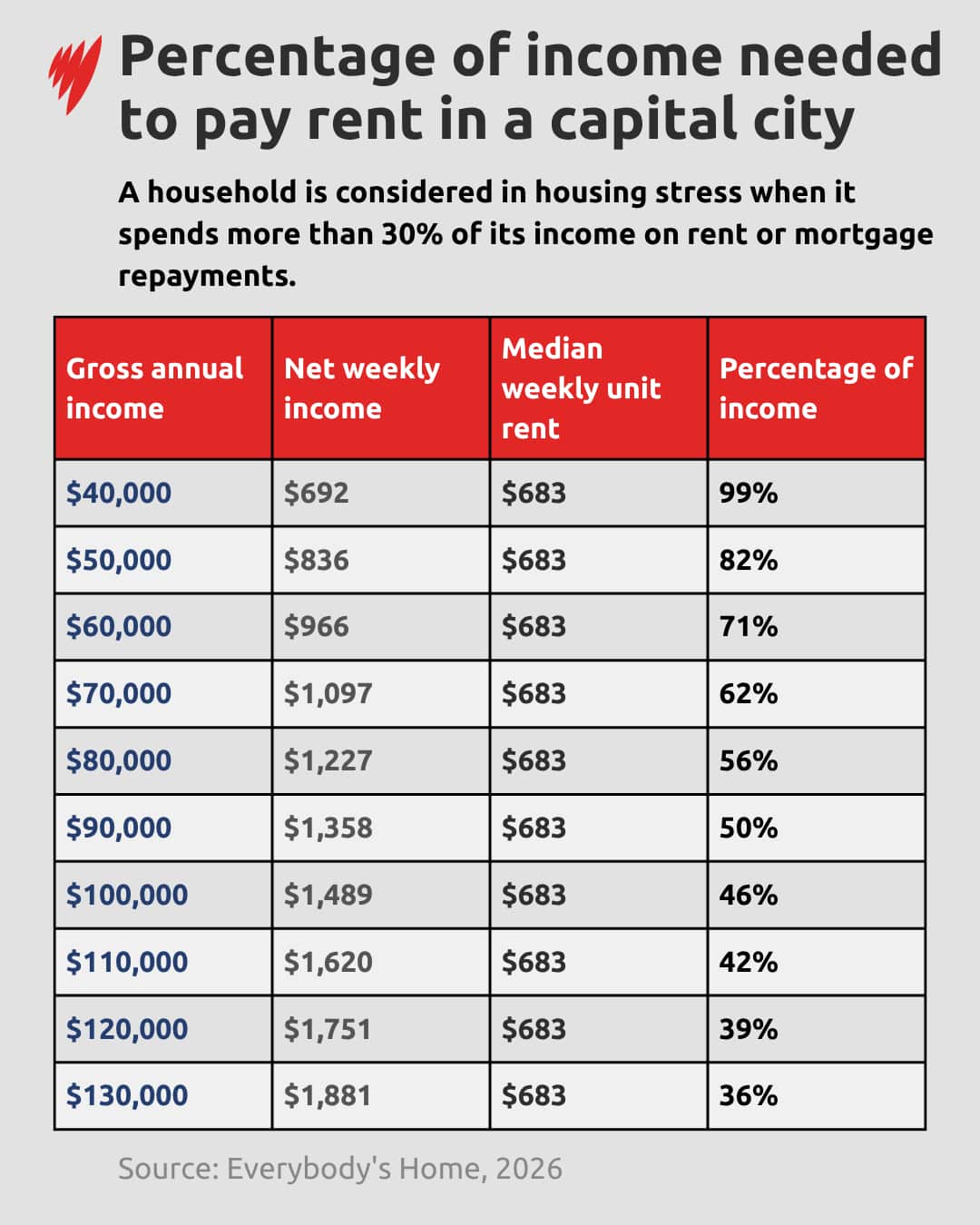
The government recently announced a $20.90 increase to the maximum Youth Allowance payment due to indexation, which will reach $1,087.20 in September. However the rate can be much lower depending on your age, living situation and dependents.
Meanwhile, the median weekly unit rent in Australia is just under $700, putting rentals out of reach for Youth Allowance recipients.
"Rent isn’t cheaper when you’re 23. Groceries aren’t cheaper. Electricity isn’t cheaper. Yet young people are expected to survive on the lowest payment in the system," Chambers added.
The group would also like to see a wealth tax, which could tax assets and reduce the pressure on income-reliant Australians who don’t yet own a home.
For the latest from SBS News, download our app and subscribe to our newsletter.







