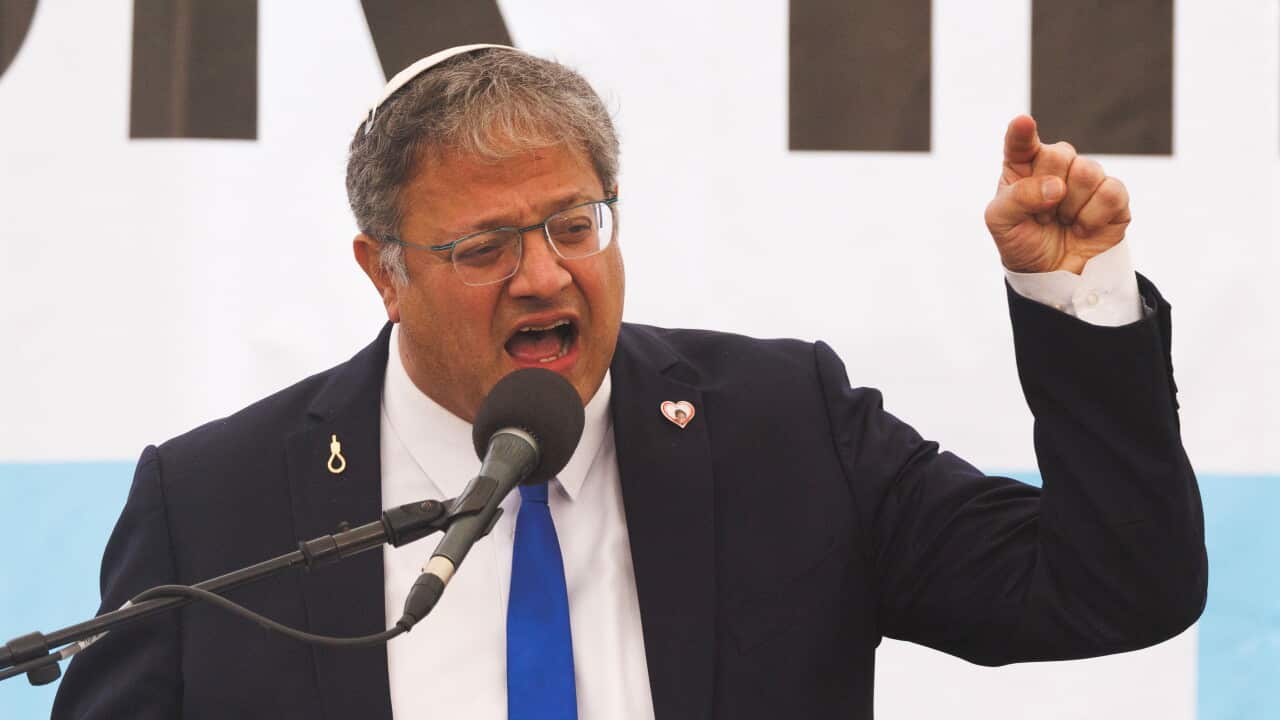
Far-right Israeli national security minister Itamar Ben-Gvir was once again in the headlines this week after a video of him taunting detained activists went viral, drawing rebuke from world leaders and his own prime minister.
However, it arguably isn't the most notorious footage featuring the man some Israelis refer to as the 'TikTok minister'.
In November 1995, just weeks before then Israeli prime minister Yitzak Rabin was assassinated by an ultranationalist Jew opposed to peace talks with Palestinians, a teenage Ben-Gvir appeared on live television holding an emblem stolen from the prime minister's Cadillac and saying: "We got to his car, and we'll get to him, too."
Ben-Gvir has never been accused of any direct responsibility for Rabin's death. But he and the extremist who did kill him moved in broadly similar ideological circles, fiercely against the Oslo Accords that Rabin signed.
The two incidents are also only the bookends of a prolific array of provocative videos the 50-year-old has become known for over the years.
News that makes sense
Your trusted source for staying up-to-date with the world around you. Get free daily news updates and analysis, straight to your inbox.
In August last year, he posted videos of himself taunting popular Palestinian prisoner Marwan Barghouti in his jail cell. Several months later, footage emerged of him mocking a previous group of captured Global Sumud Flotilla activists and accusing them of supporting terrorism.
Ran Porat from The Australian Centre for Jewish Civilisation at Monash University described Ben-Gvir as someone who "operates by creating these viral moments of 'this is Jewish power'."
"He thrives on controversy ... He thrives on these videos that depict him as powerful," said Porat, who is also a research associate for the Australia/Israel & Jewish Affairs Council.
However, Porat and other experts don't think Ben-Gvir is likely to remain in government after the upcoming Israeli elections, even if he might be increasingly popular among the nation's hard-right edge.
A 'fringe figure' with growing youth support
Ben-Gvir's televised 1995 threat to the prime minister took place when he was a member of a right-wing youth movement opposing the mid-1990s peace negotiations between Israel and the Palestine Liberation Organization.
In his younger years, he faced dozens of charges relating to anti-Arab incitement, support of proscribed organisations, disturbing the peace and other public-order offences, but was acquitted of most. He has eight criminal convictions, including support for a terrorist organisation and incitement to racism, one of which related to him carrying a sign reading "Expel the Arab enemy" in 2007.
He is a long-time settler in the occupied West Bank and, while working as a defence attorney before entering parliament, represented many Jewish settlers accused of violence against Palestinians.
Although he has been active in Israeli parliamentary politics for over a decade, he remained largely on its fringes until a deal cut with Israeli Prime Minister Benjamin Netanyahu after elections in 2022 brought him and his party, Otzma Yehudit (Jewish Power), into the highest echelons of state power.
Israel's proportional representative system means governments in its single-house parliament, the Knesset, are almost always formed by coalitions, which can put minor parties like Otzma Yehudit in a 'kingmaker' position if they hold the balance of power to either make or break governing majorities.
Porat said the national security minister position created for Ben-Gvir in 2022 had a broader range of powers than the equivalent role held by his predecessor, and he "immediately started shaping security powers under his authority, in his image".
"He deposed or released from service people he didn't agree with. He put [in] new people that were loyal to him. He administered very aggressive policies towards Palestinian inmates in Israeli jails."
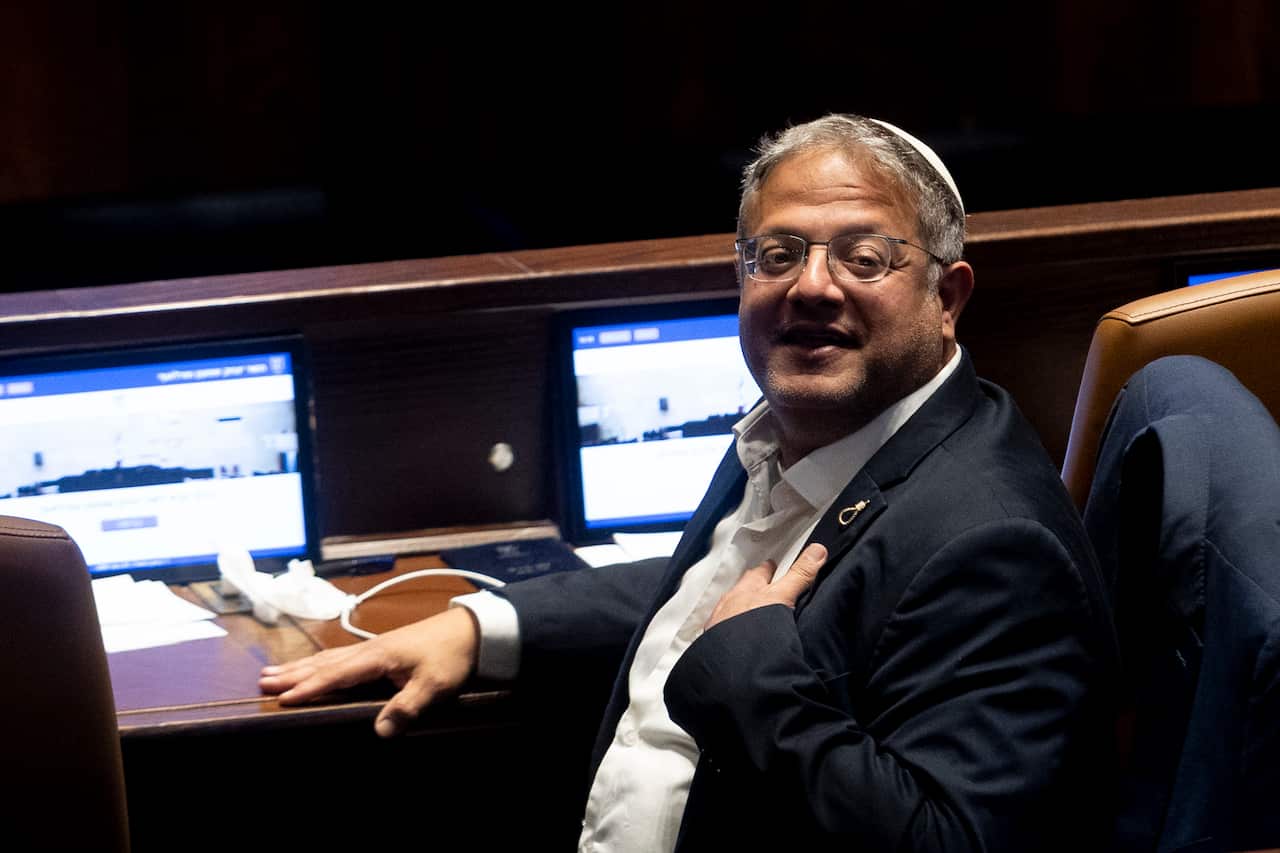
Porat said Otzma Yehudit and Ben-Gvir's support base was the "far-right margins of Israeli society" and "not most of Israel".
"His base is mostly among right-wing supporters in the settler community in the West Bank ... and other national religious extremists that are much, much smaller numbers in other areas of Israel," Porat said.
The rightward shift in Israeli politics
Among younger Israelis, however, support for Ben-Gvir is greater, said Shahar Burla, a lecturer and contributing editor of Australian media outlet The Jewish Independent.
"He is very strong in the young Israelis, even sometimes around the 10 per cent [mark], particularly around soldiers in the army," said Burla, adding that this level of support was symptomatic of a broader rightward shift in Israeli politics.
In 2025, Australia and several other countries imposed travel bans and other sanctions on Ben-Gvir and far-right finance minister Bezalel Smotrich for inciting "extremist violence and serious abuses of Palestinian human rights".
Asked about the difference between Ben-Gvir's position and that of Netanyahu's Likud Party when it came to the occupied West Bank, Porat drew an analogy.
"Ben-Gvir believes that Israel should take over the West Bank with a bulldozer, but the Likud says we should use small heavy equipment and go slowly and carefully and do it wisely and coordinate with the Americans and all that."
Both Porat and Burla said the gap between Netanyahu's and Ben-Gvir's parties was previously larger but had been narrowed by a rightward populist shift in Israeli politics.
"At the moment, there is a lot of similarity between the members of Knesset of Likud — who are very populist and loud — and the members of the Knesset of Ben-Gvir's party," Burla said.
'He doesn't operate in a vacuum'
Porat said that, while the average Israeli would feel "disgust" at Ben-Gvir's behaviour, his political style tapped into currents of feeling stirred by the Hamas-led attacks on Israel on October 7.
"The sense of hurt and humiliation that many Israelis feel after the horrible massacre or orgy of death and rape and pillage and kidnapping that happened on October 7th is that such a person like Ben-Gvir represents their sense of anger and sense of wanting to stand up and retaliate and not shut up anymore for attempts to so aggressively trying to eliminate Jewish existence," he said.
"So, he doesn't operate in a vacuum."
Because of his well-known TikTok videos, he has been referred to as a 'TikTok minister' in Israel, Porat said.
"He collects votes this way, and he's actually popular among right-wing Israelis, young ones, because ... some of them believe that the lessons from October 7 is that containment and compromise led to this disaster, to this catastrophe."
However, Porat said that Ben-Gvir's "disruptive, not constructive" actions since October 7 had also hurt his standing among Israelis.
"When there were discussions in the earlier stages of the war against Hamas in Gaza, Ben-Gvir put his full weight against any hostage deals. And in some cases, he and Smotrich and others managed to actually shoot down those deals that would have seen the hostages come home earlier, and the Israeli public will not forgive him for that."
The end of Ben-Gvir's political power?
While Otzma Yehudit currently holds six seats in the 120-seat Knesset, some recent polling has suggested that the party could pick up several additional seats in elections later this year.
Porat said the polling possibly "indicates a rising popularity of his policies mostly among his base".
Burla said Ben-Gvir's recent polling results were largely within the range of most taken in the last few years.
"He always stands on something between seven to 10 seats, which is substantial — we're talking about 5 plus per cent," he told SBS News.
"It looks like he's going to have a quite big representation in the Knesset after the election, I suspect something between nine to 10 seats."
However, other polling suggests Otzma Yehudit's parliamentary presence will remain largely steady.
Whatever the outcome, both Porat and Burla think it's unlikely that Ben-Gvir or his party would be in Israel's next governing coalition.
"If he will be in the government, that's all up to if Netanyahu and Likud will have a majority together with the right wing and the religious parties ... At the moment, it looks less likely," Burla said.
"If you read the polls for the last two and a half years since October 7, the current government ... is most likely going to be defeated and Ben-Gvir will not be a part of a government that is centre-left or centre-right or anything," Porat said.
Polls have since consistently shown Netanyahu's governing coalition falling far short of a parliamentary majority. However, there is also a chance that opposition parties will fail to form a coalition, leaving Netanyahu at the head of an interim government until the political stalemate is broken.
Burla said that, even if Ben-Gvir wasn't in government, the populist leader was unlikely to remain out of sight for the public or his political enemies.
"He will make a lot of noise from the opposition. He probably will be the strongest voice from the opposition."
The vote to dissolve the Israeli Knesset this week was triggered by an ultra-Orthodox Jewish faction that has traditionally been a close political ally of Netanyahu but recently announced that it no longer sees the prime minister as a partner.
While Netanyahu distanced himself from Ben-Gvir's recent actions — saying they were "not in line with Israel's values and norms" — Porat says the move is designed to walk a fine line.
"His rebuke was very considered, and careful enough to strike a balance between stating what needed to be stated ... and not alienating himself from .... right-wing voters who might consider voting for Netanyahu," he said.
Asked by a journalist on Wednesday whether Ben-Gvir should continue serving in a ministerial position, the Israeli ambassador to Australia said Israeli law did not allow for a minister to be stripped of their position while the government was in transitional mode.
With additional reporting by the Reuters News Agency.
For the latest from SBS News, download our app and subscribe to our newsletter.







