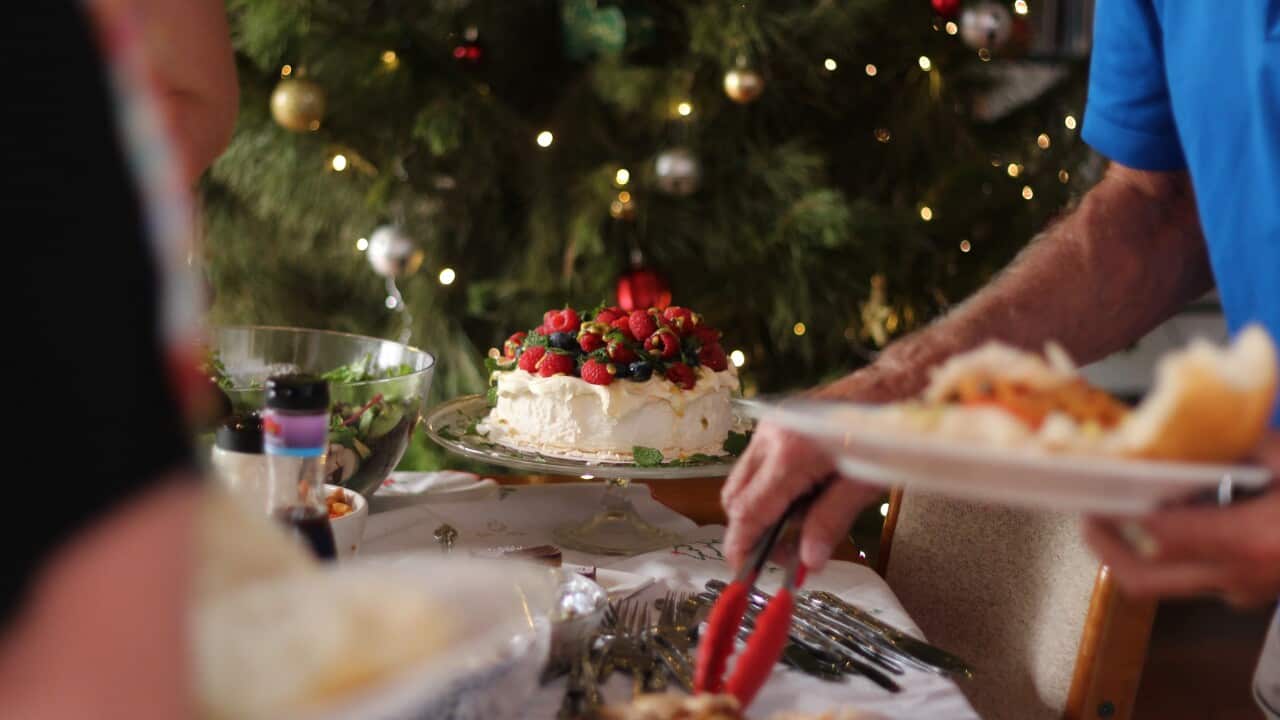
As Christmas creeps closer, so does the pressure on household budgets.
Because while Christmas time offers us days off in the sunshine and time with loved ones, it also can be an expensive time — especially if you're the one buying Christmas lunch for the family.
A new survey of 1,002 Australians from Pureprofile found households will spend, on average, $506 on festive food this year — up from $406 in 2024.
That same survey found 78 per cent of Australians plan on adjusting their spending this festive season, with 21 per cent planning to opt for more budget-friendly food and drink on Christmas Day.
But how can you actually save on your Christmas food spread? We asked some experts.
News that makes sense
Your trusted source for staying up-to-date with the world around you. Get free daily news updates and analysis, straight to your inbox.
Fresh isn't always better
Fresh produce is often treated as the gold standard at Christmas. But frozen alternatives can be just as good — and sometimes better — according to Professor Gary Mortimer from the Queensland University of Technology Business School, who specialises in consumer behaviour.
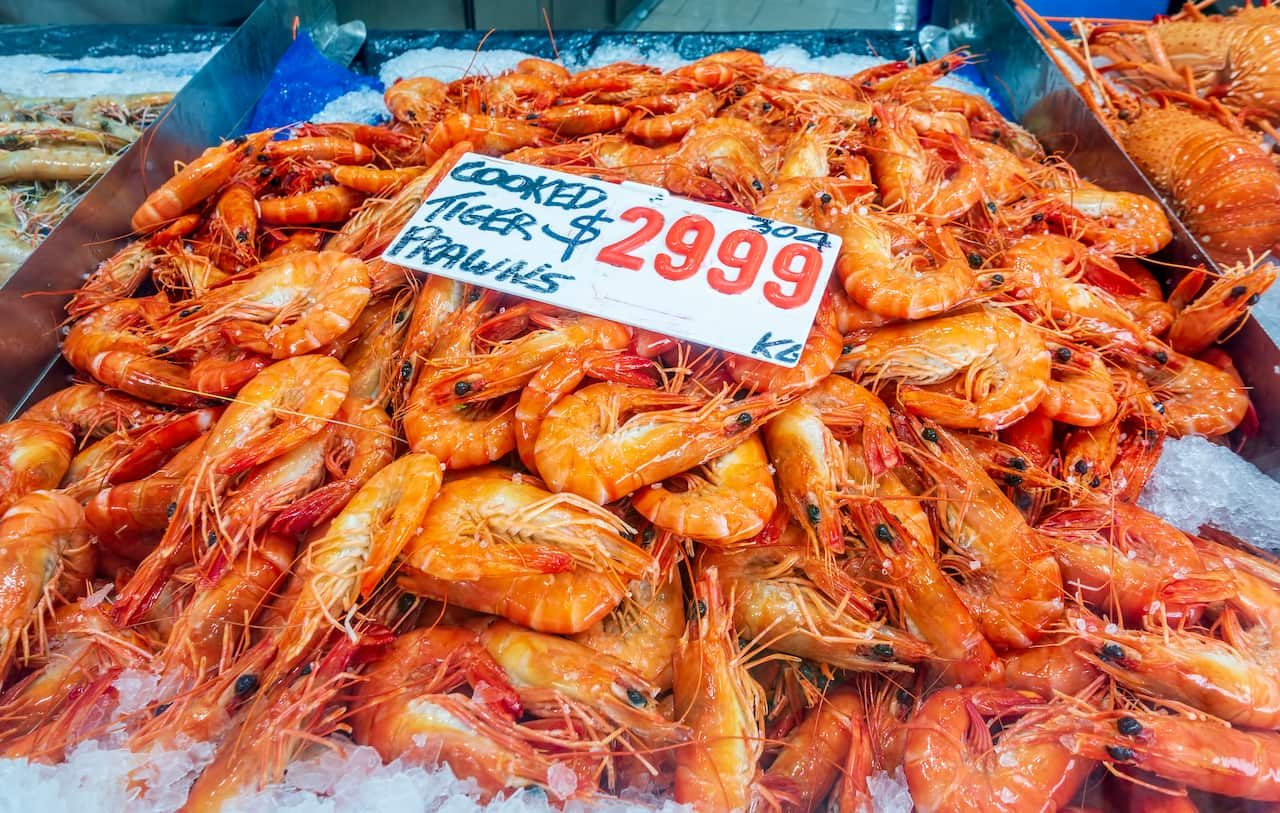
"Frozen is a better quality because often when seafood is caught and particularly when prawns are caught, they're frozen immediately," he told SBS News.
"They're pretty fresh when they're frozen. So when you thaw them out, it's actually just like they've been caught."
There's also a clear price advantage.
"You find that the frozen product tends to be cheaper than the fresh product. The same would go for frozen veg over fresh veg," Mortimer said.
More Australians are making the switch to frozen, said Eden Radford, media spokesperson at financial comparison site Canstar Blue.
"Fourteen per cent of people are actually buying food before Christmas — before December — and putting it in the freezer to store for later," she told SBS News.
"Consumers are getting a lot smarter either by want or by necessity because they know that they're just going to need to save.
"Doing things like shopping around at multiple supermarkets, choosing frozen options ahead of fresh."
Look for what's in 'bountiful supply'
Some fresh produce will be more expensive this year simply because there's less of it available.
"A lot of food tends to be fresh — fresh seafood, fresh fruit [often stone fruit] and those particular types of foods are highly susceptible to the supply and demand effect," Mortimer said.
Mortimer points to potatoes as one example: currently stripped from many supermarket shelves due to drought.
Prawns and peaches, too, can swing in price depending on disease pressure or unpredictable growing conditions.
His advice? Stay flexible.
"The challenge is looking at what's in bountiful supply, therefore the prices will be relatively low," he said.
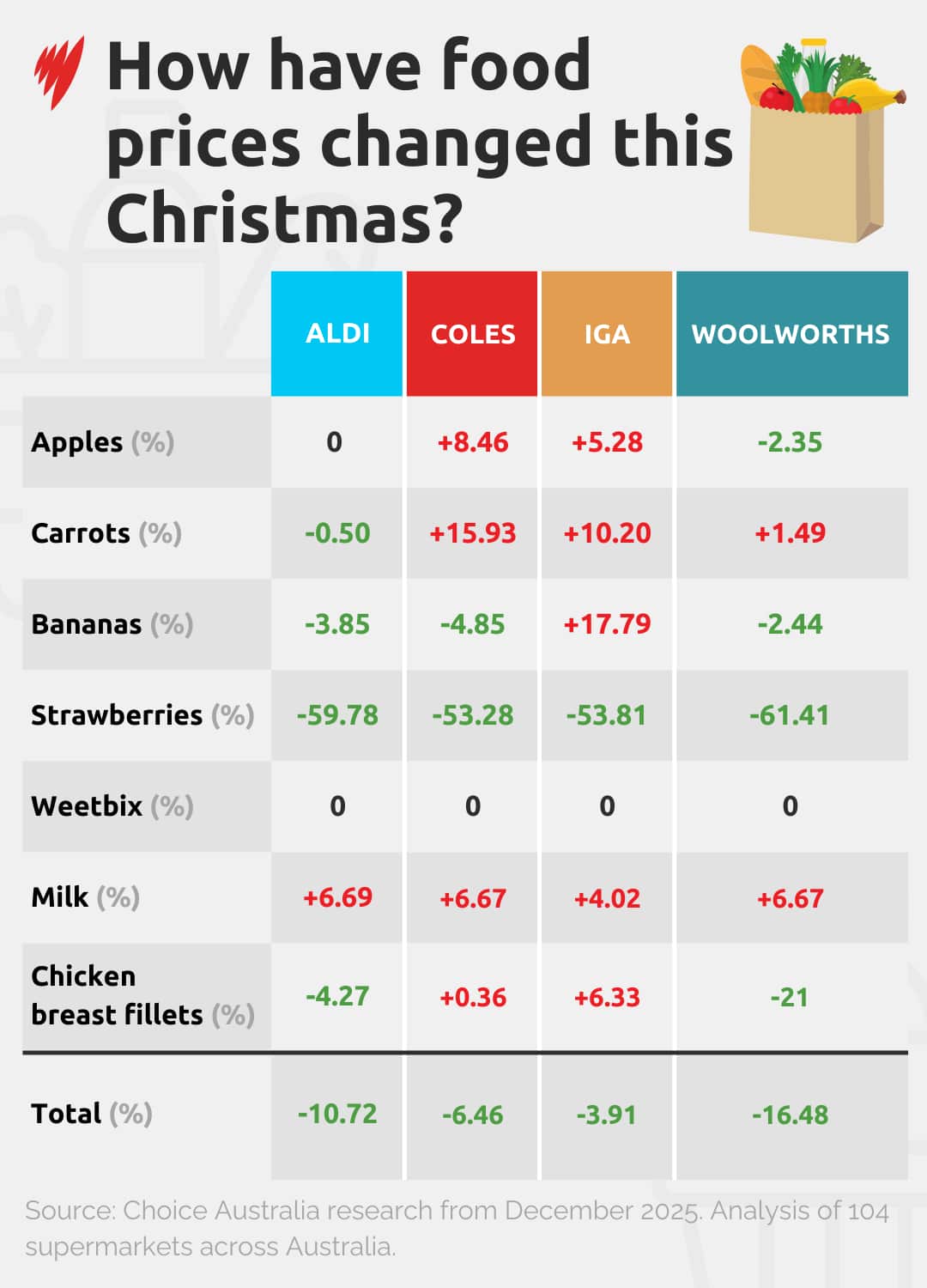
Data from consumer advocacy group Choice found that overall, the cost of a base basket of seven items — apples, carrots, bananas, strawberries, Weet-bix, milk and chicken breast fillets — had fallen across the four big supermarkets in the last quarter.
The item that fell the most in price was strawberries, as expected for seasonal produce.
The price of milk rose at all four supermarkets.
The biggest price reduction came at Woolworths, with the cost of a basket dropping by 16 per cent.
At Aldi, it fell by 11 per cent, Coles by 6 per cent, and IGA by 4 per cent.
Radford said more Australians are willing to be flexible on their grocery lists.
"Seventeen per cent of people said they'll always buy the same [Christmas] food. They don't look at price," she said.
"That suggests that people are a lot more cost-conscious and are trying to find different ways to save.
"They're willing to make a few changes. They're willing to swap some things out in order for them to save a little bit of money … it could be a different kind of meat or a smaller portion."
Buy in bulk — then split it
One of the fastest-growing savings strategies is "collaborative shopping".
"A large family or a large group will get together … buy in bulk, and share it across two or three families," Mortimer said.
He said he's seen families buy half an animal carcass for around $600 and divide it between households. Others head to the markets, split a $400 fruit-and-veg haul, or buy an $80 ham from Costco and portion it out.
Radford said thinking about portions can be an underrated saving tool.
Before shopping, she encourages people to think about whether they actually need a full-sized ham or if a smaller cut would do — or whether buying a slightly larger item might be cheaper if leftovers will cover multiple meals.
Home brand is now the quiet hero
Mortimer said the days of looking down on supermarket-owned brands are over.
"Today, one in three products [in supermarkets] are a private label supermarket-owned brand," he said.
"They're traditionally lower priced than the brand product and equal, if not better quality."
Mortimer said Christmas is when the quality difference becomes especially noticeable.
"As we move into the Christmas period, we start to see the better quality popping up — the Woolworths Select, the Coles Finest. When it comes to Christmas fare, I'd be looking at those types of products when you have Christmas lunch or dinner," he said.
Radford said shoppers are getting more analytical: "Australians aren't just going to take the price that's in front of them. They're going to look at the unit pricing and think if they can go somewhere else."
"And they're also opting to go for supermarket-branded items instead of buying the name brand," she said.
Shop across supermarkets
Choice also compared the cost of your standard basket of groceries for entertaining — including items such as stuffed olives, Twisties, crackers, pretzels, cheese, and some fresh fruit and veg.
Aldi had the cheapest shop for party items, costing $41. Its base basket items were also the cheapest at $31.41.
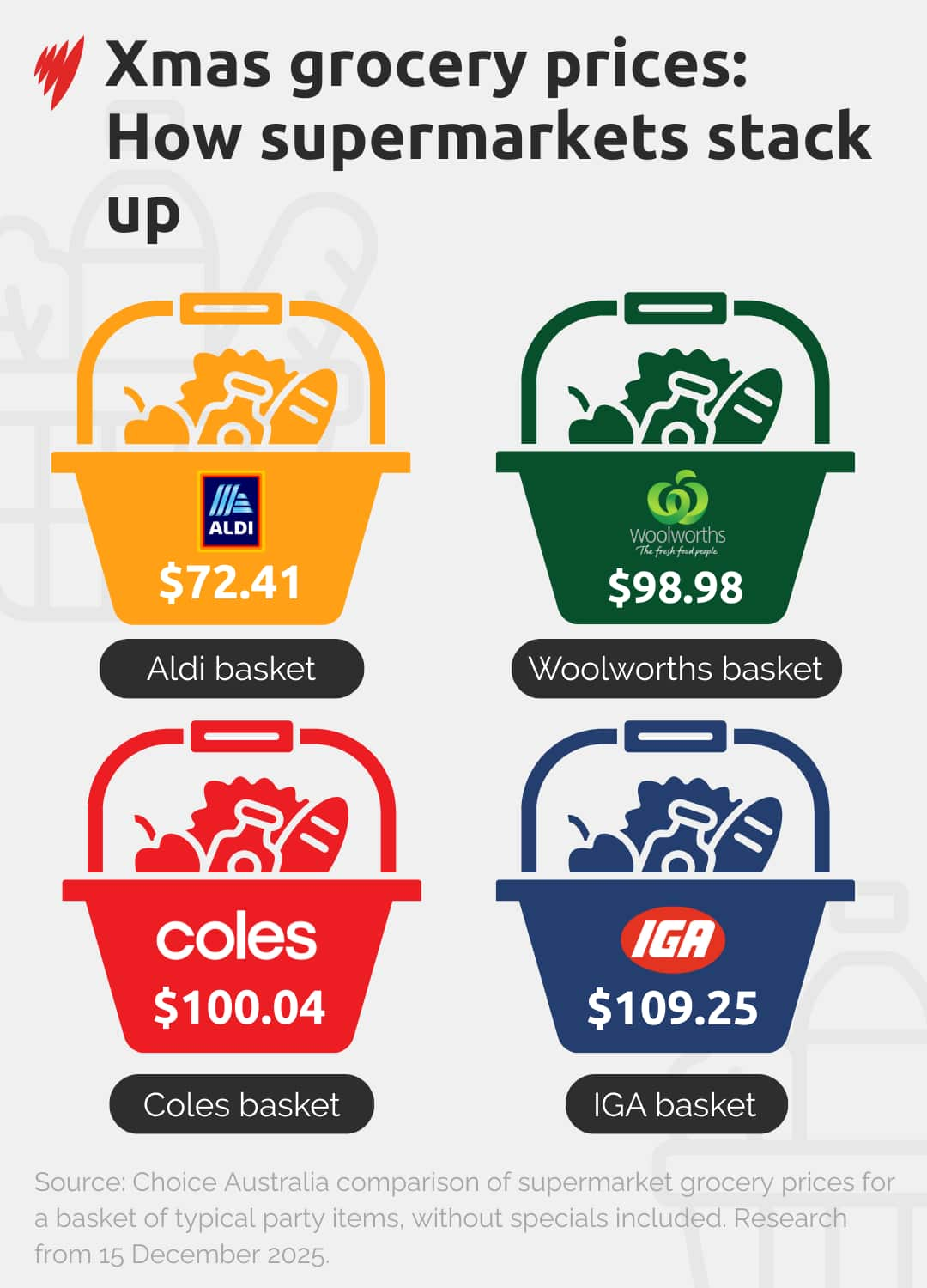
The combined cost of an entertainment shop and your base basket items, without specials, at Woolworths came to $98.98.
Coles came in slightly higher at $100.04, while the same basket at IGA would cost you $109.25. Aldi's price was $72.41.
Aldi remains the consistently cheapest supermarket, Mortimer said, but its smaller range means many shoppers split their shop.
"What we are seeing with consumers and have seen for some time now is that they're willing to shop across multiple brands of supermarkets but also independent players to save money and get that choice," Mortimer said.
"You may shop at Aldi to get the basics, but you may go to the fruit market to get the lowest priced fruit and vegetables, then you might go to the big supermarkets to get the range you need to finish off Christmas lunch or dinner."
For the latest from SBS News, download our app and subscribe to our newsletter.







