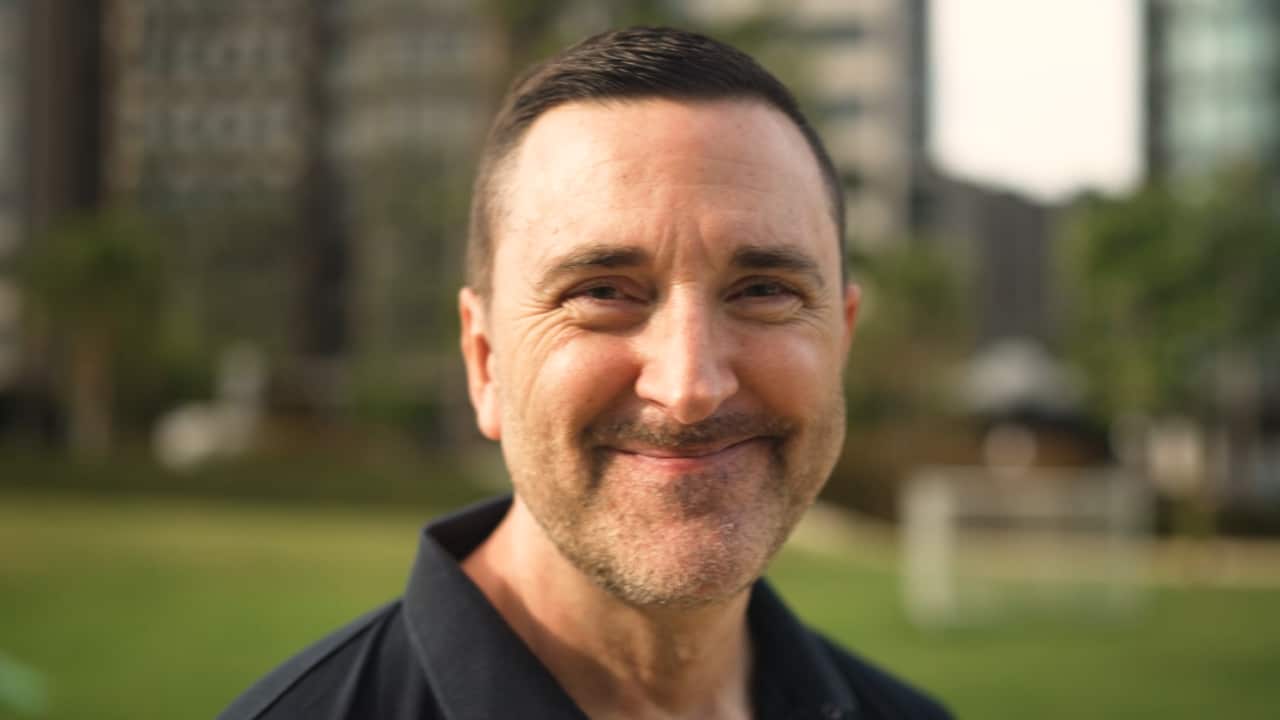
Stuart Slater doesn't drink or smoke, exercises regularly and describes his diet as healthy.
So when the 54-year-old suffered a life-threatening cardiac emergency at work at 2022, he had no idea what was happening.
"I ... just felt really dizzy and faint and I couldn't stand up and I've never had that happen to me before," Slater recalled.
"I knew there was something that just wasn't quite right."
The ambulance service said they were going to be two to three hours.
"A work colleague looked at me and said: 'can you wait that long?' I said: 'I really don't think so'."
Slater was experiencing an aortic dissection, or ruptured aorta.
He later found out that he only had a 10 to 15 per cent chance of survival.
When he arrived at the hospital, the receptionist asked him a simple question: Are you admitting yourself as a public or private patient?
He says the answer he gave that day probably saved his life.
"I was sort of confused with that question because I'd never been to hospital before and my instinct would've been to say private," he said.
"But, I actually bounced the question back to her and said: 'how should I admit to hospital?' And she said, 'what's happening?' I said: 'I think I'm having some sort of major heart issue. I'm just not sure'.
"She looked at me and went: 'public, go public. If you are presenting any critical situation, go public.'
"She probably saved my life that day. Just the very fact that I did go public that day probably did save my life."
Slater had premium private health insurance. If he had been admitted as a private patient, accessing the lifesaving technology used to treat him may not have been possible.
A new report by healthcare consulting firm HTAnalysts says that patients are waiting an average 4.7 years for clinically proven, lifesaving technologies to get approved in Australia.
Cardiothoracic surgeon Jayme Bennetts says the current approval process creates inequities in patient care.
"The main issue is that there is a significant time component to getting new technologies," he said.
He said updates to existing technologies and approval of new technologies go through the same regulatory pathway.
"That regulatory pathway is taking on average just shy of five years to get new products approved, which means that patients are being unable to access what is potentially a better and an improved way of dealing with their problems, especially with heart pathologies," he said.
"And … those technologies are already readily available overseas."
The report says that in order for Australia to catch up to global best practice in the US and Germany it must reform to streamline processes, promote alternate funding mechanisms and increase transparency.

Ian Burgess, the chief executive of the Medical Technology Association of Australia, said delays have costs for both individuals and the wider health system.
"In Australia, there's funding and access gaps to new innovative medical technologies, and that directly impacts on patient access," he said.
"It means there's inequitable patient access and it slows down adoption of medical technologies, new innovation, and when that new innovation can drive enormous value in terms of to an individual patient, better outcomes, better quality of life, and drive efficiency in our health system."
The report calls on the Australian government to establish performance targets for reimbursement times.

It also calls for the development of a provisional funding mechanism for new and innovative technologies in the private sector.
Bennetts says disparities between the private and public sector mean greater inequity in treatments.
"The regulatory pathway really is more limiting in the private sector than the public. Often some of these new technologies are available earlier publicly because they don't need to have the same approval and funding regulatory pathways through to get them to be available in that system."
While he says reform is needed to speed up these regulatory pathways, Bennetts says the regulations exist for good reason.
"I think the pathways are designed to ensure that we have a system that can afford healthcare, but also that we are delivering devices and technologies to patients where there is a proven benefit that is actually one, safety and efficacy for the patient, but two is also cost-efficient for the system.
"So those systems I think are very good and are designed with the right intent. We just need a more efficient pathway of new technologies and devices to be able to be approved quicker."
For people like Stuart, access to the right technology not only saved his life, but made it better.
"It was the greatest day of the rest of my life," he said.
"Little did I know that day that I had a 10 to 15 per cent chance of living. Your odds aren't good and you need everything to go your way.
"But 20 years ago, if I had an aortic dissection, I wouldn't have lived. And that's just showing that what the medical technology has done since then. I've had two new grandkids, my kids have had kids, but I'm just enjoying life so much more.
"I'm probably the person I always wanted to be now because I'm more relaxed with everything. People say it's a second chance of life, but it's not — it's just realising how lucky you were."
Share


