
Sore throats, runny noses, aches and pains; even with the hindsight of the COVID-19 pandemic, it can be easy to take these symptoms as par for the course during winter.
But they could be symptoms of more serious illnesses currently circulating.
The Australian Centre for Disease Control (ACDC) tracks data on a range of communicable diseases and publishes fortnightly reports on respiratory virus cases during the winter months.
So far, there have been nearly 35,000 notified cases of influenza in Australia this year, 41,000 COVID-19 cases, and more than 52,000 RSV cases. Across all three respiratory viruses, the predominant group infected is 0-4 years of age.
Late last year, a fast-moving strain dubbed "super-K" — or the H3N2 sub-clade K variant — emerged and circulated from late September through the summer, infecting the population long after the usual flu season, weakening herd immunity and driving a record-breaking number of deaths.
News that makes sense
Your trusted source for staying up-to-date with the world around you. Get free daily news updates and analysis, straight to your inbox.
In 2025, 1,700 people died from the virus — it was Australia's deadliest year for the flu in a century.
It can be difficult to distinguish between viruses. So what might you have?
How is this flu season panning out?
As Adrian Esterman, chair of biostatistics at Adelaide University's College of Health, says, it's impossible to predict which diseases will be more common this year.
"That's impossible to say at this stage, because the winter's only just started," he told SBS News.
The "usual trio" circulating — influenza, COVID-19, and RSV — are all "going down a bit" he said, and are at lower rates than this time last year.
Influenza cases were reduced drastically in 2026, with confirmed cases dropping by more than half those recorded at this time last year.
Esterman says this is unsurprising, but "still a worry".
"Last year we had half a million cases, and half of a big number is still a big number," he says.
While viruses circulate perennially, Esterman says cases usually spike during winter because people tend to congregate in enclosed spaces, which allows viruses to spread easily from person to person. During the summer, when people are outside, there's less contact.
The sun also "tends to degrade any viruses that do go into the air," Esterman says.
Flu, RSV or COVID — what are the differences?
There are four strains of influenza: Influenza A, B, C and D. Only A and B are associated with the seasonal flu. These strains can cause fever and chills, cough, sore throat, sneezing and a stuffy nose. Tiredness and bodily aches may also be present.
"Flu tends to hit much quicker, you get it within a few hours, basically," Esterman says.
"You have the usual respiratory symptoms like coughs, colds and headaches, but then it comes with a fever, lethargy ... anecdotally, there are very, very nasty symptoms."
RSV is a highly contagious virus that causes infection in the lungs and airways. It is one of the most common causes of respiratory infections in children. Most cases of RSV are mild and can be treated at home. Symptoms may include a runny nose, cough, sneezing, wheezing and fever.
The federal government's public health directory, Health Direct, says the RSV vaccine is recommended for pregnant women, all people 75 years and older and Aboriginal and Torres Strait Islander people 60 years and older. The vaccine has been available to Australians aged 75 and older for free since May 2026.
COVID-19 is the disease caused by severe acute respiratory syndrome coronavirus 2, or SARS-CoV-2. It can affect anyone, but is more serious for older people, pregnant women and people with underlying health conditions.
"COVID-19 can take much longer to take effect," Esterman says. "Symptoms include an extremely sore throat and fever, very similar to influenza. The strain going around at the moment, anecdotally, produces a very sore throat."
All three of these viruses can be identified at the GP with a rapid antigen panel test.
'Horror season'
Last year was Australia's worst on record for influenza cases, with more than 500,000 confirmed infections, driven by the spreak of the Super-K variant.
At a national online briefing in May, experts says this year's flu season remained unpredictable, but vaccinations were the best way to prevent serious illness.
Esterman says while it wasn't more harmful than any other kind of flu, its spread compromised Australia's overall immunity.
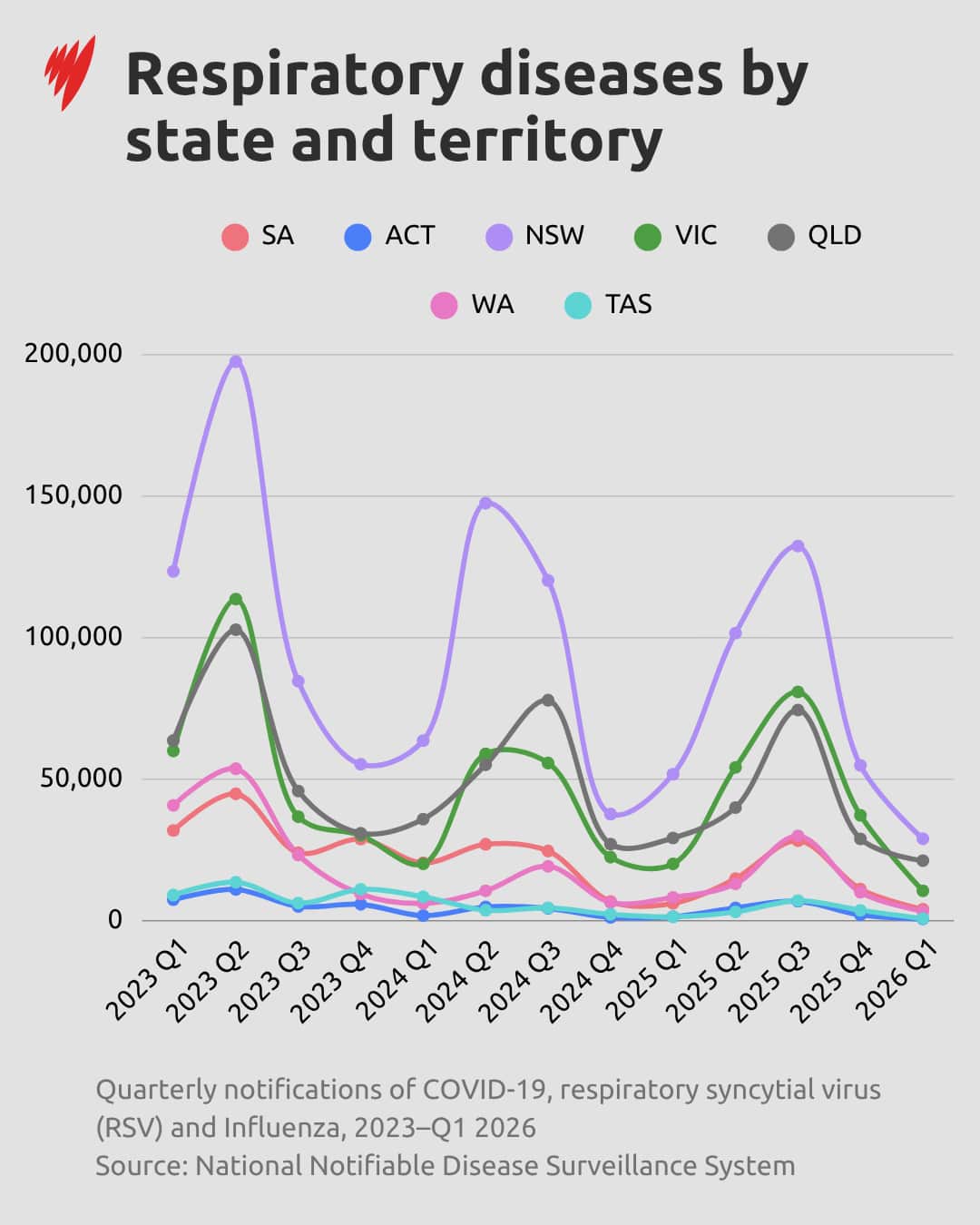
But because of the sheer number of people who were infected last year, Esterman didn't expect the 2026 flu season to be anywhere near as severe. The 2026 flu vaccine has been updated to inoculate against super-K, and a high number of infections means there will be a greater overall immunity against it.
But, Esterman says, flu notifications are "just the tip of the iceberg" as they rely on a GP testing a sick person and recording the result.
"By and large, we don't have a huge handle on what's happening".
The vast majority of people with flu, COVID-19 or even RSV, never seek treatment.
Esterman says it was important for people who felt ill to see their GP. "Most treatments for the flu, COVID-19 and RSV are only useful within five days of contracting the virus. So you must seek out treatment as soon as possible."
Declining vaccinations a 'real worry'
In Australia, overall vaccination rates are declining, even among vulnerable populations.
Childhood vaccine coverage has dropped from around 95 per cent to 92 per cent.
"Now, you might argue that's not a huge amount, but for some diseases like measles, you need that 95 per cent to get herd immunity. As soon as it drops below that, you start to have pockets of measles occurring. That's exactly what's happening," Esterman says.
"One of the big issues over the COVID-19 pandemic, and since then, has been very poor communication."
Professor Kristine Macartney, director of the Australian National Centre for Immunisation Research and Surveillance, told SBS News in May that vaccination rates were slipping and many Australians underestimated the risks.
Only 60 per cent of adults aged over 65 and a quarter of children aged between six months and five years were vaccinated for influenza last year, she says.
"Influenza can cause serious illness, it can result in hospitalisation, it can result in death. This can happen in perfectly healthy people of all ages."
Esterman says it was a "real worry".
"We should be doing everything in our power to ensure at-risk Australians are getting their job. Which I'm not sure we're doing."
For the latest from SBS News, download our app and subscribe to our newsletter.







