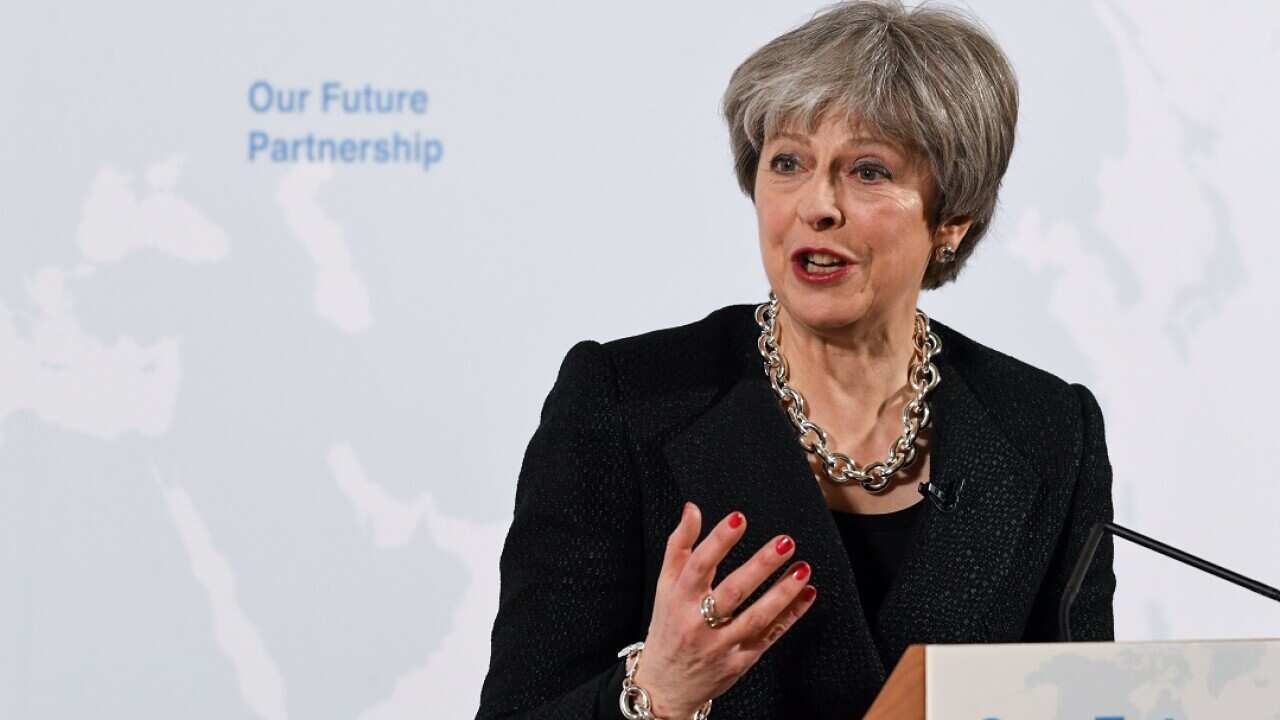
British Prime Minister Theresa May called for a wide-ranging free trade deal with the EU after Brexit, but admitted it was time to face the "hard facts" about the economic consequences of leaving the bloc.
Main points made by Theresa May in her speech:
Trade relationship
- Britain and the EU should aim for a new kind of trade deal after Brexit
- The EU's existing agreements with Norway and Canada are unsuitable because they would hurt supply chains and make it hard to keep an open border between Northern Ireland and the Republic of Ireland
Financial services
- A Brexit deal on financial services should be part of Britain's new relationship with the EU despite EU's refusal so far to allow Britain to pick and choose which part of its bloc's single market it wants to keep full access to
- Wants to maintain cross-border trade in financial services on the condition that each side preserve similar regulatory standards
Implementation period
- London and Brussels are close to agreeing terms of an implementation, or transition, period after Britain's scheduled departure from the EU in March next year
Northern Ireland
- Brexit would not put at risk the progress made on securing peace in Northern Ireland, and Britain and the EU had a joint responsibility to find a solution over how to avoid a hard border
- Any hard border or a customs border that broke up the country's national common market was unacceptable
European Court of Justice
- Britain would continue to be affected by decisions of the European Court of Justice and the country's courts would look at ECJ interpretations of laws to ensure consistency.
- The ECJ could no longer be the ultimate arbiter of the law in Britain after Brexit
EU rules and standards
- Britain might choose to remain in step with EU state aid and competition rules after Brexit; standards in Britain should remain "substantially similar" in future
Customs union
- Britain would leave the EU's customs union, as well as its single market, to pursue its own trade deals with other countries
- A customs partnership could keep the same border tariffs for goods intended for the EU but different ones for those going into the UK
- Alternatively, there could be a streamlined customs arrangement where jointly implemented measures would minimise frictions to trade, with additional specific measures for the border between Northern Ireland and the Republic of Ireland
EU agencies
- Britain wants to discuss with the EU how it could remain part of key EU agencies such as the ones covering the chemicals, medicines and aerospace industries
- Britain would follow the rules of the agencies and make a financial contribution for being part of them
Data
- Britain and the EU would need an arrangement on data protection.
Share


