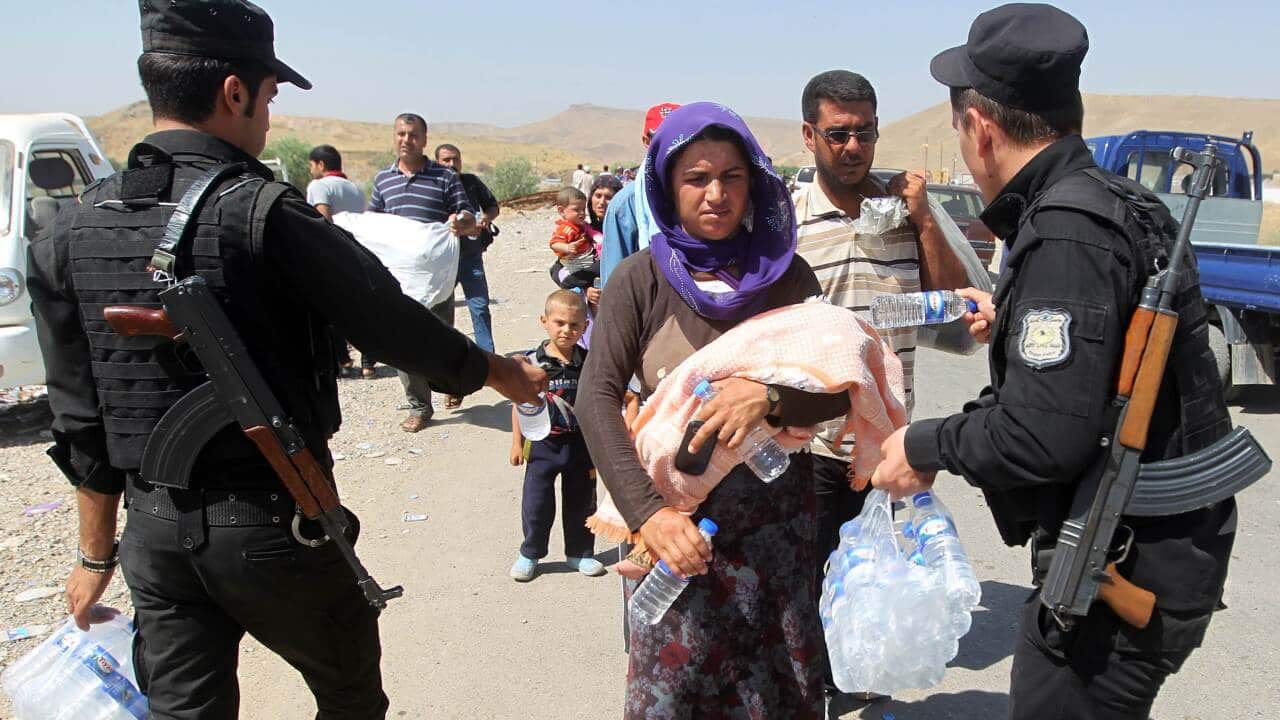
Tens of thousands of civilians remain trapped on a mountain in northern Iraq after fleeing Islamic State militants who seized the town of Sinjar.
MAP: Which areas are under IS control?
The United Nations is calling for more international action to protect them.
For more than 10 days now, they have been stranded on a mountain without adequate food, water and shelter.
As many as 20,000 Iraqis, United Nations Secretary General Ban Ki-moon says, are trapped on Mount Sinjar with nowhere else to run.
News that makes sense
Your trusted source for staying up-to-date with the world around you. Get free daily news updates and analysis, straight to your inbox.
“Even when people manage to find a way out, they remain exposed to searing heat and a perilous odyssey. I urge the international community to do even more to provide the protection they need,” he said.
'We want peace. Not more. Just peace'
Those stranded on the mountain are just some of the estimated 1.2 million Iraqis displaced as Islamic State (IS) militants continue their advance across Iraq.
Speaking through a translator, one man made a desperate plea to the United Nations, calling for a safe zone for the Yazidi people.
"There's no-one to help us. We don't want.. no money, no oil, no higher position. Just, we want our rights. We want to live in peace. Not more. Just peace. It's just one word,” he said.
Relief efforts stall
Cargo planes carrying drinking water and tents have dropped some emergency supplies to those trapped, members of the minority Yazidi community.
However relief efforts stalled when crew members could not find a place to drop supplies amid a crush of desperate people.
A Kurdish government helicopter delivering aid to Mount Sinjar crashed, killing the pilot and injuring a journalist for The New York Times.
"There are immense problems of having an organised aid effort for so many people,” said UNHCR Adrian Edwards.
“The people who've fled Sinjar are arriving in worsening conditions by the day. They've been exposed to this environment -- lack of water, immense difficulties of simply existing up there -- for some time now, and their needs are very great, indeed”.
Kurdish forces regain Iraqi town of Makhmoor
Meanwhile, Kurdish forces have won back the Iraqi town of Mahkmoor, near Irbil, from IS control. People are still afraid IS will return and are unsure of their own security forces. Kurdish forces were able to regain the town because US air strikes helped weaken the jihadists’ hold on it.
Military intervention
As the United States has continued air strikes on Islamic State targets in Iraq, Australian Prime Minister Tony Abbott has given the strongest indication yet that Australia is prepared to send military forces.
"We're talking to our partners, and our partners in this instance are certainly much wider than simply the United States and the United Kingdom. But we are talking to our security partners about what we can usefully do to help,” he said.
Calls for refugee intake
However, the Greens have cautioned against military action, calling on the government to instead focus on expanding its refugee program for the Iraqis fleeing the violence in the country.
"Australia should offer an emergency intake of refugees, including from Iraq, so that people can get out of harm's way and come to a safe haven. That is something that is within our power and that Tony Abbott could do today,” he said.
A spokesman for Immigration Minister Scott Morrison told SBS on Wednesday that 4000 places have been made available in Australia's special humanitarian program for refugees offshore.
The spokesman says the government is keeping a close watch on the situation in Iraq and Syria and will consider offering protection as part of its emergency response.
The developments coincide with a call for an emergency intake of refugees from the Greens.
Deputy leader Adam Bandt said the Coalition must also rule out sending any Iraqi asylum seekers or refugees in detention back to Iraq,
Political turmoil
As the humanitarian crisis unfolds, the political situation in Iraq is also tense after the country's president named a new prime minister.
On Monday, President Fuad Masum asked Deputy Parliament Speaker Haider al-Abadi to replace Nuri Al-Maliki.
Mr Maliki has ordered Iraq's security forces not to intervene in the political process but has promised to fight to keep his position.
He has urged the security forces to focus on defending the country.
“I really urge you, the Iraqi military, to uproot the Islamic State group and al-Qaeda. You are responsible. They are, otherwise, a cancer that can spread. We are all responsible for the safety and security of our country,” he said.
Prime Minister-designate Haider al-Abadi has the backing of neighbouring, Iran and is gaining widespread support from the international community.
The hope is his appointment can help bring unity to the country as it struggles to contain the threat of the Islamic State fighters.







