

“You know you’re in Tijuana when someone offers you a gram of cocaine for ten dollars.”
The Australian tourist laughed and shook his head at the memory of the encounter, as though such things weren’t at all his reason for visiting the infamous city of 1.3 million where the United States and Mexico meet.
But the 23-year-old rugby player—his stint in England done and dusted—would have been hard-pressed to deny that that cheap and plentiful vice didn’t hold at least some appeal for him and the other members of his group. I would later see him licking whipped cream from the crotch of a naked stripper while her workmates looked on dully.
A young German from near Hamburg was no more enthusiastic about the proceedings than the girls he was ostensibly there to see. “I have to be here until we leave at ten,” he said glumly. “Is all of Mexico like this?”
It isn’t. Tijuana, however, is the border town par excellence, a place that seems to exist almost solely to satisfy the darker desires of those who—for reasons social, religious and financial—are unable to satisfy them only a few hundred metres to the north. It is awash in cheap booze and generic pharmaceuticals, populated by hookers and hucksters. When it comes time to leave, there are last-minute gifts that will be thrown away at the first opportunity, knick-knacks and knock-offs of negligible value, sombreros and ponchos no local would ever wear.
Tijuana is also experiencing a slow but steady increase in tourists numbers, which are inching towards a level not seen since late last decade. At that time, like so many other places in Mexico—“So far from God, so close to the United States,” as former president Porfirio Díaz once put it—the city was embroiled in a wave of cartel violence and kidnappings that discouraged all but the most intrepid of thrill-seekers.
“You know you’re in Tijuana when someone offers you a gram of cocaine for ten dollars.”
When the number of homicides in Baja California eventually fell—from 1,528 in 2010 to 584 in 2012, according to Mexico’s National Statistics and Geography Institute—the number of people heading south again began steadily to climb. In 2013, foreigners accounted for more than 45 per cent of all visitors to the city after their numbers bottomed out at less than 25 per cent just a few years earlier.
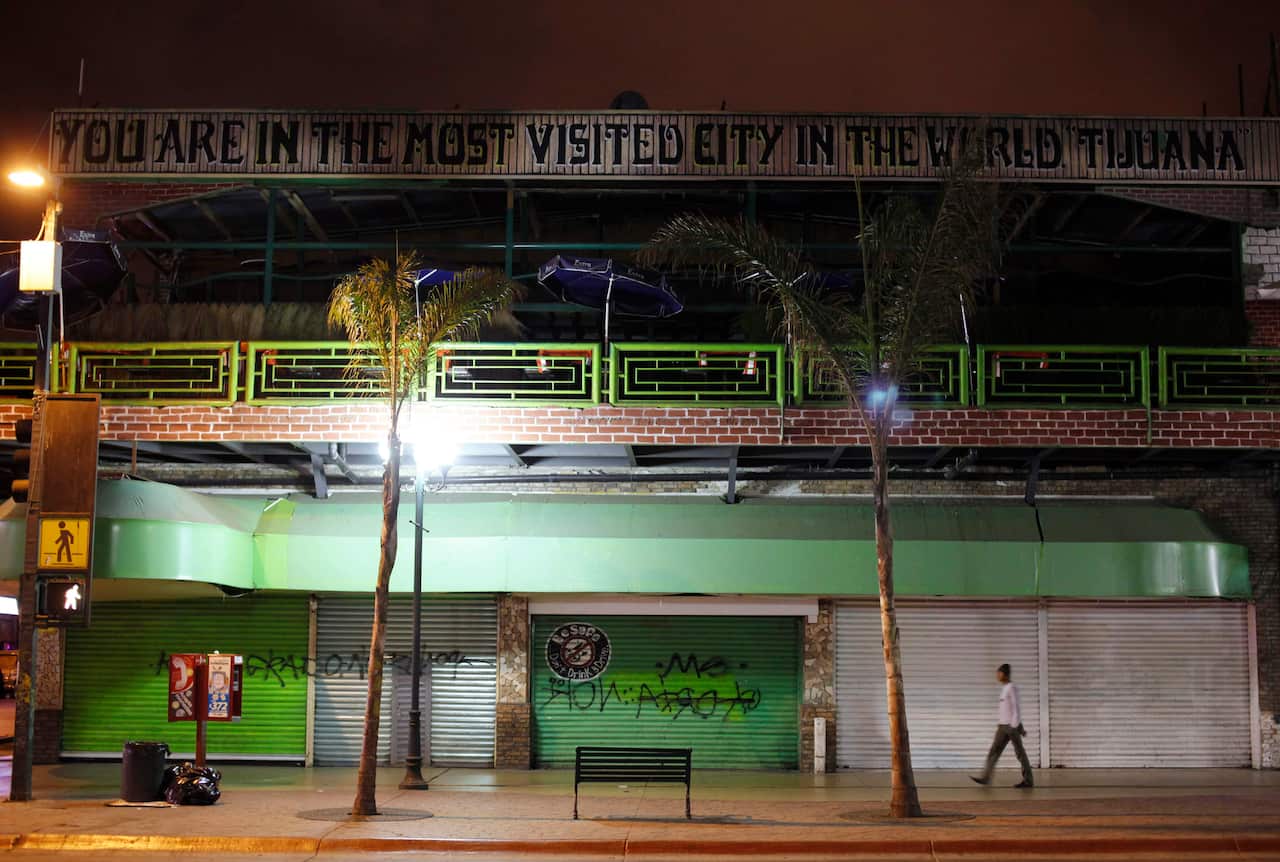
James used to work at a San Diego hostel that operates one-day tours to Tijuana—indeed, he used to run the tours himself—but is tonight in the role of paying customer along with his rugby-playing countryman. The city has changed immeasurably in the five years since he was last here, the 26-year-old Australian told me, draining a one-dollar happy hour beer on the balcony of El Torito Pub on Avenida Revolución, the city’s main tourist drag.
“If we’d been standing here a couple of years ago,” he said, “we’d have been able to hear gunfire only a few blocks away. Every few minutes, a truck of Federales[Mexican Federal Police] would have passed us packed with guys in balaclavas.”
I would later see him licking whipped cream from the crotch of a naked stripper while her workmates looked on dully.
The police presence today is comparatively and noticeably light. The Federales who do occasionally cruise by tend to be unmasked and not especially heavily-armed. A municipal police truck that passes only has two officers on the back and one of them is fast asleep.
“You still have to be careful at night, especially in the sleazier parts of town”—a reference to the red-light district in which the tour group is about to descend for lap dances and whipped-cream sundaes—“but it’s always been like that and it’s like that in other cities, too. There are places in the US where I wouldn’t walk around at night, either.”
“The difference here is that now I don’t feel like I might get caught in the middle of a shootout or something.”
In addition to the most lascivious of gringos, Mexicans, too, are beginning to return. But where drunken day-trippers see an alluring den of sin, locals see an increasingly sophisticated, cosmopolitan city that rivals anything north of the border for confidence and culture.
Indeed, where Tijuana’s visual arts scene once consisted of a donkey painted to look like a zebra, it today thrives in the old arcades off Revolución, the pasajes, where small galleries have popped up in their dozens. The strip’s long-abandoned bus station has been converted by savvy tech types into Hub Stn, which houses a number of small, innovative start-ups. Tijuana’s Opera in the Street Festival attracts nearly 10,000 people every year.
In other words, whatever the headlines say—and it is true that the city’s homicide rate has increased again in the past twelve months—the fact remains that most people here are simply trying to get on with it and are succeeding admirably.
Arnie is a US-Mexican citizen who sat out the worst of the drug war in Los Angeles but has been returning to Tijuana more regularly in recent years as the security situation has settled.
“You couldn’t get my grandmother here,” he said. “She takes the headlines at their word."
“I like the chaotic nature of it,” he said. “I like how messy it is. A lot of what we say about America—about individual liberty and freedom and all that—is actually much more applicable down here.”
But he said most people north of the border still refuse to visit their southern neighbour and balk when he tells them how often he does so.
“You couldn’t get my grandmother here,” he said. “She takes the headlines at their word. That’s the problem with Americans generally. They refuse to come down here and see how things have changed.”
This may change in the coming years as Tijuana solidifies its relationship with San Diego and both cities push to make travel between them easier. Last month, Tijuana mayor Jorge Astiazarán and San Diego mayor Kevin Faulconer signed the first formal agreement between the cities in twenty years and next year is set to see the opening of a pedestrian bridge between Tijuana’s Rodríguez International Airport and the northern side of the border.
But Arnie isn't particularly interested in changing people's perspectives too much.
“If people want to be scared, that’s their problem," he said as he downed one final tequila. "Actually, it's better if they are. It leaves more Tijuana for us.”





