
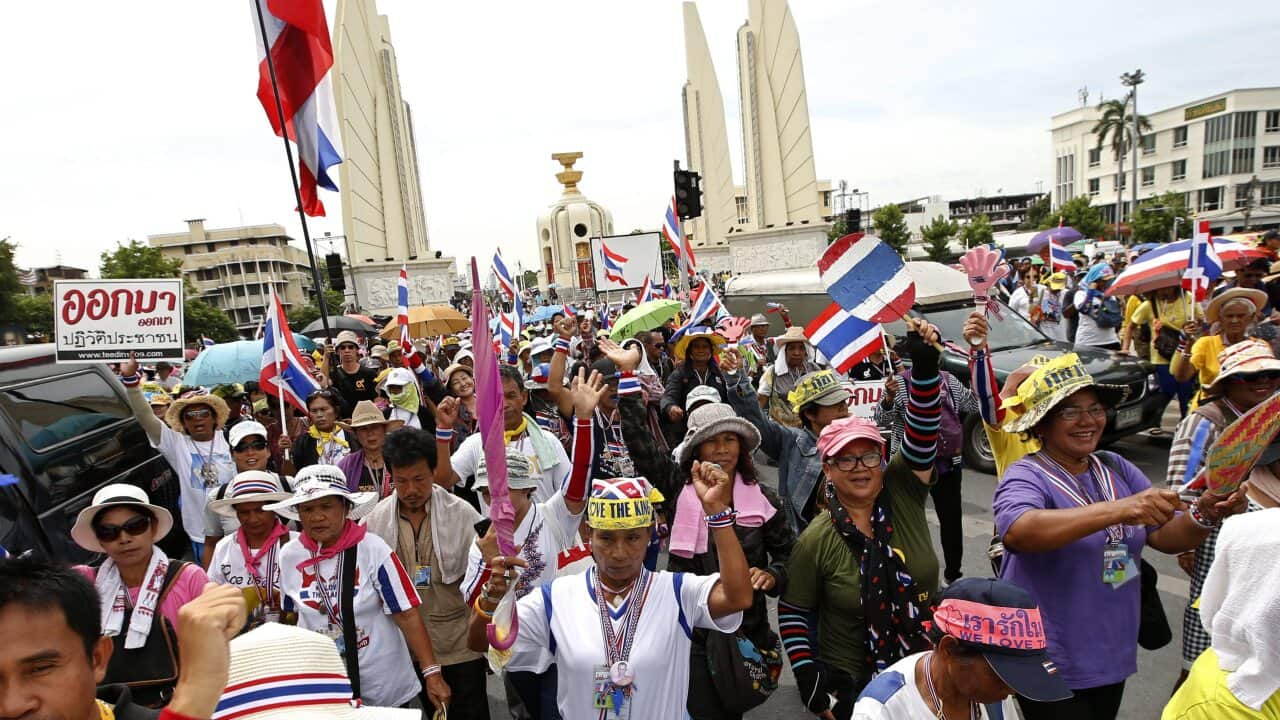
The army said the move was "not a coup" -- in a country which has seen 18 actual or attempted military takeovers since 1932.
Here is a timeline of the political crisis which has its roots in the 2006 ouster of tycoon-turned-premier Thaksin Shinawatra, who went into self-imposed exile to avoid jail for a corruption conviction.
May 20: Army declares martial law, stresses the move "is not a coup" and that there is no need for public panic.
May 15: The Election Commission says a general election scheduled for July 20 is "no longer possible" as polls cannot be held without the support of the protesters.
Army chief General Prayut Chan-O-Cha warns his troops "may use force" to quell political violence after three people are killed in an attack on anti-government protestors in Bangkok.
May 10: Pro-government protestors warn of "civil war" if an unelected leadership takes over the reins of power.
May 9: Protestors call for the Senate to aid their bid to topple the government.
May 7: Constitutional Court removes Yingluck and several cabinet ministers from office. New caretaker premier Niwattumrong Boonsongpaisan appointed by remainder of cabinet.
April 30: Government announces new elections for July 20.
March 21: Constitutional Court annuls February elections.
March 18: State of emergency lifted in Bangkok.
March 1: Demonstrators lift blockade of Bangkok.
February 19: Court bans use of force against protesters, a day after five are killed in clashes during a police operation to dislodge them.
February 14: Thousands of riot police are deployed in Bangkok to reclaim government buildings surrounded by demonstrators.
February 11: The election commission says election re-runs will be held on April 27 in constituencies where voting was obstructed.
February 2: Demonstrators prevent 10,000 polling stations from opening for the election, affecting several million people.
January 26: A protest leader is shot dead while giving a speech, as fellow demonstrators disrupt advance voting for the election.
January 21: Government declares a 60-day state of emergency in Bangkok and surrounding areas.
January 17: A grenade leaves one dead and dozens wounded at an opposition march, the first of several blasts targeting the rallies.
January 16: Anti-corruption authorities probe possible negligence of duty by Yingluck over a controversial rice subsidy scheme.
January 13: Tens of thousands of protesters occupy major streets in an attempt to "shut down" Bangkok.
December 28: An unknown gunman kills one protester and wounds several others -- the start of a series of drive-by shootings targeting demonstrators.
December 27: The army chief refuses to rule out a coup, saying "anything can happen".
December 26: The government rejects a call from the Election Commission to postpone the ballot after violent clashes.
December 22: Protesters stage massive anti-government rally in Bangkok.
December 9: Yingluck calls early elections. Opposition later announces boycott.
December 8: Opposition lawmakers resign en masse from parliament.
November 30: Opposition demonstrators attack a bus carrying government supporters. Several people are killed and dozens wounded in street violence.
November 25: Opposition supporters march on state buildings, eventually occupying several ministries.
November 11: Amid growing outrage on the streets, the upper house overwhelmingly rejects the legislation.
November 1: The lower house of parliament, which is dominated by the ruling party, votes in favour of the bill.
October 31: Protests break out against an amnesty bill which critics said was aimed at allowing Thaksin -- whose sister Yingluck Shinawatra is now in power -- to return home without going to jail for a corruption conviction.