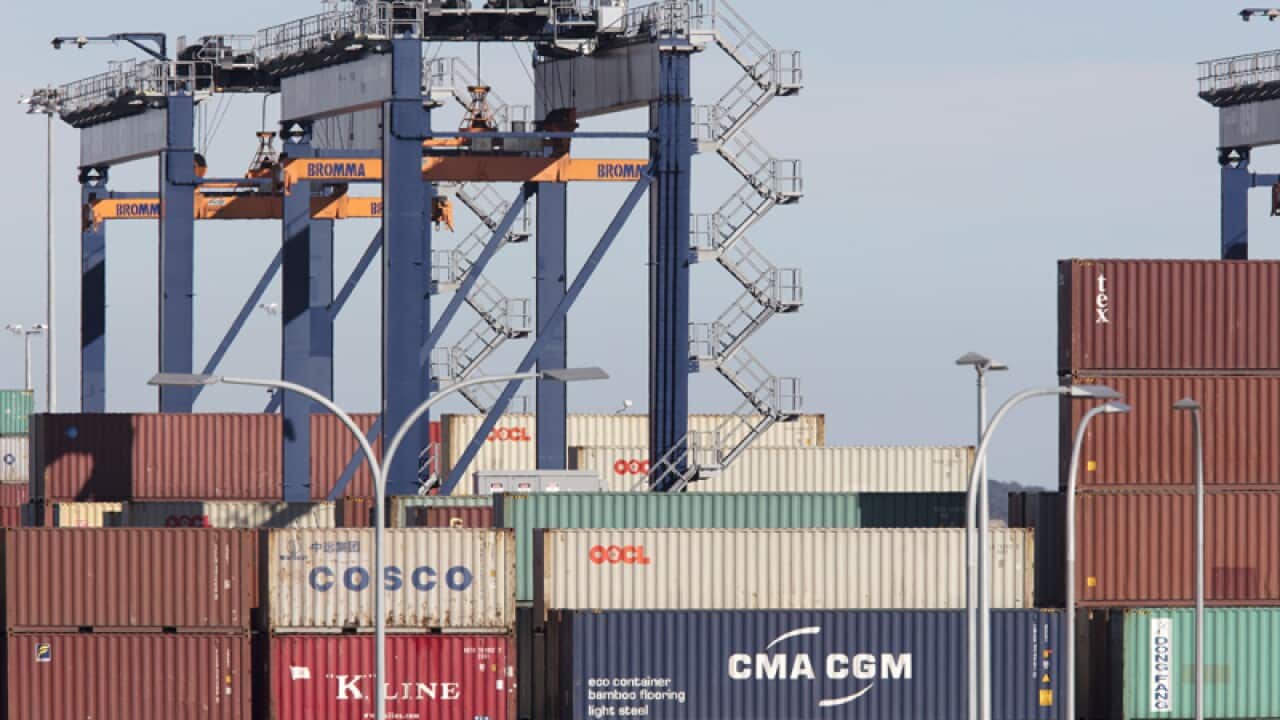
Trade will likely be a drag on March quarter economic growth, though a rise in consumer imports shows household spending is not slowing down, economists say.
The nation's trade surplus fell to $3.1 billion in March, from February's $3.6 billion, the Australian Bureau of Statistics said on Thursday.
Imports rose two per cent and exports jumped five per cent in the month, delivering the third largest trade surplus on record.
However, JP Morgan senior economist Tom Kennedy said the surplus was mainly driven by prices rather than volumes, meaning trade could weigh on the chain volume measure of gross domestic product (GDP) in the March quarter.
He said it was likely export volumes fell three per cent in March, while import volumes were up 1.5 per cent.
News that makes sense
Your trusted source for staying up-to-date with the world around you. Get free daily news updates and analysis, straight to your inbox.
"Combining these dynamics means that net trade is now likely to be a drag on GDP growth, rather than a modest support as per our previous forecast," Mr Kennedy said in a note.
"It is not all bad news, however, with the revision to the data in the past six months suggest that export volumes in the fourth quarter of 2016 may be revised higher."
The main drivers of exports in the month were gold and rural goods, while imports were led by textiles and clothing, and food and beverages.
Citi economists said the rise in consumer imports, after weakness in February, would be welcome news for the Reserve Bank of Australia as it signals consumption spending was not slowing down.
"This leaves the RBA back to juggling the impact of weak core inflation and excess labour supply versus the dangers from record high and still rising household debt and house price growth," the economists said.







