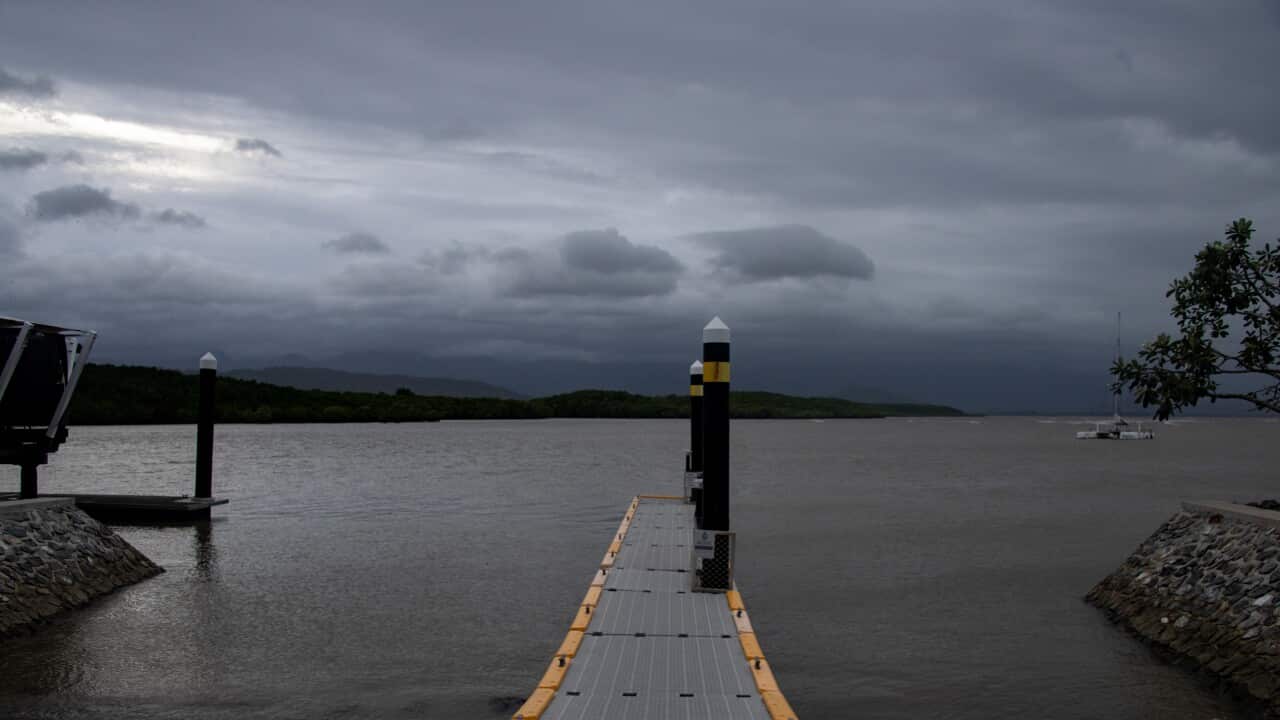
In brief
- Severe Tropical Cyclone Maila is forecast to slowly turn towards far north Queensland on Thursday.
- It had stalled between the Solomon Islands and Papua New Guinea for several days.
A record-breaking cyclone is expected to finally make its move towards the Australian coast, putting a flood-weary region again on high alert.
Severe Tropical Cyclone Maila is forecast to slowly turn towards far north Queensland on Thursday after stalling between the Solomon Islands and Papua New Guinea for several days.
The category 4 system is currently producing wind gusts of up to 260km/h after setting a new record as the strongest cyclone recorded so far north in the Solomon Sea.
It is set to weaken as it interacts with landfall closer to PNG and gradually treks toward Queensland's coast, potentially making landfall next week.
Residents in Queensland's far north are still wary of its potential impact, with the system likely to initially follow a similar path to March's Cyclone Narelle when it crosses the coast.
News that makes sense
Your trusted source for staying up-to-date with the world around you. Get free daily news updates and analysis, straight to your inbox.
Maila is currently forecast to make landfall between Cooktown and Lockhart River on Tuesday as a category 2 system, the Bureau of Meteorology's (BoM) Jonathan How said.
"There is still some variation in the exact timing among the computer models, but confidence is increasing that Maila's track will take it towards northern parts of Cape York peninsula," he said.
"But it is still five days away, and Maila's exact path, timing and strength will be influenced by a number of factors before then."
Maila is on track to cross close to where Narelle hit Cape York on 20 March before it left a trail of damage across the Top End and Western Australia.
It regained strength after crossing northern Australia and slammed into WA's north-west, peaking as a category 4 system as it destroyed buildings, brought down trees and triggered flooding.
On Thursday, the weather bureau warned that Cape York communities could expect further damaging to destructive winds, potentially intense rainfall, flooding and coastal erosion upon Maila's arrival.
Another cyclone would be a blow to a region still cleaning up Narelle's mess.
Maila was at one stage rated a category 5 system before it resumed its slow march toward Australia.
Maila's location at sea has so far kept the most damaging winds away from major population centres.
Footage showed destruction of property in remote parts of the Solomon Islands' Western and Choiseul provinces.
National broadcaster SIBC reported that three members of one family had gone missing after a boat capsized in heavy seas.
BoM senior meteorologist Liam Smart told AAP Maila was a record-setter for the region.
"It's the strongest cyclone this far north in the Solomon Sea on record," he said.
While it is technically possible for cyclones — known in the northern hemisphere as hurricanes or typhoons — to form at just one degree north or south of the equator, it is exceedingly rare.
For the latest from SBS News, download our app and subscribe to our newsletter.







