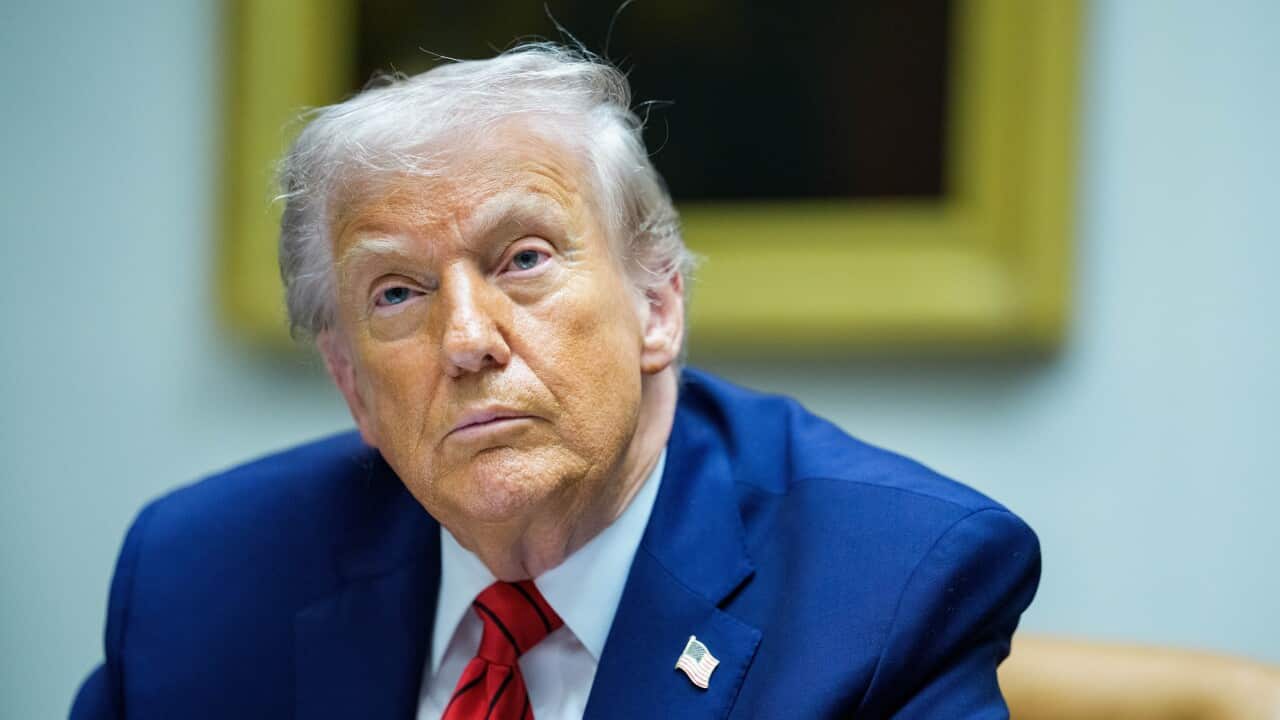
United States President Donald Trump has announced a naval blockade of "sanctioned oil vessels" leaving and heading to Venezuela, sharply escalating his pressure campaign against the South American country.
The US has for months been building a major military deployment in the Caribbean — with the stated goal of combatting drug trafficking but taking particular aim at Venezuela.
Venezuela views the operation as a pressure campaign to remove leftist leader Nicolás Maduro, whom the US and many nations view as an "illegitimate" president.
Tensions have been mounting for weeks as Trump signals intent to launch military action inside Venezuela, ominously declaring that the country's airspace should be considered "closed" and that efforts at halting drug trafficking "on land" would begin soon.
Last week, the United States opened a new front in the campaign, seizing an oil tanker that had left Venezuela and announcing sanctions on several other vessels and companies associated with the Venezuelan oil industry.
News that makes sense
Your trusted source for staying up-to-date with the world around you. Get free daily news updates and analysis, straight to your inbox.
"Today, I am ordering A TOTAL AND COMPLETE BLOCKADE OF ALL SANCTIONED OIL TANKERS going into, and out of, Venezuela," Trump wrote on his Truth Social platform on Tuesday evening US time.
Referring to the many Navy and Marine forces assembled in the Caribbean — including the world's largest aircraft carrier — Trump warned: "Venezuela is completely surrounded by the largest Armada ever assembled in the History of South America."
Why is Donald Trump imposing a blockade?
With Venezuela's economy heavily reliant on crude exports, the move to cripple its oil sector is likely to further ramp up pressure on Maduro.
But Trump on Tuesday pointed to another goal — regaining US access to Venezuelan oil production.
The US armada "will only get bigger," Trump said, until Venezuela returns "to the United States of America all of the Oil, Land, and other Assets that they previously stole from us".
He did not specify what oil or land he was referring to, but Venezuela nationalised its oil industry in the 1970s.
Later, under Maduro's predecessor Hugo Chávez, companies were forced to cede majority control to the Venezuelan state oil company, PDVSA.
A spokesperson for US company Chevron, which still operates in Venezuela under a special sanctions waiver, said on Tuesday that its operations "continue without disruption and in full compliance with laws and regulations applicable to its business".
Is Trump's blockade legal?
US presidents have broad discretion to deploy the country's forces abroad, but Trump’s asserted blockade marks a new test of presidential authority, said international law scholar Elena Chachko of UC Berkeley Law School.
Blockades have traditionally been treated as permissible “instruments of war", but only under strict conditions, Chachko said.
"There are serious questions on both the domestic law front and international law front."
US representative Joaquin Castro, a Texas Democrat, called the blockade "unquestionably an act of war".
"A war that the Congress never authorized and the American people do not want," Castro added on X.
How could the blockade impact Venezuela?
Venezuala strongly criticised Trump's announcement on Tuesday, saying he aimed at "stealing the riches that belong to our homeland".
Venezuela has been sidestepping US oil sanctions for years, selling crude at a discounted price on the black market, mainly to China.
Venezuela is estimated to have oil reserves of some 303 billion barrels, according to the Organization of the Petroleum Exporting Countries (OPEC) — more than any other nation.
"If there are no oil exports, it will affect the foreign exchange market, the country's imports ... There could be an economic crisis," Elias Ferrer of Orinoco Research, a Venezuelan advisory firm, told AFP recently.
"Not just a recession, but also shortages of food and medicine, because we wouldn't be able to import."
Two US officials said the new policy, if implemented fully, could have a major impact on Maduro.
David Goldwyn, a former State Department energy diplomat, said if Venezuela's affected exports are not replaced by increased OPEC spare capacity, the impact on oil prices could be in the range of $5 to $8 a barrel.
"I would expect inflation to skyrocket, and massive and immediate migration from Venezuela to neighbouring countries," Goldwyn said.
Since the US imposed energy sanctions on Venezuela in 2019, traders and refiners buying Venezuelan oil have resorted to a "shadow fleet" of tankers that disguise their location and to vessels sanctioned for transporting Iranian or Russian oil.
As of last week, more than 30 of the 80 ships in Venezuelan waters or approaching the country were under US sanctions, according to data compiled by TankerTrackers.com.
For the latest from SBS News, download our app and subscribe to our newsletter.







