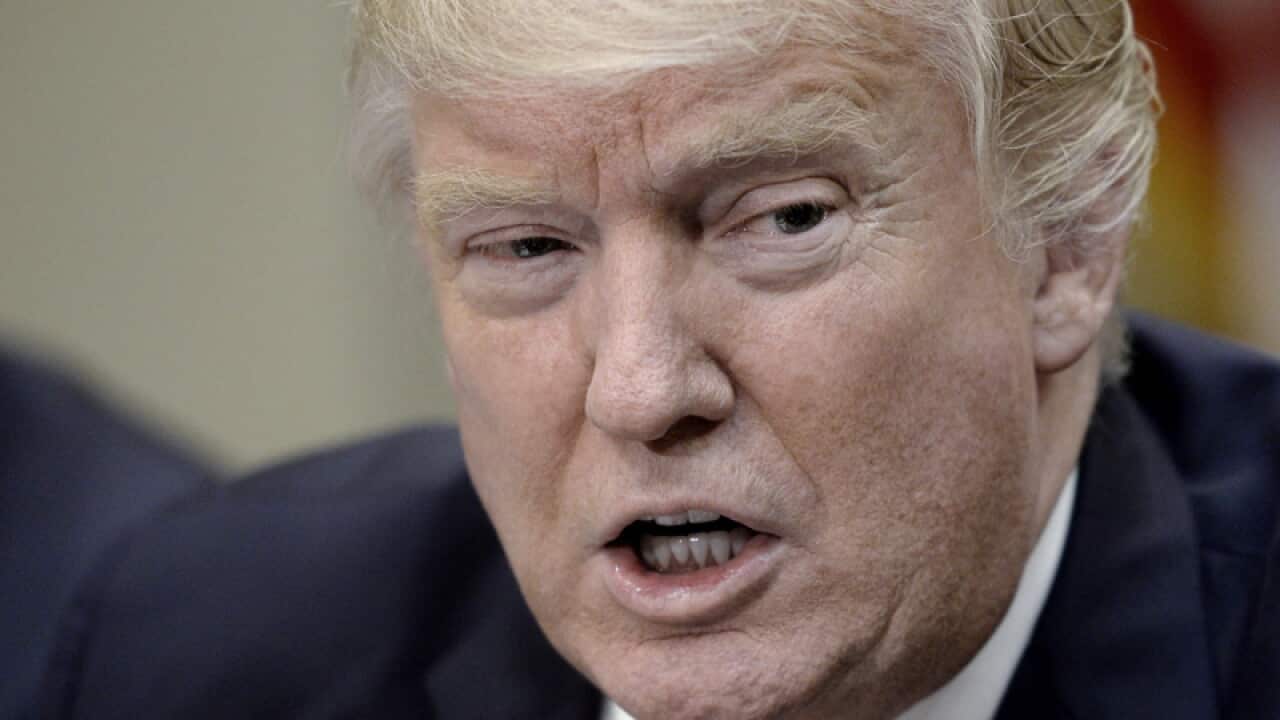
Donald Trump has become less predictable as he reaches his first 100 days in office, a group of academics has warned, raising problems for global security and the world economy.
The Australian National University on Wednesday launched a series of essays marking 100 days of the Trump administration in the United States.
Professor Michael Wesley, who heads the university's College of Asia and the Pacific, said Mr Trump had "broken the mould" in terms of global politics.
The ANU created a "predictometer" to gauge the Trump administration's delivery on its policy agenda.
The meter was set at 25 per cent on day one, but based on the three factors of what the president said he would do, what has been done and the policy positions of senior appointees in the administration - this has gone backwards and is now nudging single digits.
News that makes sense
Your trusted source for staying up-to-date with the world around you. Get free daily news updates and analysis, straight to your inbox.
Prof Wesley said the gap between what Mr Trump said and did had "left friends and rivals alike unsure of what the administration really thinks about crucial issues, or whether there is anyone doing very much policy thinking at all".
"Uncertainty is going to continue to be part of the Trump administration for the foreseeable future," he told the National Press Club at the essay launch.
Prime Minister Malcolm Turnbull will hold his first face-to-face meeting with Mr Trump in New York next week.
Professor Warwick McKibbin, who also contributed an essay, said the prime minister should push the benefits of open trade and sticking to global trade rules as he sought to gauge the president's economic policy.
Prof McKibbin said one of the biggest risks for Australia was the US retreating into protectionism and raising tariffs, which could cause a global recession.
"What you do get is the potential for a trade war three or four years down the track because once the fiscal policies are in place and once the imbalances in the external accounts get worse, somebody has to be blamed," he said.
"You won't blame the administration ... you will blame the foreigners."
Another essay author, Jane Golley, said this made it all the more important for Australia to take a leadership role in promoting open markets and borders.
"It's no time to be talking Australian jobs for Australians and shutting down our doors," she said.
One of the biggest policy uncertainties is how the US will respond to North Korea.
"The economic costs of protectionism ... really become immaterial if someone decides to press that button and drop the bomb," Dr Golley said.
"I think it's going to take far more clever foreign policy to ensure that doesn't happen and that matters more than anything else."







