
United States President Donald Trump has escalated his longstanding designs on controlling Greenland, vowing to levy higher tariffs on European allies until the United States is allowed the "complete and total purchase" of the autonomous Danish territory.
In a Truth Social post on Sunday, Trump said Denmark, Norway, Sweden, France, Germany, the Netherlands and the United Kingdom would face additional 10 per cent import tariffs from 1 February, rising to 25 per cent on 1 June.
The tariffs would be "payable until such time as a deal is reached for the complete and total purchase of Greenland", Trump added.
The countries Trump singled out — all of which already face tariffs imposed by the US president last year — have pledged support for Denmark and the people of Greenland.
In recent days, they have deployed small military contingents to Greenland in a show of NATO support for Denmark.
News that makes sense
Your trusted source for staying up-to-date with the world around you. Get free daily news updates and analysis, straight to your inbox.
So, under international law, can the US apply economic pressure to coerce a territorial concession from another state? The answer is complicated, according to one legal expert.
Donald Rothwell, a professor of international law at the Australian National University, said the legality of each tariff would depend on the individual trade agreements the US has with each European country.
The trade law implications are "quite significant", he said, given the transatlantic trade deals the White House reached last year with the European Union and United Kingdom.
The EU pact is now at risk of being derailed after European Parliament members signalled this week they would delay ratification in light of Trump’s Greenland threats.
Legality questionable if Trump succeeds
Leaders in both Denmark and Greenland, a mineral-rich Arctic territory of strategic importance to the US, have repeatedly said the island is not for sale.
Whether tariffs against Denmark amount to unlawful coercion depends on their severity and economic impact, Rothwell said.
"We're not at that point at the moment," he told SBS News. "But in theory, if State A was to impose absolutely crippling tariffs on State B, well, then that would certainly raise some international questions."
However, if Trump does manage to extract a treaty agreement from Denmark to cede Greenland to the US, its validity could be murky.
"Any treaty concessions by one state to another forced upon a state as a result of coercive activity undermine the legitimacy of the treaty arrangement," Rothwell explained.
If Denmark were to capitulate, he said, "there would be a real question about the legality of the treaty, because of the impact of the trade measures that the United States is threatening against Denmark".
Trump invokes global security as justification
Trump has said he is acting in the interests of global and national security, writing in his Truth Social post that "China and Russia want Greenland" and that "world peace is at stake".
Those arguments have no bearing on the legal analysis, according to Rothwell.
Trump has not ruled out using military force to take Greenland, though the White House says he prefers diplomacy.
The foreign ministers of Denmark and Greenland met with US secretary of state Marco Rubio and vice president JD Vance this week but were unsuccessful in shifting the US position.
"It's clear that the president has this wish of conquering over Greenland. And we made it very, very clear that this is not in the interest of the kingdom," Danish foreign minister Lars Løkke Rasmussen told reporters afterwards.
He said the issue was "very emotional" for the people of Greenland and Denmark.
"Ideas that would not respect [the] territorial integrity of the Kingdom of Denmark and the right of self-determination of the Greenlandic people are, of course, totally unacceptable."
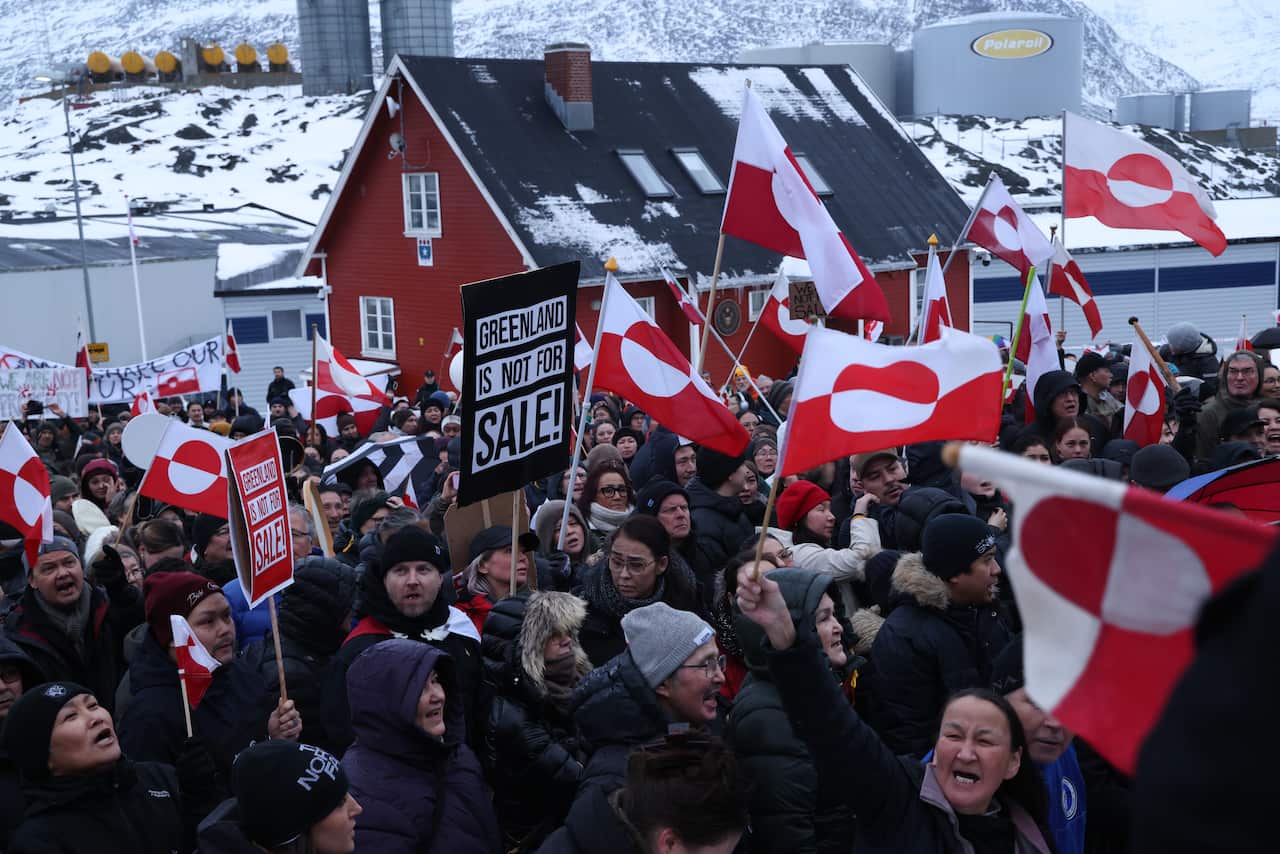
Thousands of people took to the streets in Denmark and Greenland over the weekend to protest Trump's demands. Demonstrators bore signs reading "Greenland is not for sale", "We are not property", and "Our land, not yours".
Greenlanders' right to self-determination
Under the United Nations Charter, the people of Greenland have a recognised right to self-determination.
A recent poll found 85 per cent of Greenlanders did not want to become part of the US, while more than half said they would vote in favour of Greenlandic independence from Denmark.

UN rights and legal experts expressed serious concerns this week about Trump's posture, calling on the US to "unequivocally reaffirm its commitment to the UN Charter".
Rothwell said that while there is no timeline for Greenlandic independence, it's a realistic future possibility — meaning any attempt to acquire the territory without the endorsement of its people would breach their right to self-determination.
'Unprecedented' situation
The UN Charter came into force in October 1945, after the end of World War Two.
In the 19th and early 20th centuries, it was not uncommon for major powers to acquire territory in pursuit of national interests. However, in the post-1945 world order, Rothwell said, such conduct by the US is "unprecedented".
He drew broad parallels between the US' current moves and Russia's approach in the lead-up to its 2022 invasion of Ukraine, noting the gradual escalation of pressure.
"The United States is using diplomatic, political and now economic levers," he said. "They've threatened military measures, but they haven't gone that far."
'Worrying moment' for global stability
From a global security and stability perspective, "this is a pretty worrying moment", Rothwell said, with a diplomatic resolution "increasingly looking unlikely" as positions harden on both sides.
If the US fails to achieve its objectives through economic pressure and continues on its current trajectory, it may ultimately resort to military force to take Greenland — a move that would, in Rothwell's view, trigger the immediate collapse of NATO.
Denmark’s Prime Minister, Mette Frederiksen, has also indicated that a military takeover of Greenland by the US would mark the end of the military alliance.
"Once NATO collapses," Rothwell said, "the global security environment is going to be reshaped."
For the latest from SBS News, download our app and subscribe to our newsletter.







