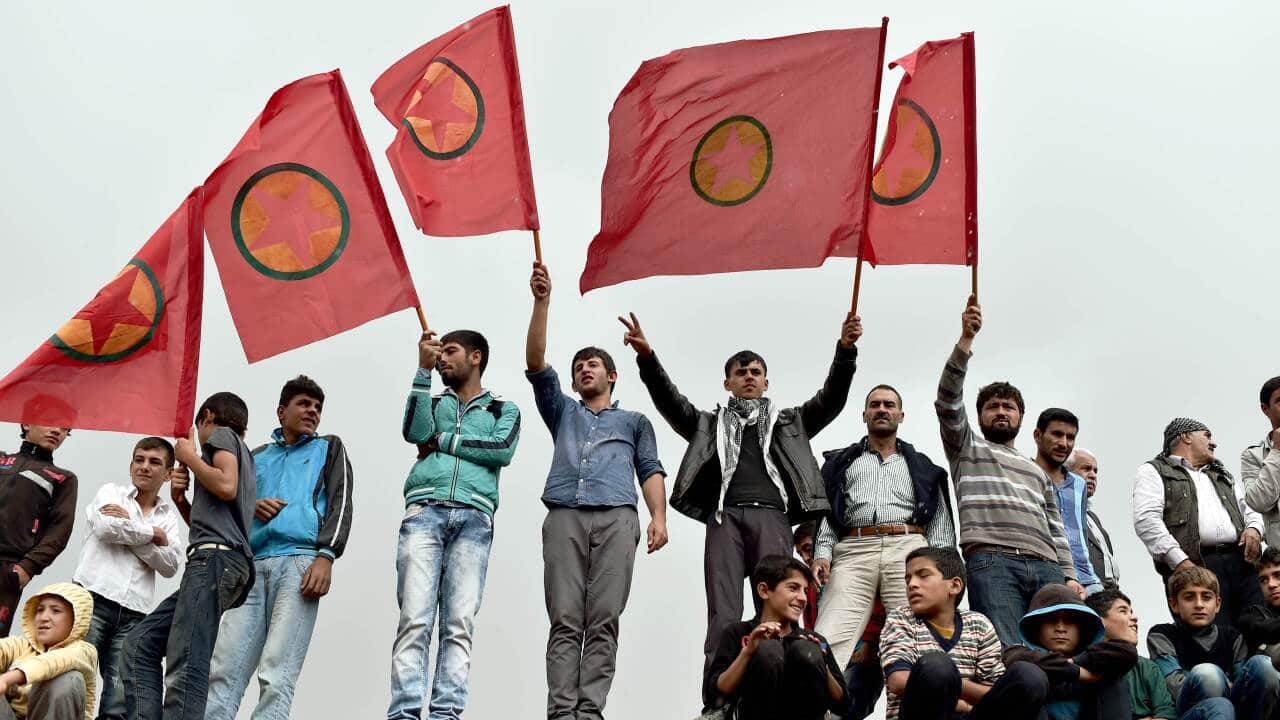
The strikes are the first on the outlawed group since a 2013 ceasefire was put in place, halting 30 years of violence that had claimed at least 40,000 lives.
The self-proclaimed Islamic State has been fighting in the region for nearly a month, in a bid to take over the key Syrian town of Kobani.
Fierce clashes between IS insurgents and Kurdish forces have shaken Turkey's fragile peace process with the PKK - a group which has been blacklisted as a terrorist organisation by Ankara and much of the international community.
News that makes sense
Your trusted source for staying up-to-date with the world around you. Get free daily news updates and analysis, straight to your inbox.
Frustrated with Turkey's lack of action to stop the IS advance, members of Turkey's 15 million strong Kurdish minority have rioted on the streets, leading to the deaths of at least 35 people.
Reports from an anonymous security source says the PKK has been launching gun attacks on the police station in the village of Daglica, near the Iraq border, since Saturday because of the troubles in Kobani. The source says, in response, Turkish F-16 jets bombed the village.
Despite the air strikes, Turkish Prime Minister Ahmet Davutoglu says their stance in the peace process has not changed.
"Turkey's solution to the peace process has not changed," he said.
"Nobody should doubt our decisiveness in the peace process and nobody should doubt that Turkey will do whatever it takes to maintain public order, and take all the necessary measures against any threat towards public order."
"Otherwise it would be impossible to continue the peace talks. Public order is the basis of the peace talks."
But the anger of mourners in the Turkish town of Suruc was apparent as large crowds gathered for the funerals of four female Kurdish fighters, who were killed during clashes with IS in Kobani.
Hundreds of mourners chanted "Murderer Erdogan" in Turkish and "long live the Women's Protection Unit" in Kurdish.
Meanwhile, the United States is continuing discussions with Turkey on the potential to use the country's military bases in the international campaign against IS.
American-led forces have conducted over 20 attacks on the militants near Kobani this week. But NATO-member Turkey has refused to join the Coalition unless it also confronts Syrian President Bashar al-Assad.
White House spokesman Josh Earnest says the issue of military bases in Turkey is an issue that continues to be discussed between officials.
''I would anticipate that in the weeks and months ahead, not only will we continue to be in touch with them on operationalising the commitments, on the commitments they've already made, but also having ongoing discussions with them about additional commitments they could make to support this broad, international coalition."
US President Barack Obama has held a meeting with the defense chiefs from more than 20 coalition countries about the attacks by IS - also known as ISIL - on Syria as well as Iraq.
He says the military action has produced results.
"Stopping ISIL's advance on Erbil, saving many civilians from massacre on Mount Sinjar, retaking the Mosul Dam, destroying ISIL targets and fighters across Iraq and Syria. Obviously, at this point, we are also focused on the fighting that is taking place in Iraq's Anbar province and we are deeply concerned about the situation in and around the Syrian town of Kobani, which underscores the threat that ISIL poses in both Iraq and Syria, and coalition air strikes will continue in both these areas."
Mr Obama stressed that the campaign against IS will not be short or simple, but he says the threat from IS extends well beyond the borders of Syria and Iraq.
"Ultimately, it will pose a threat beyond the Middle East, including to the United States, Europe and far flung countries like Australia that have already seen terrorist networks trying to infiltrate and impact population centers on the other side of the world."







