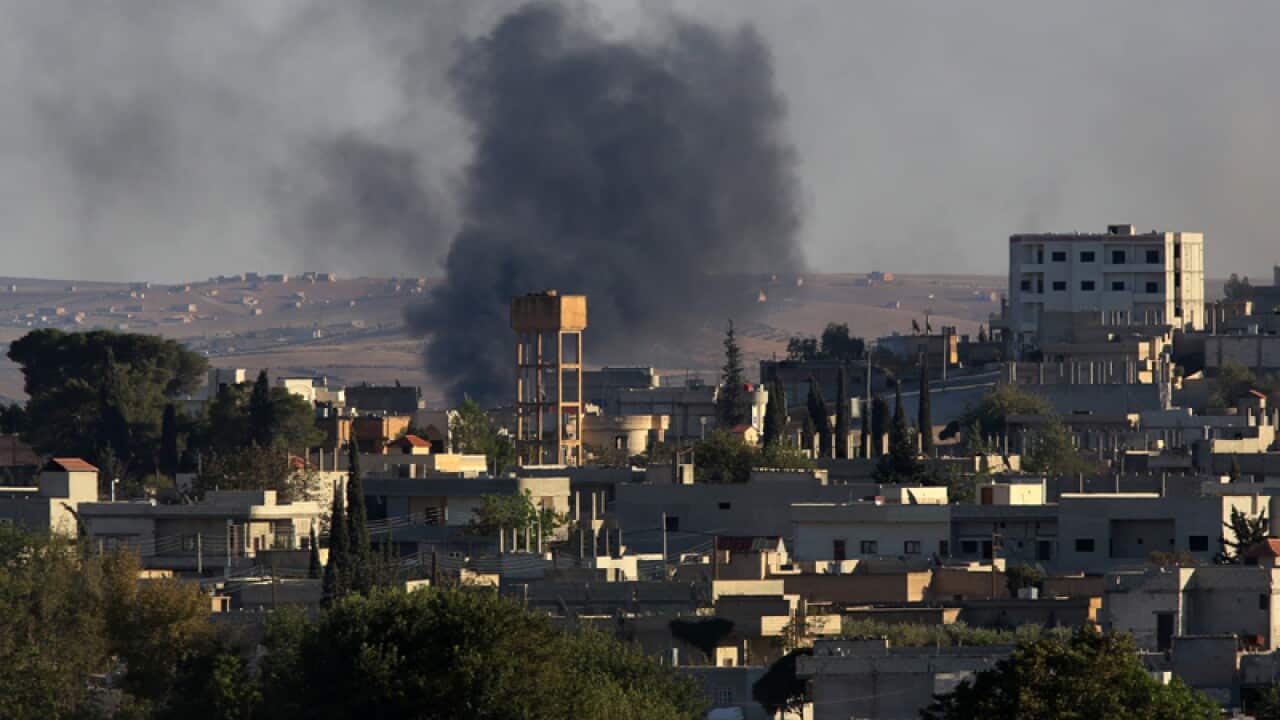
Turkey's parliament has authorised military action against the Islamic State jihadist group, as Australia said it would send its planes and special forces would also join the battle.
The move allows the deployment of armed forces in Syria and Iraq, as well as the transit of foreign forces in Turkish territory for operations against IS militants.
The broad mandate does not commit Turkey to sending soldiers into the two neighbouring countries, where IS has captured large areas, declaring an Islamic "caliphate" and committing widespread atrocities.
Washington welcomed Turkish MPs' decision. State Department spokeswoman Jen Psaki said there have been numerous high-level discussions with Turkish officials on fighting the IS threat, and that Washington looks "forward to strengthening that co-operation".
But Iran warned Ankara against further stoking tensions in the region, with Foreign Minister Mohammad Javad Zarif telling his Turkish counterpart that "countries in the region must act with responsibility and avoid aggravating" matters.
News that makes sense
Your trusted source for staying up-to-date with the world around you. Get free daily news updates and analysis, straight to your inbox.
Five Arab nations have participated in the US-led strikes on Syrian soil while the same number of European countries have committed aircraft to Iraq.
On Friday, Australian Prime Minister Tony Abbott announced in Canberra that the federal cabinet had approved Super Hornets to start bombing raids against Islamic State extremists, and special forces to train and advise Iraqi forces.
"It is a combat deployment, but it is an essentially humanitarian mission to protect the people of Iraq and ultimately the people of Australia from the murderous rage of the ISIL death cult," Abbot said.
"ISIL must be disrupted and degraded at home and abroad, so it is absolutely in Australia's national interests that this mission go ahead."
US Defence Secretary Chuck Hagel said he had discussions with France's defence minister on the possibility of Paris extending its participation in the American-led air war to include action on Syrian territory.
But Jean-Yves Le Drian would not confirm or deny that the subject came up during his talks at the Pentagon.
He would only say that France had joined the air strikes in Iraq because Baghdad had made a formal request under the UN charter.
Fresh US-led raids in Syria on Thursday destroyed an IS checkpoint near the besieged Syrian border town of Kobane and hit two tanks elsewhere, the Pentagon said.
In Iraq, coalition air strikes hit a number of IS vehicles as well as a building used by the jihadists.
At least 17 members of the Iraqi security forces were killed along with 40 jihadists in overnight attacks on two security force bases in the west of the country.
Kurdish militiamen, meanwhile, were locked in fierce fighting to prevent Kobane - also known as Ain al-Arab - from falling to IS.
Heavy mortar fire around the town was heard across the border.
"There are real fears that the IS may be able to advance into the town of Kobane itself very soon," the Syrian Observatory for Human Rights monitoring group warned.
A Kurdish official inside Kobane acknowledged that the better-armed IS fighters had advanced during the night.
"They are closer, two to three kilometres in some places," Idris Nahsen said by telephone.
"Compared to IS, our weaponry is simple. They have cannons, long-range rockets and tanks."
As the jihadists neared the outskirts of Kobane, there was a quickening of the exodus of civilians which had already seen tens of thousands take refuge across the border in Turkey.
"Kobane is practically empty of its residents now," Observatory director Rami Abdel Rahman said.
The US is pressing Ankara for the use of the Incirlik air base in southern Turkey by US jets launching assaults on IS in Syria.
But it is unclear if Turkey will allow the transit of lethal weaponry and may restrict the authorisation to humanitarian aid and non-lethal supplies.
Turkish President Recep Tayyip Erdogan pressed the West on Wednesday to find a long-term solution to the crises in Syria and Iraq, saying dropping "tonnes of bombs" on IS would provide only temporary respite.







