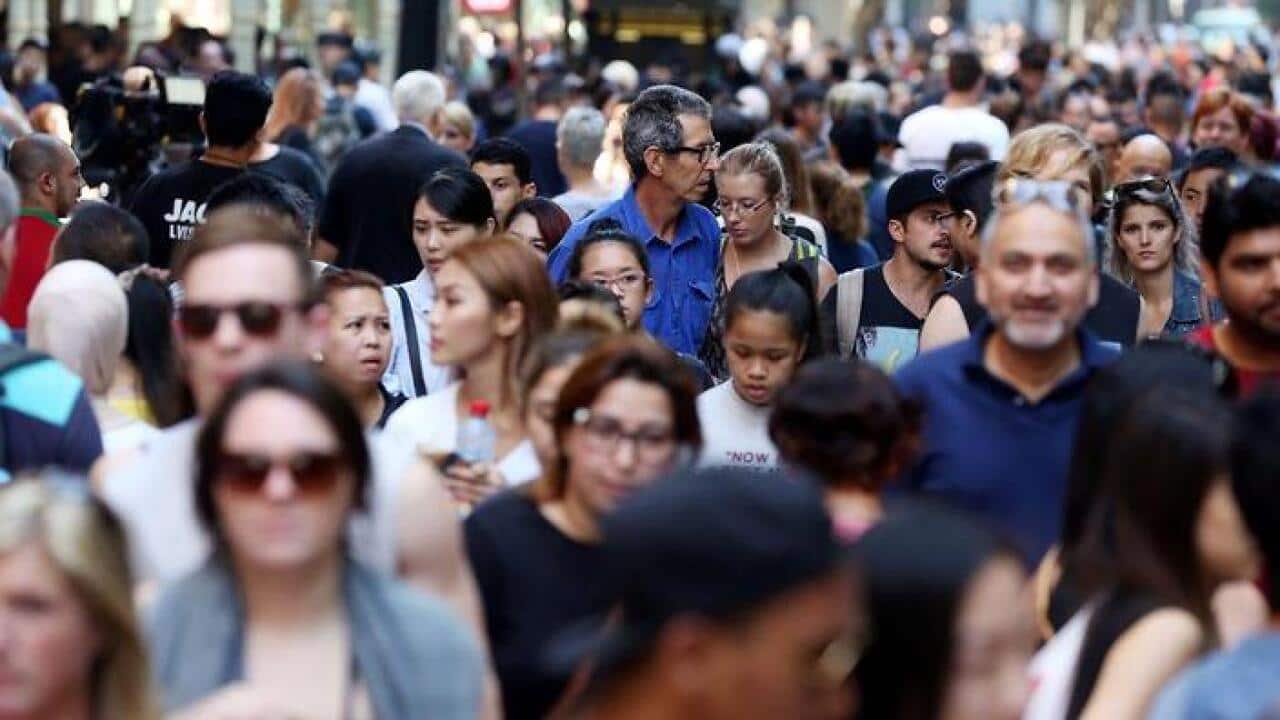
According to the last Census, nearly half of all Australians were born overseas or had at least one parent who was born in another country.
Australians come from about 300 cultural backgrounds, and about the same number of languages are spoken, including Indigenous languages.
It's against this backdrop that the Advancing Community Cohesion Conference is taking place.
Assistant Minister for Social Services and Multicultural Affairs Zed Seselja told SBS News that the role of the government was key to social cohesion.
News that makes sense
Your trusted source for staying up-to-date with the world around you. Get free daily news updates and analysis, straight to your inbox.
"The Australian government plays an important role in ensuring Australia continues to be one of the most socially cohesive nations in the world," he said.
"We know that the economic and social integration by new migrants and their families is vital to their future. We provide a settlement framework, widely considered best practice, to help migrants integrate into Australian life.
"Along with refugees and other migrants who've helped Australia become one of the most diverse, prosperous and harmonious nations on earth, our government's organisations, businesses, communities and individuals have helped maintain our social cohesion."
More than 7.5 million migrants had moved to Australia since 1945.
Greens Leader Richard Di Natale describes himself as a "product of migrant Australia".
He said the arrival of migrants and the exposure to different cultures, promotes learning and respect.
"So when you bring people to Australia, what you do is you challenge people who are in Australia to think in different ways, to actually learn from each other, and for us to grow collectively from that experience," he said.
"It's a two-way transaction, not a one-way transaction. It allows us to settle on the things that we know are universal, that we will always hold on to. Respect for our democratic institutions, for universal human rights, for making sure that we continue to provide opportunities for everybody.
"We learn from the many cultures that demonstrate a strong commitment to family, respect for elders, and they are things that help us, as a nation, grow together."
Mr Di Natale cited Pauline Hanson's stunt in August when she wore a burqa in the Senate as an example of an act which could discourage social cohesion.
But, he said Australia isn't alone in confronting the issue."When you look at what's happening globally, you recognise that what we have, it's not a situation that's limited to Australia," he said.
"We have an unequal society in Australia, we have an unequal society across the world. And that is the condition in which we've seen the emergence of Donald Trump, using fear and division. Right through Europe, we're seeing the emergence of far-right political groups, in Austria, Germany, Marine Le Pen in France."
This week's gathering marks the second Advancing Community Cohesion Conference.
Delegates include government ministers and officials, academics, researchers, religious leaders and scholars.
The conference convenor Dr Sev Ozdowski is the Chair of the Australian Multicultural Council.
He felt multiculturalism and social cohesion go hand-in-hand.
"When you compare the two definitions, the definition of multiculturalism and the definition of social cohesion, you will they are an almost perfect match," he said.
"The same principles go to multiculturalism and social cohesion. So I must say that the Australian multicultural policies and programs are really key contributors to cohesiveness in Australia."







