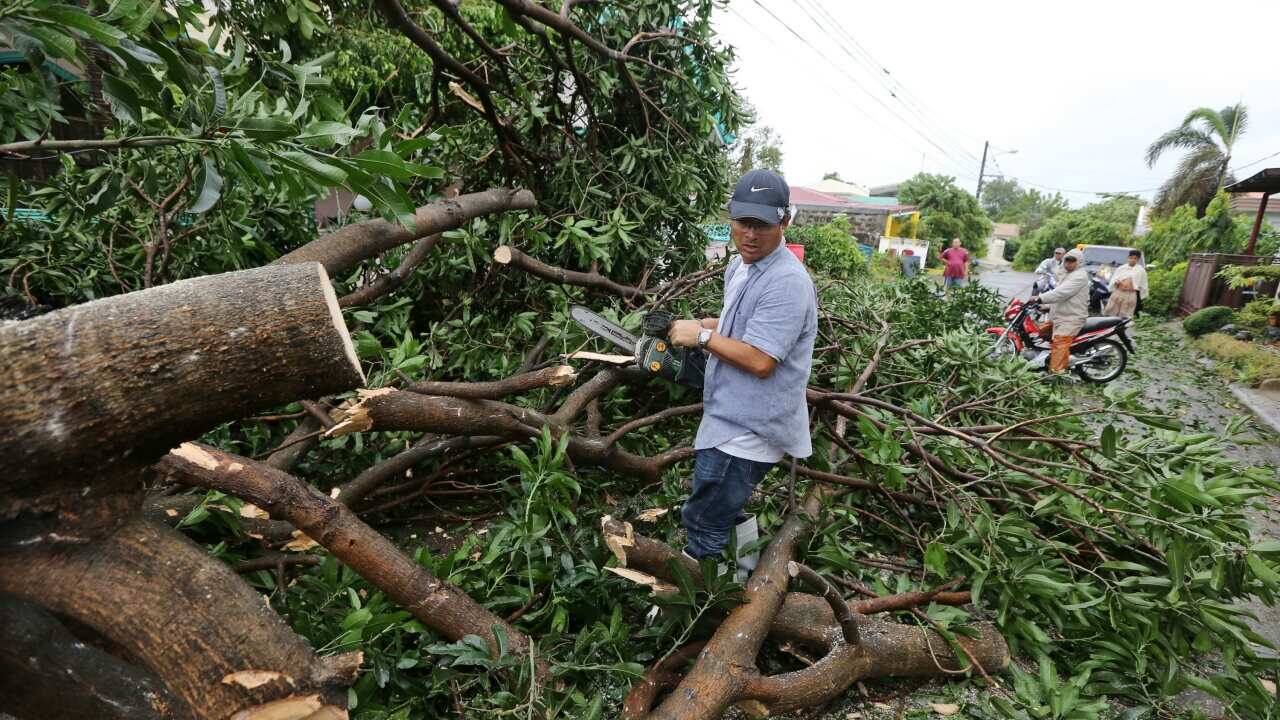
The first typhoon of the Philippines' brutal rainy season has shut down the nation's capital, killing at least 20 people across the country and cutting power for millions.
The system has been downgraded to a category-one storm by monitoring agency Tropical Storm Risk as it moves towards China, travelling northwest into the South China Sea.
Ferocious winds from Typhoon Rammasun on Wednesday tore roofs off houses, overturned cars and ripped down electricity lines in the mega-city of Manila, as well as remote fishing villages hundreds of kilometres away.
'I thought I was going to die'
"I thought I was going to die. I went out to look for gasoline in case we needed to evacuate, but it was a mistake," said tricycle driver Pedro Rojas, 35, as he nursed a cut head while sheltering at a town hall on the outskirts of Manila.
News that makes sense
Your trusted source for staying up-to-date with the world around you. Get free daily news updates and analysis, straight to your inbox.
"My tricycle rolled over twice after I slammed into sheets of rain. It was like hitting a wall ... huge tin roofings were flying everywhere."
Falling trees, poles and walls killed at least 20 people across the northern parts of the Philippines that Rammasun swept over with wind gusts approaching 200km/h, authorities said.
One of those was a rescue worker who died in the capital when a government building collapsed on him, while falling trees killed two elderly people in rural areas of a province neighbouring Manila.
Rammasun, which in Thai means "God of Thunder", tore in from the Pacific Ocean with wind gusts of about 250km/h and smashed into poor fishing communities in the east of the archipelago on Tuesday night.
Storm loses steam as it heads towards southern China
It weakened slightly as it cut across the main island of Luzon and exited into the South China Sea on Wednesday afternoon. Weather forecasters warned it may pick up strength again as it tracks towards southern China.
The eye of the storm just missed Manila, home to more than 12 million people, but the huge winds and bursts of heavy rain brought the city to a virtual standstill.
Power in Manila and neighbouring provinces was cut in the morning as branches were torn off trees and electricity lines snapped.
Manila's power distributor, Meralco, said 5.3 million homes had lost electricity in the capital and surrounding provinces, and that it could be days before services were restored to some areas.
'Extent of damage is huge'
Energy Secretary Jericho Petilla urged people to buy generators and stock up on fuel.
"The extent of the damage is huge," Petilla said.
Across the country, about 350,000 people fled their homes and sheltered in evacuation centres, according to the disaster management council.
The Philippines is hit by about 20 major storms a year, many of them deadly. The southeast Asian archipelago is often the first major landmass to be struck after storms build above the warm Pacific Ocean waters.
Rammasun was the first typhoon to make landfall since this year's rainy season began in June.







