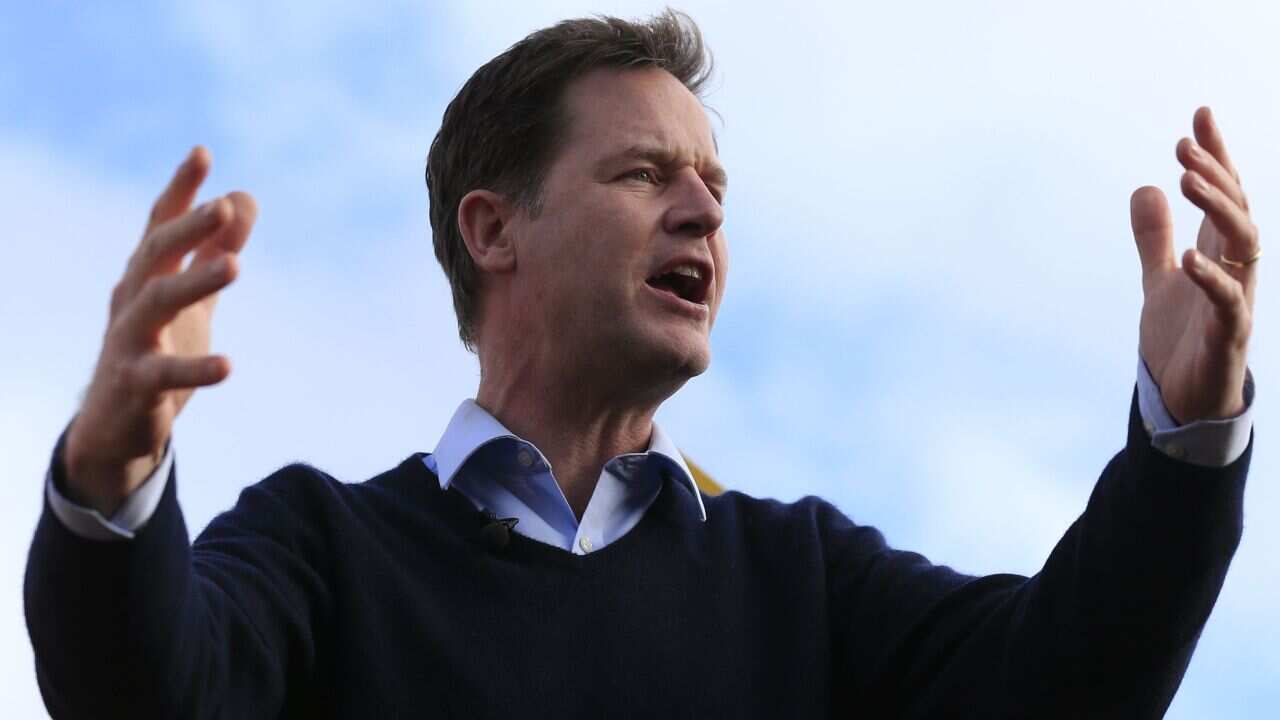
British Prime Minister David Cameron and his rivals have been rallying support over the long weekend, with Thursday's looming election widely expected to be the most unpredictable in decades.
Most opinion polls suggest the ruling Conservatives and their main opponents, the Labour Party, are neck and neck, each hovering around the 30 to 35 per cent mark.
The BBC poll tracker shows the Conservatives on 34 per cent, Labor with 33 per cent, UKIP at 14 per cent, the Lib Dems on 8 per cent and the Greens with 5 per cent.
If no party wins a majority, some form of coalition government appears likely. That may or may not involve the Liberal Democrats as happened in the last general election five years ago.
Liberal Democrats leader Nick Clegg was a kingmaker then, but this time his party could be headed for oblivion.
The Liberal Democrats polled 24 per cent at the last election, but now support has plummeted to just eight per cent.
With neither of the main parties likely to win enough to govern in its own right, minor parties again could play a key role.
The Lib Dems have positioned themselves as the sensible middle ground.
“We’ll cut less than the Conservatives and we’ll borrow less than Labour,” Nick Clegg has said.
But the reality is its leader is facing his own challenge. Clegg is fighting for survival in his own seat, where many people are angry at the party’s broken pledge not to raise tuition fees.
Polling day on Thursday
Some 30 million of Britain's 64 million people will vote in 650 parliamentary constituencies where 3971 candidates are standing in Thursday's election.
Heading to around 50,000 polling stations between 7am and 10pm on Thursday, the voters will choose one from a list of up to a dozen parliamentary candidates in each constituency, while in many areas they will also vote in elections to local councils.
In Britain's first-past-the-post system, whoever attracts the highest number of votes becomes the constituency's representative in London, meaning candidates can sometimes win with as little as
30 per cent of the votes cast.
Candidates must be supported by 10 registered electors from the constituency and pay a deposit of £500 ($A966), which they forfeit if they fail to win five per cent of the votes.
England has 533 constituencies, with 59 in Scotland, 40 in Wales and 18 in Northern Ireland.
The geographical size of the constituencies varies enormously between urban and rural areas, while the number of voters per constituency averages about 70,000.
In the last parliamentary elections in 2010, 45.6 million people were registered to vote but only 29.7 million did so, a turnout rate of 65 per cent. About 15 per cent of votes were cast by post.
The number registered this year is expected to total between 45 million and 50 million, but it will not be announced until after the election.
Parliamentary elections have been held on Thursdays since 1935, but there was no requirement to do so until the introduction of the 2011 Fixed-term Parliaments Act, under which elections must be held every five years on the first Thursday in May.
Some people believe the tradition began because Thursday was market day in most towns, meaning people from outlying areas could vote at the same time as buying and selling.
Others point to Thursday as an early closing day for shops before the advent of seven-day opening, giving voters more time to reach polling stations.
Another popular theory is that Thursday was chosen to minimise disruption by allowing time for the formation of a new government over a weekend.
Share


