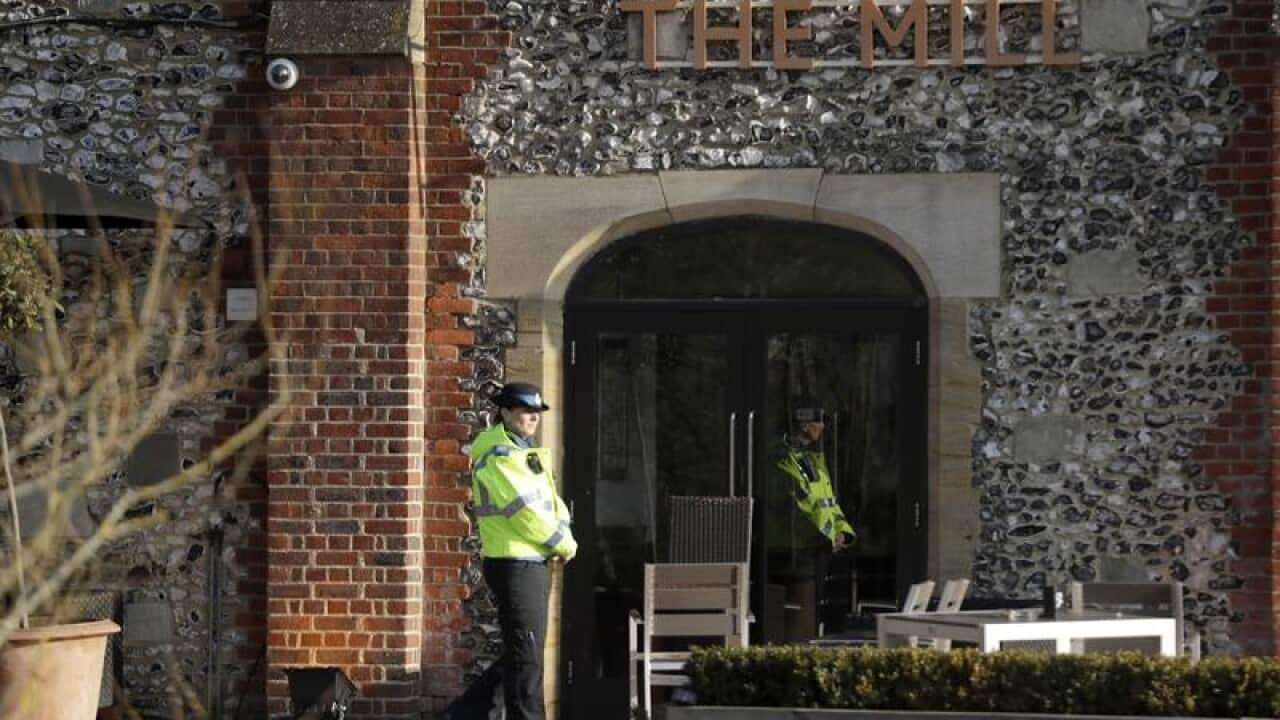
UK counter-terrorism officers are working to uncover the origin of the nerve agent used in the "attempted murder" of ex-Russian spy Sergei Skripal and his daughter, Yulia, in southern England.
Skripal, 66, and his daughter Yulia, 33, were found unconscious on a bench outside a shopping centre in the southern city of Salisbury on Sunday afternoon.
UK Home Secretary Amber Rudd said the pair remain in a serious condition while a police officer, who was one of the first to respond to the incident, is "talking and is engaging" in hospital.
Britain's top counter-terrorism officer Mark Rowley said on Wednesday that government scientists had identified the specific nerve agent but he would not say what it was because it was part of the investigation.
"This is being treated as a major incident involving attempted murder by administration of a nerve agent," he said.
News that makes sense
Your trusted source for staying up-to-date with the world around you. Get free daily news updates and analysis, straight to your inbox.
The BBC on Thursday quoted an unidentified source as saying the nerve agent was "likely to be rarer" than Sarin and was "said not to be VX."
The case has drawn comparisons to that of Alexander Litvinenko, another Russian former intelligence officer who died in 2006 after drinking tea laced with a radioactive isotope. A British inquiry concluded that Litvinenko was targeted for assassination by the Russian intelligence services.
Rudd told BBC Radio 4's Today program the UK government would keep a "cool head" amid speculation linking Russian state agents to the attack.
"When we have all the evidence of what took place, we will - if it is appropriate - attribute it to somebody," she told the BBC, ahead of a statement to parliament later on Thursday.
"We need to be very methodical, keep a cool head and be based on the facts, not rumour," Rudd said.
A spokesman for British Prime Minister Theresa May described the poisoning an "appalling and reckless crime".
Defence Secretary Gavin Williamson earlier told ITV1's Good Morning Britain: "Russia's becoming an ever-greater threat and what we are seeing right across the eastern front in countries such as the Ukraine and Estonia is an increasingly aggressive stance.
"Russia's changing the way they actually fight and raise the level of conflict. We are seeing this in the north Atlantic as well - the amount of submarines that are operating, there's a 10-fold increase in the last seven years.
"Russia's being assertive, Russia's being more aggressive, and we have to change the way that we deal with it because we can't be in a situation in these areas of conflict where we are being pushed around by another nation."
Williamson declined to say whether he held Russia responsible for the attack in Salisbury, saying: "What's happened is absolutely disgusting and it is so important we give the police the space and opportunity to do a proper and thorough investigation."







