
IN BRIEF
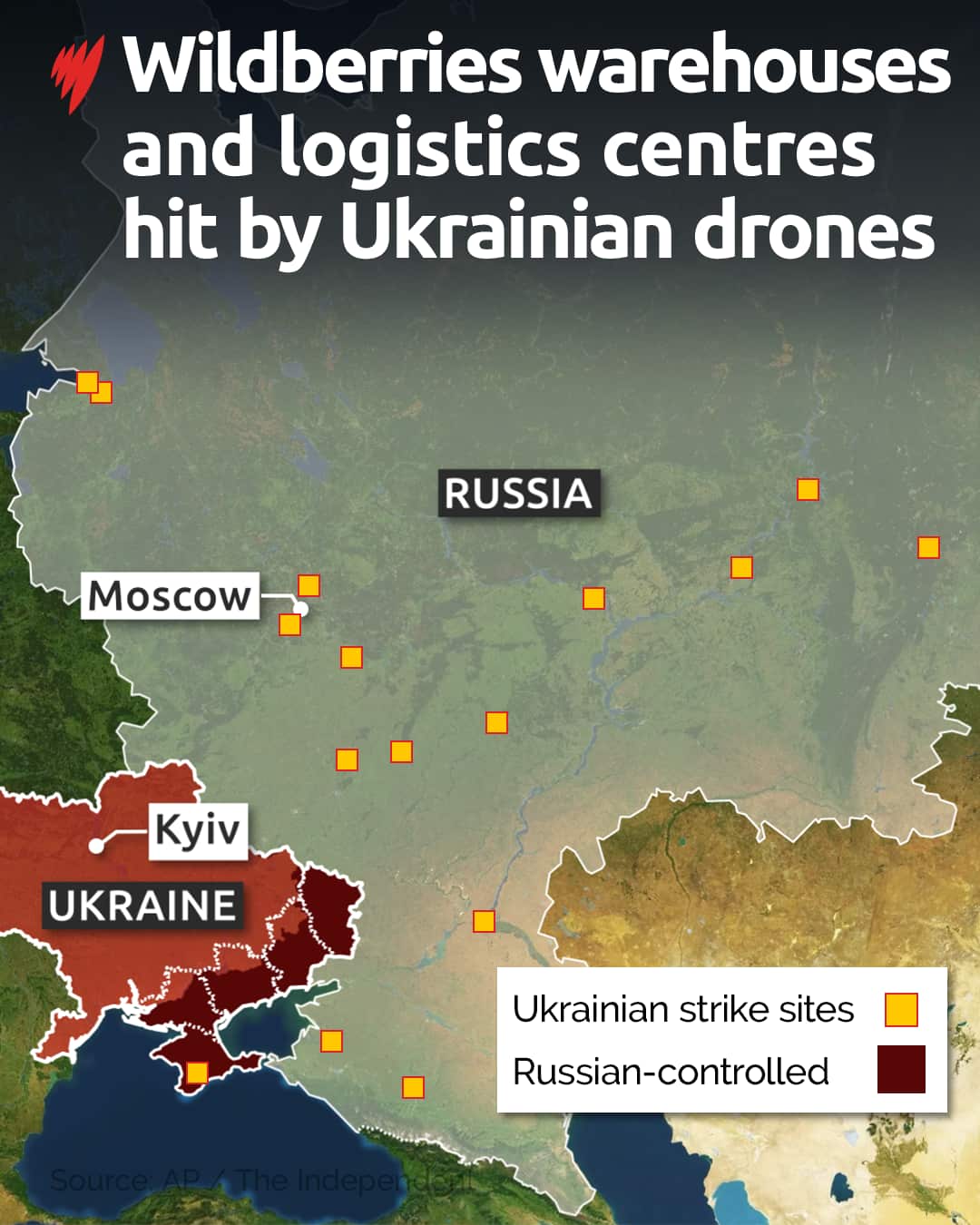
- Ukraine has targeted warehouses and logistics facilities in Russia and Russian-controlled territory owned by retailer Wildberries.
- Ukraine's long-range drone strikes are reaching deep inside Russia, stretching its air defences.
Ukraine is bringing the war home to Russia, experts say, with a growing campaign of long-range drone strikes targeting infrastructure embedded in everyday Russian life.
More than four years after Russia launched its full-scale invasion, Ukraine is increasingly using domestically produced drones to strike targets deep inside Russian territory.
Among the targets is Wildberries, Russia's biggest online retailer, with a sprawling network of warehouses and distribution centres.
At least 20 Wildberries locations have been targeted, including sites more than 2,000km from Ukraine.
Experts say the strikes are about more than damaging individual warehouses.
News that makes sense
Your trusted source for staying up-to-date with the world around you. Get free daily news updates and analysis, straight to your inbox.
They say the attacks demonstrate Ukraine's expanding ability to reach deep inside Russia, while making the economic and psychological costs of the war harder for ordinary Russians to ignore.
Bringing the war 'home'
Professor Matthew Sussex, a defence and national security expert at Deakin University, said Ukraine is deliberately trying to make the war's consequences harder for ordinary Russians to ignore.
"Ukraine is hitting Wildberries mainly to bring the cost of war home to Russians," he said.
He described Wildberries as Russia's version of Amazon, a platform where people can buy almost anything and have it delivered to their door.
"Wildberries has become extremely popular for everyday Russians to order things, consumer goods that they have relied on in the past which have become unavailable due to the sanctions regime [placed on Russia by other countries]," he said.
Sussex said Ukraine's strategy is ultimately about making Russians feel the consequences of a war that, for many, has remained at a distance.
"If you're in Moscow or some parts of St Petersburg, you don't really feel the cost of the conflict," he said.
"Ultimately, Ukraine has to change the game up somehow."
Why else was Wildberries targeted?
There is also a military dimension to the strikes.
Ukraine says Wildberries has been involved in supplying Russian forces with military and dual-use equipment.
Retired Australian Army major-general Mick Ryan agreed there's a strategic reason for choosing Wildberries.
"These things are part of the Russian military logistics network," he said. "Russian soldiers and units buy things out of these warehouses all the time."
Wildberries and the Russian government have both said the e-commerce giant does not supply to the army.
Sussex believes the broader economic impact is ultimately more significant. Wildberries has billions of dollars in annual sales, and thousands of Russian businesses rely on the platform to sell and distribute their products.
"The concern is that if these attacks continue, then Wildberries may have to be bailed out by the government," Sussex said.
"The implications are much more economic, much more structural."
Ryan also said that as the targets were warehouses, the potential for civilian casualties when attacking them was "very much reduced" compared to sites like shopping malls.
Oleksandra Molloy, a drone warfare expert and senior lecturer at the University of New South Wales, said the focus is ultimately on the logistics network behind Wildberries.
"It's really that logistics and transport network and supply chain of goods that support the Russian military," she told SBS News.
"It also appears to be part of the attempt to increase economic pressure in Russia."
By targeting Wildberries, Ukraine can simultaneously disrupt military-related supply chains, put pressure on the wider Russian economy and affect a company deeply embedded in everyday life.
Ukraine steps up its aerial capacity
The attacks are part of a broader evolution in Ukraine's use of drones.
Molloy said it indicates the technology has moved well beyond reconnaissance and intelligence gathering.
Ukraine is now using long-range unmanned systems to conduct precise strikes against infrastructure.
She describes the shift as a form of "drone sanctions" — the use of relatively inexpensive unmanned technology to pressure an adversary beyond the battlefield.
Experts say that the distance of these attacks is significant in its own right.
Some of the Wildberries facilities targeted by Ukraine are more than 2,000 kilometres from the Ukrainian border, and Molloy said systems are tested to around 3,400km.
For Ryan, that demonstrates how dramatically Ukraine's long-range strike capability has developed.
He said four-and-a-half years ago, when Russia launched its full-scale invasion, Ukraine did not have this capability. Now, it can threaten targets across Russia.
"It tells us that Ukraine can hit wherever it wants in Russia," Ryan said.
Ryan said Ukraine has built the capability largely through domestic defence production, rapidly developing and refining its own drones and missiles.
"Long-range strikes don't win wars ... But it’s an important component of any winning strategy."
But the capability isn't just about the technology. It also requires detailed intelligence, planning and personnel dedicated to carrying out long-range missions.
Molloy said the Wildberries strikes provide a clear demonstration of that capability, with the evolution meaning drones can now threaten "critical infrastructure, military points, but also any logistics operations".
"It's not limited only to the battlefield itself," she said.
"It shows that it just goes well beyond that."
Stretching Russia's air defences
Ryan told SBS News that the strikes have another strategic benefit.
Ryan said Russia must decide how much air defence it can devote to protecting infrastructure far from the front line, given Ukraine has worked hard to degrade its air-defence network, targeting its sensors, interceptors, units and commanders.
"One of the things Ukrainians have worked very hard on is taking down the air defence system in Russia," he said.
"The sensors, the interceptors, the units, the commanders."
He said more targets Russia is forced to defend, the harder those decisions become.
"There are more different kinds of targets across a wider geographical area that the Russians are forced to defend," he said.
"Not only are they using up interceptors, but they are creating gaps that the Ukrainians can penetrate for attacks on important industrial and defence industry targets."
Ryan said that is part of the broader calculation behind targeting infrastructure like Wildberries, forcing Russia to spread its defences across an enormous geographical area, potentially leaving more strategically important sites exposed.
Making Russians feel the war
That growing capability gives Ukraine another way to fight a war where the front line itself has remained relatively static.
Sussex describes it as an "aerial war in the rear areas of the conflict".
Rather than relying solely on battlefield gains, Ukraine is trying to degrade Russia's ability to sustain the war, while simultaneously making the conflict more tangible for its population.
For ordinary Russians, that could mean disrupted deliveries, damaged businesses, rising economic costs and, ultimately, confronting the reality that the war isn't happening in Ukraine alone.
Ryan said there is a clear psychological dimension to the strikes.
If Ukraine is willing to fly more than 2,000km to hit a warehouse, Russia has to consider what else Ukraine could reach.
But he warned the strategy could backfire on Ukraine, with Russians potentially "doubling down" in their support for the war.
Sussex echoed this sentiment, adding that despite growing frustration with the war, Russia's government has extensive tools to suppress public dissent.
For the latest from SBS News, download our app and subscribe to our newsletter.







