(Transcript from World News Radio)
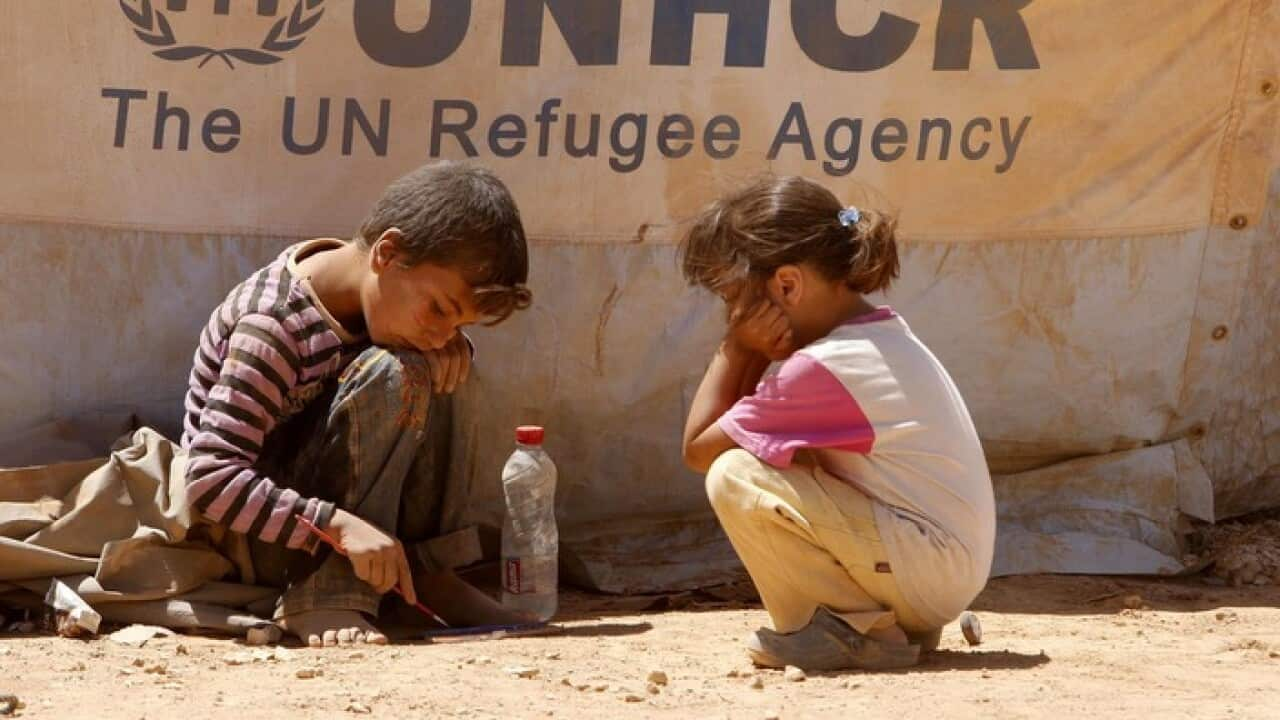
The United Nations has estimated that 230 million children reside in conflict zones around the world.
In most cases, they're innocent victims of the violence going on around them.
But UN officials say they're also disturbed by the number of children who continue to be drawn into conflicts as fighters.
Van Nguyen has the details.
(Click on audio tab to listen to this item)
"The hardest was to see young children of my age playing on a football field not far from an area where I was standing guard. On a night when I was standing guard in the cold outside the gate, I saw again the image of these children who were playing and pain in my heart. My eyes full of tears, I asked softy, 'Oh God, what did I do so that I can't be like them.'
Junior Nzita was just 12 years old when he became a soldier in the Democratic Republic of Congo.
Now aged 30, he's told a special session of the United Nations Security Council he's sorry for the harm he caused, as a member of a militia unit comprising mainly young people.
"Innocent lives were destroyed for no reason. Please allow me to reiterate my apologies for all of the harm that we caused to our fellow human beings. I continue to regret it. In order to make us much more skilled at carrying out this dirty work, our recruiters succeeded in awakening in us the animal instinct that was slumbering in there. In the magic ceremonies, they convinced us that we were invincible, but the reality always showed us that the opposite was true. Many of my brothers in arms are no longer with us. They were killed after climbing too high on the ladder of violence. I was associated with this group for 10 years and I waged war for three years."
United States Ambassador David Pressman says Junior Nzita's ultimate story gives hope for those trying to help children caught in conflict zones.
"Junior Nzita was forced to become a soldier at the age of 12. And as he so eloquently briefed us and wrote, "My childhood was not like other children's. It was stolen, confiscated, and deprived of the love of my mother and the protection of my country." But Mr. Nzita's story is not only about loss, it is about what he has created. His organization provides support for marginalized children and helps reintegrate them into society. Given the opportunity, he chose to make life better for others who have suffered what he has suffered. We must ensure that all children, in all societies, are shielded from conflict and have the opportunity to become leaders who can build strong, stable communities and wage the important work of making peace. "
UN Secretary-General Ban Ki-moon has condemned the myriad horrors faced by children in war zones.
He says the situation isn't getting any better.
"Since I last addressed the Council on this issue one year ago, hundreds of thousands more children have been confronted with the emergence or intensification of conflict, and have endured new and grave threats posed by armed groups. Sadly, this includes some of the worst human rights violations a child can experience - including death, injury, imprisonment and torture, sexual abuse, forced recruitment and abduction. There is rarely anyone to hear their protests or advocate for their rights."
And Mr Ban says armed groups in conflict areas continue to target children.
"The rise of violent extremism in conflict areas is particularly disturbing. The tactics of groups such as Da'esh and Boko Haram make little distinction between civilians and combatants. These groups not only constitute a threat to international peace and security, but often target girls and boys. No cause can justify such acts."
Mr Ban has called on the international community to work together to ensure that children's best interests are at the heart.
"We agree that we cannot tolerate a world in which children are killed and maimed, where they are abducted, subject to sexual violence, forced to become soldiers, and where schools and hospitals are attacked. That is why we engage not just with governments, but also armed groups to stop grave violations against children."
Deputy Executive Director of the UN Children's Fund, Yoka Brandt, says for many, 2014 was the worst year to be a child.
And she agrees that so far, 2015 looks no better.
"This year, 2015, the world's youngest citizens in Iraq, Syria, South Sudan, Nigeria, Mali and the Central African Republic are still being recruited children into armed groups. Youths, orphans, girls, their lives lost. Their innocence stolen. When a boy is abducted from his village and made to fight, when a girl is taken from her family, exploited and abused, when children are targeted because of their ethnicity, their religion, when a child witnesses massacres and sees the worst of humanity rather than the best, we are rightfully outraged. But our outrage is not enough. Our outrage must be matched by action to end and prevent all grave violations of child rights."
United States Ambassador David Pressman is also calling for more action by world governments.
"Whether victimised by terrorists or exploitative governments or armed groups, children deserve and need our protection, from better reporting to new accountability measures created by member states, to inclusive peace negotiations and robust demobilization efforts, we must make these policy choices here and in our capitals so that our children do not have to confront impossible choices in our stead."
Share


