In brief
- UN secretary-general António Guterres is concluding a decade as chief of the international body.
- How does the UN choose its next leader, and who is in the running?
The United Nations is searching for a new leader as the world confronts converging crises and the institution itself faces existential questions.
UN secretary-general António Guterres' second five-year term ends on 31 December.
It caps a decade in which he has sought to position the UN as a mediator in conflicts, a champion of climate action and a forum for global cooperation — even as wars and geopolitical divisions have tested the limits of its influence.
Questions about the UN's role are hardly new, but they have taken on fresh urgency amid deep financial pressures, growing divisions among major powers and its limited ability to shape conflicts from Ukraine to the Middle East.
Since Donald Trump's return to the US presidency last year, his administration has withdrawn the country from dozens of UN and international bodies and slashed US contributions to the organisation, pushing it to the brink of financial collapse.
News that makes sense
Your trusted source for staying up-to-date with the world around you. Get free daily news updates and analysis, straight to your inbox.
At the end of Guterres' final address to the United Nations General Assembly this week, the former Portuguese prime minister urged world leaders to regulate artificial intelligence, focus on climate change and end wars.
"On January 1st, when I am no longer secretary-general, be sure of this. Wherever I will be, whatever I will be doing, I will keep championing the conviction that peace is possible," he said.
"I will continue to stand up for the values of the United Nations Charter and I will never, ever give up."
The secretary-general is the UN's chief administrative officer and its most prominent diplomatic representative. They oversee the organisation's work while using diplomacy and mediation to address conflicts and other global challenges.
At a pivotal moment for the organisation and global diplomacy, who will succeed Guterres — and how is the UN's next leader chosen?
What's the process to choose the UN secretary-general?
The process of appointing the UN's next leader formally began in November, when the presidents of the General Assembly and Security Council issued a joint letter inviting member states to nominate candidates.
The letter noted that no woman had ever held the position and encouraged member states to consider nominating women.
Each member state can nominate only one candidate, either individually or jointly with another country.
Candidates must submit a vision statement, CV and campaign financing disclosures before taking part in public hearings before the General Assembly.
There, candidates deliver an opening statement before fielding questions from member states.
But while all 193 UN member states have a role in the process, the final decision is made by the 15-member Security Council.
Council members hold a series of informal straw polls to gauge support for each candidate, typically indicating whether they "encourage", "discourage" or have "no opinion" on their candidacy.
Eventually, the council must agree on a candidate to recommend to the General Assembly. That requires at least nine votes and no veto from any of its five permanent members — China, France, Russia, the UK and the US.
That gives those five nations considerable influence over the decision.
The successful candidate is then recommended to the General Assembly, which formally appoints the secretary-general.
Who are the nominees?
Nine candidates have been nominated to succeed Guterres from 1 January.
Two have been withdrawn, leaving seven contenders in the race. Four of them are women.
Although there is no formal rotation system, the role has historically passed between regions, with Latin America and the Caribbean broadly seen as next in line.
Only one Latin American has served as secretary-general: Javier Perez de Cuellar of Peru, who was at the helm from 1982 to 1991.
Here's who is in the running.
Ivonne A-Baki
A former Ecuadorian ambassador to the US and several other countries.
A-Baki, born to Lebanese parents, was instrumental in brokering dialogue between Ecuador and Peru following their brief 1995 border war.
She was nominated by Tonga.
Carolyn Rodrigues-Birkett
Rodrigues-Birkett, the former foreign minister of Guyana, is currently her country's ambassador to the UN.
She has said the United Nations needs to restore its "credibility" on the global stage.
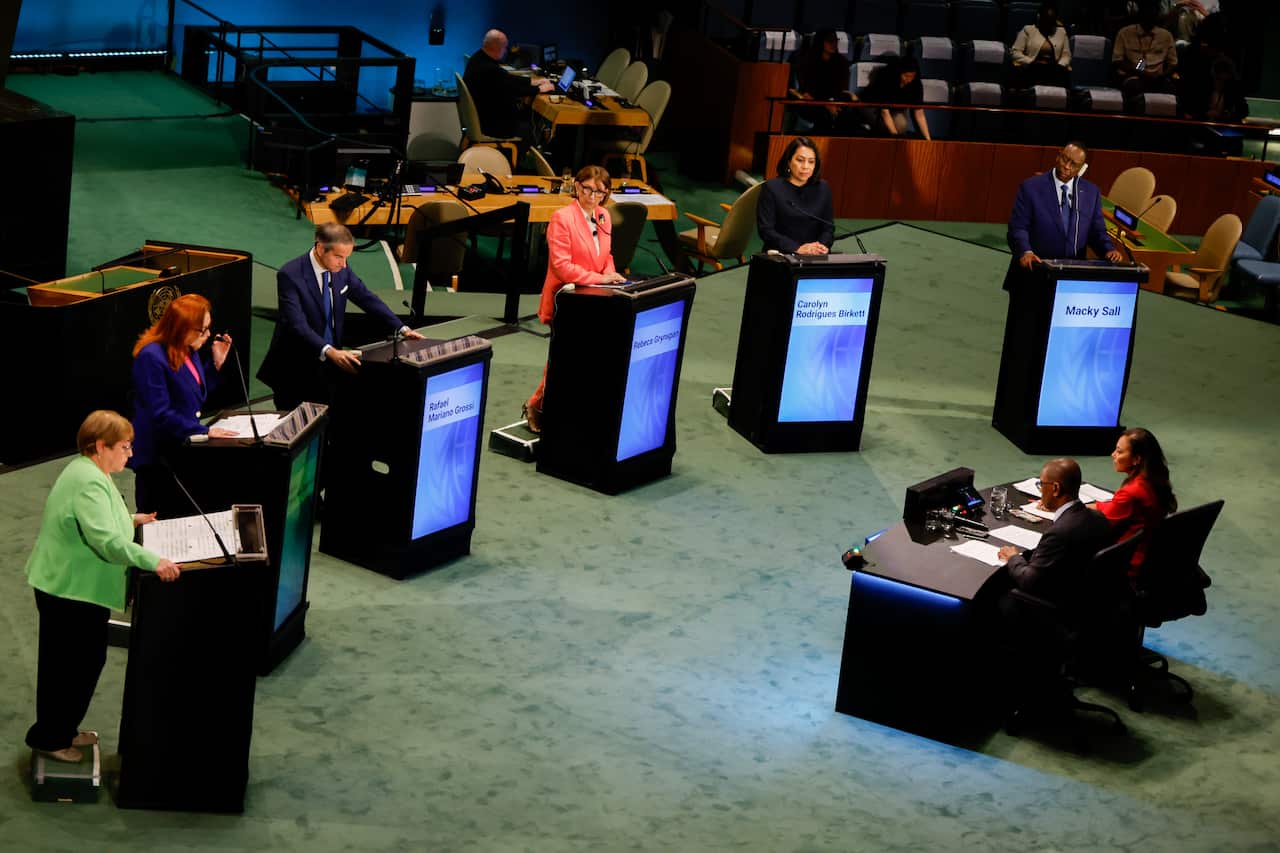
"The UN is judged through the peace and security lens. But the UN is much wider than that and it's delivering in many, many areas -- in development, in human rights," she said.
She placed first in the third of three straw polls so far by the Security Council.
Rebeca Grynspan Mayufis
Costa Rica's former vice president, Grynspan Mayufis leads the UN trade and development body but took leave from her duties to campaign for the top UN post.
In 2022, she pulled off a diplomatic feat by brokering the Black Sea Grain Initiative between Moscow and Kyiv to allow grain exports following Russia's invasion.
The 70-year-old is the daughter of Jewish parents who she says barely survived the Holocaust before emigrating to Costa Rica.
So far in three straw polls, the Security Council has twice placed her in the lead.
María Fernanda Espinosa Garcés
Espinosa, a former foreign minister of Ecuador, has called the United Nations the only universal platform for handling humanity's common challenges, but also wants deeper reform of the world body.
She's a previous president of the UN General Assembly and has suggested creating an "early warning" system to detect and flag signs of impending conflict.
Espinosa's candidacy has been backed by Antigua and Barbuda, but not her own country.
Rafael Mariano Grossi
An Argentine career diplomat, Grossi has led the International Atomic Energy Agency since 2019, propelling him into the middle of the battle over Iran's nuclear program as well as the Russian occupation of Ukraine's Zaporizhzhia nuclear plant.
He did not step down from his current post to campaign for secretary-general, saying it would be a "dereliction of duty".
Some observers say he's been more strident in pushing for UN reform, and believes the UN secretary-general should take a more hands-on approach.
Olara Otunnu
Otunnu served as UN under-secretary general and special representative for children and armed conflict from 1997 to 2005 under then-UN chief Kofi Annan.
He also served as Uganda's UN envoy, and as his country's foreign minister for a brief period.
Otunnu stood as the presidential candidate for the opposition Uganda People's Congress in the 2011 election, losing to longtime leader Yoweri Museveni.
Macky Sall
Sall, a former Senegalese president, has stressed the link between peace and development.
He was proposed by Burundi, the current chair of the African Union.
Senegalese authorities accuse him of bloodily repressing violent political demonstrations that left dozens dead between 2021 and 2024.
— With reporting by Reuters and Agence France-Presse
For the latest from SBS News, download our app and subscribe to our newsletter.







