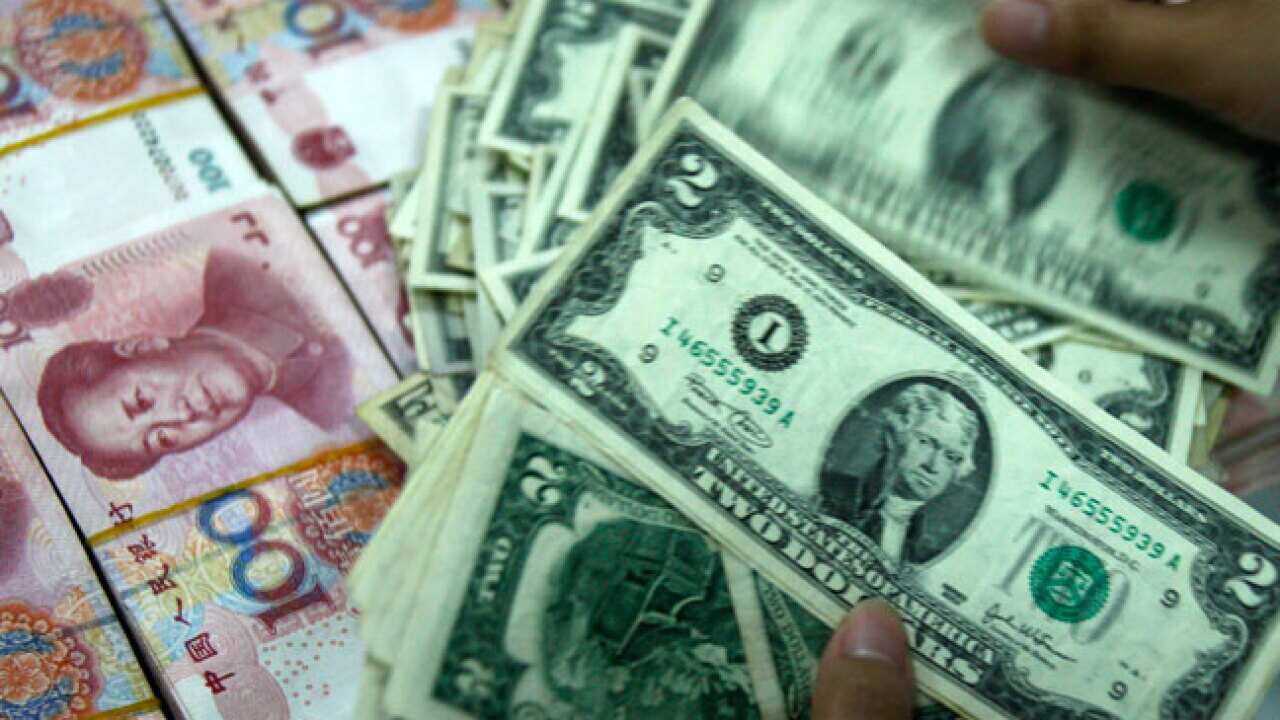
In a report to Congress, the Treasury said that China, eight other countries and the eurozone were all innocent of charges that they manipulated exchange rates "for purposes of ... gaining unfair competitive advantage in international trade".
"Based on the resumption of exchange rate flexibility last June and the acceleration of the pace of real bilateral appreciation over the past few months," China's behaviour did not qualify under the official definition of manipulation, it said in the long-delayed report.
"Treasury's view, however, is that progress thus far is insufficient and that more rapid progress is needed."
News that makes sense
Your trusted source for staying up-to-date with the world around you. Get free daily news updates and analysis, straight to your inbox.
It pledged to "continue to closely monitor the pace of appreciation" of the yuan.
In addition to China, the Treasury looked at the policies of the eurozone and eight other economies: Brazil, Britain, Canada, Japan, Mexico, South Korea, Switzerland and Taiwan. The 10 together account for about 75 per cent of US trade.
"Treasury has concluded that no major trading partner of the United States met the standards" of manipulation as identified by the law "during the period covered in this report".
The Chinese currency policy has been a major irritant in bilateral relations with the world's second-largest economy, and was a key topic of discussion when President Barack Obama hosted Chinese President Hu Jintao on a state visit last month.
The United States accuses Beijing of keeping its currency undervalued, flooding the country with cheap exports and costing US jobs.
US legislators have pushed the Obama administration to get tough with China over the yuan.
A bill threatening sanctions to punish Beijing's currency policy is lurking in Congress, which has awaited the Treasury report since it was first supposed to appear on October 15.
China has pledged to allow the yuan to gain value, but at a measured pace so as not to destabilise its rapidly expanding economy.
The Treasury said the yuan, also called the renminbi (RMB), had appreciated 3.7 per cent against the dollar between mid-June and January 27.
In fact, it added, weighing the higher rate of inflation in China, "the RMB has been appreciating more rapidly against the dollar on a real, inflation-adjusted basis, at a rate which if
sustained would amount to more than 10 per cent per year".
A top politician in congress, Max Baucus, head of the Senate Finance Committee, slammed the Treasury's findings.
"China's currency practices harm ranchers, farmers, and exporters across America and around the world," the senator, a Democrat representing the western state of Montana, said in a statement.
"China has been given a free pass on its currency practices for far too long. We need to hold China and our other trading partners accountable for their actions, and we must acknowledge - and take steps to remedy - those actions that harm the competitiveness of
American businesses and workers."
The report came a week ahead of the government's December trade balance numbers. The Commerce Department is expected to report next Friday that the US trade deficit widened to $US50.0 billion ($A49.3 billion) from $US42.6 billion ($A42.01 billion) in November.
China has appeared on track to beat its 2008 record trade surplus with the US. Over the first 11 months of 2010, the China trade gap was $US252.4 billion ($A248.88 billion), compared with $US268.0 billion ($A264.26 billion) for all of 2008.







